
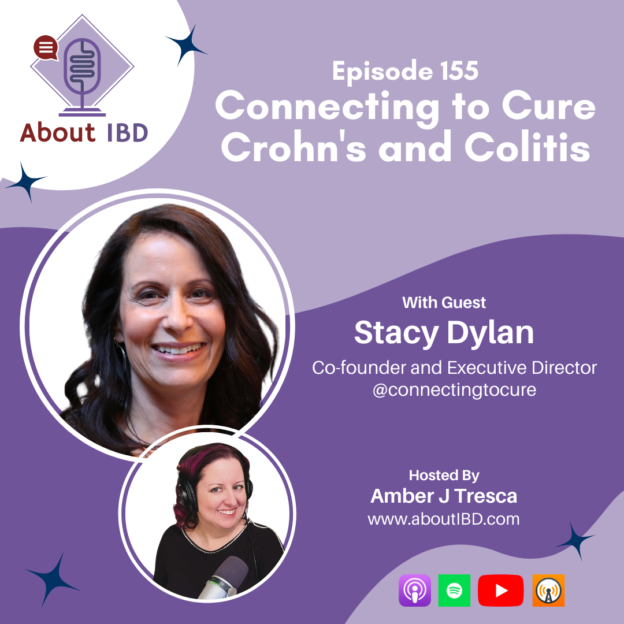
Amber is joined by Stacy Dylan, co-founder and executive director of Connecting to Cure Crohn’s and Colitis (CtoC). CtoC is a patient advocacy group focused on addressing unmet needs in the IBD community. Stacy founded CtoC to help other families after her son was diagnosed with Crohn’s disease. CtoC offers support groups, mentorship programs, and gut-friendly workouts. Stacy offers advice to parents of children with IBD, encouraging them to take things one step at a time and not be overwhelmed by information from the internet.
Listen and Subscribe to About IBD: Apple Podcasts | Spotify | Overcast | Castbox | All Other Podcast Apps
Follow Connecting to Cure Crohn’s and Colitis:
- Web: https://www.connectingtocure.org
- Twitter: @connecttocure
- Instagram: @connectingtocure
- Facebook: @ConnectingToCure
- Follow Stacy’s Medium page at: https://stacyjdylan.medium.com
Find Amber J Tresca at:
- AboutIBD.com: About IBD
- Verywell: Verywell Health
- Facebook: @aboutIBD
- Twitter: @aboutIBD
- Pinterest: @aboutibd
- Instagram: @about_IBD
- YouTube: @AboutIBD
Find Mac Cooney (mix, sound design, and theme music) at:
- Facebook: @maccooneycomposer
- Instagram: @maccooneycomposer
- Web: Cooney Studio
- YouTube: @MacCooneyComposer
- Theme music, IBD Dance Party, is from ©Cooney Studio.
Transcript
[Music: IBD Dance Party]
Amber Tresca (00:05):
I am Amber Tresca, and this is About IBD. I’m a medical writer and patient educator who lives with a j-pouch due to ulcerative colitis. It’s my mission to educate people living with Crohn’s Disease or ulcerative colitis about their disease and to bring awareness to the patient journey. Welcome to episode 155.
(00:21):
IBD patients experience many unmet needs. A diagnosis of IBD doesn’t only affect the person living with the condition, it has an effect [00:00:30] on the entire family. One of the biggest gaps is in support for parents, families, and caregivers who have a child living with IBD. When kids are diagnosed with IBD under the age of six, it’s called very early onset IBD or VEO IBD. VEO IBD has some differences when compared to IBD that’s diagnosed in older kids or later in life. My guest is Stacy Dylan. She’s the co-founder and executive director of Connecting to Cure, a grassroots patient advocacy group that’s [00:01:00] focused on addressing unmet needs in the IBD community. Stacy tells us about her son’s journey with Crohn’s disease and how it spurred her to do more for families like hers. She lets us know about the programs Connecting to Cure offers and the unique fundraisers they have. Plus, we hear about Stacy’s blog and the important role live music plays in her life.
(01:25):
Stacy, thank you so much for coming on About IBD.
Stacy Dylan (01:28):
Hi, Amber. Thank you so much for having me.
Amber Tresca (01:30):
[00:01:30] Absolutely. This is long overdue. I’m so grateful that we finally found the time. You’re a very busy person, and that is because you wear many hats in the IBD community. And so I wonder if you would take a minute first to introduce yourself to our listeners.
Stacy Dylan (01:47):
Sure. You’re a very busy person too, so it takes a lot to get the timing right for two busy people. My name is Stacy Dylan, and I run the charity called Connecting to Cure [00:02:00] Crohn’s and Colitis. We were founded I think about 12 years ago. I co-founded the charity with Dana Zatulove. And the reason why, was because my son Lowell has Crohn’s disease. He was actually diagnosed when he was two with IBD with colitis, and then it was changed to Crohn’s when he was five. We started the organization, Dana’s son, Brian, was diagnosed when he was eight with [00:02:30] colitis and we met and we decided we just needed to do more to help the IBD community. So that was our impetus for starting Connecting to Cure.
Amber Tresca (02:39):
Thank you so much for that. You actually told me something that I did not know. I did know that you started Connecting to Cure because you have a son that lives with IBD, but I didn’t know that he was first diagnosed with ulcerative colitis and then his diagnosis changed. I wonder if you would start there. If you would start at the beginning and what that was like to get a diagnosis, [00:03:00] especially because he was so young at the time.
Stacy Dylan (03:03):
Sure. Well, interesting that you said that because also a lot of kids who get diagnosed that young, and it’s called very early onset IBD or VEO IBD, it’s hard to tell. A lot of times it does show up only in the colon and they can’t really see it in other areas of your intestines. And so sometimes it’s indeterminate colitis or indeterminate IBD and then it will be changed [00:03:30] later on.
(03:30):
So when he was about 18 months, he started having a lot of diarrhea. My pediatrician at the time was saying it’s probably toddler diarrhea and we went down the route of food allergies. And he actually does have some food allergies and he did more have more at the time. And then it just wasn’t getting better even with eliminating some of the foods. And actually then once he started to have blood, [00:04:00] then at that point she said, “You needed to see a specialist.” And then we went to see a gi.
(04:06):
Now, I know some people have… It takes a really long time for them to get diagnosed, and I guess we were lucky. We live in Los Angeles and we had a good team here. But I did not know anything about inflammatory bowel disease. And he had the food allergy testing. I think he had celiac testing. And then it still wasn’t getting better. He doesn’t have celiac. [00:04:30] And then the GI who we had at that time recommended doing a colonoscopy, which is pretty crazy if you think about if you have kids and you think about a 2-year-old having a colonoscopy. The instruments they use for colonoscopies are not made for young children. Now, I don’t know any about it now, but maybe they have changed some of them.
(04:51):
So it was pretty scary to think about that, but I also needed an answer. And so [00:05:00] we did the colonoscopy. And actually, the hardest part of it was the prep because you can’t eat anything the day before, clear liquids. And when you have a 2-year-old, it’s really hard to explain that to them. And I remember just a friend of mine said, “We’re just going to go to the beach and walk around, go to the park and just do all as much as we could that day to distract him.”
(05:27):
And so I remember it was almost a relief [00:05:30] when the day came to do the colonoscopy, even though again it was scary. My husband and I waiting while that procedure was being done. And I remember the doctor coming out and saying he has ulcerative colitis. And again, I really did not know that much about it, but I also felt a sense of relief at that time because I said, “Okay, well we know what this is. Now we can treat it.”
(05:53):
Fast-forward 22 years later and the landscape has changed a lot, but [00:06:00] at the time it wasn’t really that simple. And I guess it’s not ever really that simple with IBD. But I do remember feeling relief and I do remember thinking, “Okay, now there’ll be a medication or there’ll be something they’ll tell us to do.” So we did end up trying a lot of medications, the ones that were available at that time.
(06:18):
Just to summarize that, yes, it was very scary to have to put my son through that. And doing the… Just thinking about it now, I think I was sort of just in this mode of, “We [00:06:30] have to get this done. It’s okay. Doctors are taking care of it,” but just sort of living in my head and not really understanding it or really feeling it emotionally what it was going to be like.
Amber Tresca (06:42):
Right. Yeah. How could you know? I mean you couldn’t possibly know. But I’m wondering if they prepared you at all, if anybody ever said before they did the colonoscopy, “We think this could be X, Y, or Z”?
Stacy Dylan (07:00):
[00:07:00] That’s a really good question. I don’t believe so because again, at that time, I don’t even know, this was something I was thinking about the other day, if very early onset IBD was classified at that time. I mean there obviously were other people diagnosed that young, but I actually don’t think that they said that could be a possibility. They might’ve said something like colitis but not ulcerative colitis, like some… And I was like, “Oh, that’s some kind of digestive disease [00:07:30] or digestive issue.” Actually, I don’t even think maybe I thought it was a disease. So no, I don’t remember being prepared at all that that’s a possibility.
Amber Tresca (07:41):
Do you remember the first time you heard the acronym or the phrase “very early onset”? Because I don’t remember the first time I heard it, but I think you’re right. I don’t think it was quite classified because they kind of almost think it’s a different kind of IBD than [00:08:00] what is diagnosed later. And we’ll have to put some links in the show notes to more information. But do you remember the first time you heard it?
Stacy Dylan (08:07):
It might not have been until he was five, and that’s when he had another scope and the diagnosis was changed to Crohn’s disease because he had ulcers and inflammation throughout. Actually, his disease is actually not really mostly in his colon, it is mostly in his small bowel. But I think it was changed to Crohn’s at 5. And I think that’s when, because at that time, [00:08:30] Boston Children’s Hospital was the place where they were doing the most work around VEO IBD. So I think it was probably when he was five that I first heard that term.
(08:40):
And now there’s a lot of institute, there’s a lot of more research going on about that and a lot of other experts in VEO IBD at other institutions. But Boston Children’s Hospital at the time was the leading place that the research on VEO IBD was being done and also kids were being treated for it.
Amber Tresca (08:58):
Right. How about Lowell? [00:09:00] Does he have memories of that time? Do you guys ever talk about that?
Stacy Dylan (09:04):
He says that one day someone that he knows asked him if he could imagine his life without having Crohn’s, and he was unfathomable. He can’t… So he doesn’t remember. Obviously he was two, he doesn’t remember a time before. I think that he also had… Like I said, he had food allergies and he had pretty severe food allergies. A lot of them he is grown out of, but he’s still anaphylactic to dairy, [00:09:30] extremely allergic to it. And of course, back then, the food allergy landscape was also very different. They were saying, don’t give your child any peanut products. And then if you had an allergy to anything that came up on a test, either the skin test or the blood test, to stop giving it to them right away. And I actually believe that that caused this particular dairy allergy to get worse because he was having a little bit and he would have reactions, but as soon as we took all of it out and then later on when he would even have like [00:10:00] a cross… It just got worse. And of course they’ve changed the guidelines since then.
(10:04):
But the reason why I’m bringing that up is because I think for both of us, since I still… It took me a long time to really understand what IBD was. I was so worried about the allergies because he was in preschool, then he was in elementary school and there’s food everywhere.
Amber Tresca (10:24):
Everywhere, mm-hmm.
Stacy Dylan (10:25):
And there’re snacks. And I would go on play dates with him if he was in preschool, I’d [00:10:30] go on play dates and I was like, “Okay, yes, well can have a play date, but I’m going to come to the play date.” Sometimes I would wait in the car. Sometimes I’d be hanging out with the mom or the nanny. And I was so focused on that because it was very anaphylaxis, you could die, right?
Amber Tresca (10:46):
Mm-hmm.
Stacy Dylan (10:46):
So that was my big concern. And I was cooking all of his meals. And so I think for both of us, we feel we have talked about it, that that was more difficult at the time navigating.
(11:00):
[00:11:00] Now looking back, I see that the management of the disease was different then. There weren’t the same guidelines.
Amber Tresca (11:06):
Right. Right.
Stacy Dylan (11:06):
And also there weren’t the medications that they have now, so it wasn’t like there was a lot of choices. But I have all of his medical records actually. And one time I went through them. And looking back on his lapse from when he was really young, their inflammatory markets were high, his albumin was always low. So during that time, his disease was progressing, [00:11:30] but he was actually functioning pretty normally. Like going to school, he played sports, had friends. We were dealing with the food allergies. I’d make a special cupcake that he would bring to parties. And so it wasn’t until he had his first surgery when he was 12, when he was 13, that the Crohn’s became just a bigger problem for us.
Amber Tresca (11:56):
Do you think that was the time when you were almost [00:12:00] forced to learn more about it? You probably knew more about food allergies when he was younger.
(12:04):
I knew a lot about food allergies. Yes. I remember when REMICADE was first available to him and he was… I always forget if he was seven or eight, but of course, I was that kind of parent who had to read about every medication. And then I remember, I vividly remember we were on a trip and it was in a newspaper. It was like, “FDA…” I don’t know if it was FDA or ads, black [00:12:30] box warning to REMICADE. And it was like he was just about to start it.
Stacy Dylan (12:35):
Oh boy.
Amber Tresca (12:35):
It was probably around the time that he was starting the biologics that I started to learn more about it actually, and even understanding what the differences is between a biologic and the other medications he had been on. So it was probably around then. And then of course later on when I started the charity and also when he had his surgeries, I became, I wouldn’t say I’m an expert, but more informed [00:13:00] about IBD.
(13:01):
I feel like moms though, when your kid lives with a disorder, you become an expert. So I think that’s fair to say.
Stacy Dylan (13:09):
Yes. Well, I feel like I’m an expert in his disease.
Amber Tresca (13:14):
Right.
Stacy Dylan (13:16):
The reason why I said that is because there are some people as you know because they’re in this community as well that are really focused on the research and understand all of that. I mean, I feel like I used to read more research and understand it more. And [00:13:30] it’s not something that comes naturally to me to understand things like that. I was an art history major and I have a master’s in psychology, so I’m not a science person. So that’s what I meant. But I do understand probably a lot more than a lay person does about it, but it’s not something that I focus on.
[MUSIC: About IBD Transition]
Amber Tresca (13:52):
Coming up, Stacy tells us about the mission for Connecting to Cure.
(14:00):
[00:14:00] All right. So great segue into Connecting to Cure. We understand why you started it. And I think actually too, it’s interesting that when you finally do start to learn more about IBD, and this was true of me as well, then it was suddenly like, “I wanted to know everything” and then I went super [00:14:30] deep into it. And it sounds like maybe you sort of had the same experience because you started a nonprofit. But tell me more about the mission that you have for Connecting to Cure.
Stacy Dylan (14:41):
Sure. Like you said, yes, I did get super deep into it once I had the wherewithal to do so. When Dana and I met and we decided to… We were actually doing a Team Challenge, which is the endurance and fundraising program for the Crohn’s & Colitis Foundation. We [00:15:00] both met at the first practice here in Los Angeles, and we didn’t know each other. And we had never done a race or anything before. And I hated running. She did too. The coach said the first day, “Okay, so we’re just going to run around the park for 30 minutes.” And we were like-
Amber Tresca (15:18):
“What?”
Stacy Dylan (15:18):
… “We’re going to run for 30 minutes without stopping?” Well fast-forward to, we ended up really liking it. And so we’d meet every [00:15:30] Sunday with the team and we’d do our long runs together. And it was during those runs where we would start talking. We started talking and we just both felt like this calling to do more for the community.
(15:41):
And at the time, we were focused on research. We were focused on we want to raise money and be more grassroots. And whatever money we raise, we’re going to fund, we’re going to give directly to research. So that was really our original mission. I have our original mission statement somewhere that we had on our first site that we built, and it basically [00:16:00] just said fundraising for IBD treatments and cures. And then during that time, I think we had started the charity and that’s when Lowell had his first surgery. We had events and we met people, not just people with IBD, but certainly we had a lot of people in IBD in our community. And we realized that people, patients, and caregivers really needed more than just research because I became disillusioned about the cure because I was actually told when Lowell was [00:16:30] first diagnosed that, “Oh, there’s going to be a cure in 10 years.” And the genes the microbiome. But of course once they started getting deeper into those things, it became much more complicated.
(16:42):
So I was thinking, we were both thinking, people families are living with this disease and they’re asking for support groups and other kinds of resources to help them. I think that’s really, really important actually, because I think we all… I don’t know. [00:17:00] My feeling is, and like I said, when he was diagnosed, I was relieved, “Okay, we’re going to take a medication or do something and it’s going to be…” I didn’t think it was going to be cured, but I think it was be managed better, which for a lot of people, yes, that’s true now, especially with all of the newer medications.
(17:15):
It was not true for Lowell. And it’s not true for a lot of people that I have met over the years. So why not… We have to live our lives. People have to live their lives. It’s hard. As you know, there’s a lot [00:17:30] of issues with IBD. And so we wanted to be able to provide resources. So then we just changed our mission to creating awareness and supporting patients. And we have added a lot of other programming along the way. And so we still raise a lot of money and donate to research, but we have also a lot of other programs that we do. And those include our support groups, both for caregivers and patients. We have a mentor program, which is for [00:18:00] pediatric patients or teens or even some young adults to be matched up with a teen or young adult who’s maybe further along in their diagnosis and can help them and meet with them and talk to them about any issues that they have about their disease.
(18:14):
We have an IBD or gut-friendly workout we like to call it. It’s for caregivers and patients. And then we now have a leadership council, which is kind of like a junior board, but over the years we’ve met a lot of young people who’ve reached out to us and said, “Hey, [00:18:30] I have this idea to do this to whatever it is. I’m into diet and I want to make recipes that are gut-friendly.” Or we have one on our council now who makes cards and sends them to people who have IB data infusion centers or who are inpatient in a hospital. So all different young people. And I love that. I love that there are so many… That’s what I love about… I don’t really love anything about this disease, but I do love that there are a lot of people who want [00:19:00] to contribute and help others. And so we support them through some of our programs.
(19:06):
And I also wanted to say that we are focused on caregivers. And again now 20 years later in the general culture of caregiving, there’s more attention being paid to the toll that any caregiver might face taking care of someone. But I think it’s really important to focus on caregivers of patients [00:19:30] or children who have a chronic illness. And so that’s really, really important to us.
(19:36):
What happened was we had all these ideas of things we wanted to do, which we have done, but we didn’t really have an infrastructure in place to support all of these things. And now we’re kind of in a place of going back and trying to figure out what is most important to us, what is most important to our mission, what is the thing that we really want to do. And so we’re kind of in the process of that [00:20:00] and creating more infrastructure so that me, myself, am not completely burnt out and also needing to be a part of all of these things.
(20:11):
So we’re doing well. We’re getting there. We’re hiring a new person. I have a couple of employees, but we’re hiring an operations manager. So we just hired her actually, and she’s going to start next week. So because we didn’t have the infrastructure in place, and what I feel like we do that is unique besides [00:20:30] community and caregivers and patients, is that we do raise a lot of money for research. We’ve raised over $3 million, three and a quarter million dollars that we’ve given away over the years. But we also run all these programs. And then there’s a lot of patient advocacy organizations that are not really raising as much money for research because there’s so many needs, like I said, so they focus on that. And we’re very small, yet we’re trying to accomplish all of these [00:21:00] big goals.
(21:01):
So now that’s part of why we’re kind of rethinking. Not that we’re going to stop doing any of those things, but we’re thinking about how much of our bandwidth we should spend in these areas or that areas and what’s the most important. And I think it’s kind of exciting. I mean, I’m excited just because I was at a point where it was unmanageable. Dana is still involved with our charity and she runs our marathon program, but [00:21:30] she’s not involved as my partner in the same level anymore because she has other things in her life that she is doing, and that’s totally fine, and I’m happy she’s still on our board and still involved. And then it just became even more apparent that one person, I’m not saying I’m doing everything myself, but everything we were doing was like I was 50% in on, and I want everything to be a little bit better and strengthened a little bit more. So [00:22:00] I think that’s what I wanted to say about that, if it makes sense. I think hopefully it makes sense.
Amber Tresca (22:07):
Yeah, it does make sense. And it makes sense to me on a different level, the level that you were talking about because, all right, there are so many unmet needs and IBD, and so it can very quickly happen that you are focusing on trying to fill those [00:22:30] holes and then at a certain point you realize that you can’t possibly, there’s just too many of them. And so basically you have to pick your lane.
(22:40):
And then also learning how to run a nonprofit, that’s a whole thing on its own. It’s a company, but it’s a different kind of company. It’s not the same. It’s kind of running a small business, but then there are little quirks to it. So I get it.
(22:58):
I’ve been trying to remember [00:23:00] when we met first, which I don’t, because it feels like sort of I’ve always known you, but what has been wonderful over the years is to see how you have evolved Connecting to Cure and how you keep adding more programs. I know you’re saying that you’re streamlining now, which makes sense, but to watch you grow to see how much money you raise, I know how hard that is. [00:23:30] I know what dedication that takes. So we’re talking a little bit about the future. And what kind of programs do you think you are going to focus on? It sounds like caregivers, but what kind of specifically? How are you going to support caregivers of people who live with IBD?
Stacy Dylan (23:52):
I think that we… Yes. I mean again, we’re not excluding anything or really stopping any program. I mean [00:24:00] if anything, it would be the thing that would happen is our research dollars would be less that we give away in the next couple of years. And then we get things to a better place where we have more people and we can still do that, but then really work on our program. So yes, I would say it’s not that we’re abandoning the research, but like you said, because there’s so many needs, we feel very passionate about a community of people with IBD. So in terms of caregivers, we would love to… I mean, our caregiver [00:24:30] support group is great and very vital. We do it on virtually now because since the pandemic, which is great, now we reach people all over the country, but it is difficult because we do it in the evening. So we’d like to have more groups actually. Maybe one on the East Coast for caregivers.
(24:49):
Another thing is… And like you said before, there’s so many needs. So I wanted to just go back a little bit and say I feel very strongly about partnership, about partnering with other organizations [00:25:00] to get some of these things done, all of the organizations that you’re familiar with that we’ve worked with and that really are able to come together and different ideas and strengthen a program. So we’d like to have more caregiver support groups. But also since we started out talking about VEO IBD, I have been getting a lot of inquiries and people reaching out about that. And there are some VEO IBD support groups, but I’d like to be able to have maybe [00:25:30] a specific one for very early onset, more the parents at that point because it’s so hard, and for us to be able to provide more resources for newly diagnosed children under the age of six.
(25:46):
For example, I have this blog post that I’ve been meaning to write or I have written some of that, is because I’ve talked to so many parents over the years who have kids who are diagnosed, there are themes, there are very similar themes. Like I said, [00:26:00] I mentioned before, REMICADE black box, people are concerned about the medications, people are concerned about the diet, all of these things. So to really provide more resources for newly diagnosed family patients and their families.
(26:13):
And then another big priority right now is to have a pediatric support group. We would like to do it in person here in Los Angeles, but we have been thinking about ways to do it virtually. But I think it’s hard to do a support group virtually with very young kids. [00:26:30] So that is one of our… Really, that’s our main goal actually.
(26:37):
And then I guess in general, it’s like we want our messaging, our website and everything we do to sort of match what we’re actually doing, which is this providing a community. We fund kids to go to the Paint a Turtle camp, which is a camp here in Los Angeles where kids with different diseases can go every week and they have an IBD week. So we fund campers there. So we just [00:27:00] want to let people know that we are here and that we can help send your kid to camp, we can provide a support group, we can provide a mentor. So it’s more actually like being able to get our message out more.
(27:14):
Just one little side note, it’s like, again, I don’t like IBD and I think it’s not a good… It’s as you know, but I was talking to this woman the other day and she had been working at this law firm and she told me that she had met people with veterans [00:27:30] with IBD and were not being treated in the way that the standard of care is now. I mean I’m not going say it generalize because I don’t know. And then I was like, “Oh my god, that’s a whole other untapped population.” It’s not like I get excited, but it’s like I just feel like that’s a need. It’s a need. And I feel like I haven’t really heard that many people talk about that. And I’m not saying we have a plan to do something about that. I would like to, but [00:28:00] this is what’s interesting, are things that come up about a chronic illness or IBD in particular is you’re like, “Oh my god, yeah, what about those people?”
(28:09):
Of course there’s all these other issues like disparities and people in other countries and we do get inquiries from people from other countries who can’t get any medication and don’t have health insurance. And so it’s just to keep all of these things in mind. But we are driven to really help families, especially families with young kids in any way we can. And [00:28:30] someone could come to us with an idea, “Hey…” Some of the young people have come to us with an idea, and we’re like, “Oh, that’s a great idea. That will help other people.” So just being open to that and trying to strengthen what we’re already doing and get the message out of what we’re doing.
Amber Tresca (28:48):
Yeah. And I think that’s a big part of it too, is that just helping people to find you, to let you know that they’re out there. I think at least once a week I’m giving [00:29:00] your social media or the website to somebody just because it can be so difficult to make those connections for whatever reason. And it’s like, “Yeah, there actually is a group that is focused on caregivers and here’s where they are.” And I’m still finding smaller, more local nonprofits that are helping people and are focused usually on a particular area or they work with a hospital or whatever and come to find out they’ve been doing this [00:29:30] for quite a while and we just never found one another. So yeah, it’s a huge problem, which is one of the reasons why I’ve been after you to do my show for a little while, is to try to get you found.
(29:42):
And the veterans, I’ve had a few veterans on the show as well as some-
Stacy Dylan (29:47):
[inaudible 00:29:48]. Yeah, I remember now.
Amber Tresca (29:48):
Yeah. Some actually who I’ve had MDs on the show or actually a DO who is a veteran who lives with an IBD as well as the only IBD-trained specialists [00:30:00] in the Department of Defense, which is bonkers, because men and women are coming home and developing IBD and also IBS in kind of large numbers. And you’re right, it’s not being discussed this much. And that’s a total aside, but that’s kind of another little thing that an unmet need that has kind of been a sort of side focus of mine as well. So it’s interesting to me that you mentioned it.
(30:30):
[00:30:30] Up next, Stacy gives her advice for parents of kids who live with an IBD.
(30:45):
I’m sure you could talk for days to parents, those of very early onset and those of children that are diagnosed when they’re older as well. But if you can narrow it down, what are [00:31:00] some of the things that you would say to parents whose child has just been diagnosed with an IBD.
Stacy Dylan (31:05):
First and foremost, and this is just what I learned along the way with my own journey, parents, when you find out your kid is diagnosed very early onset young or teen or however, that you’re in this sort of rush to figure everything out. And then you get anxious and stressed and you’re like, “Oh, we have to try this, we have to do that.” And then that becomes a whole thing in itself that is probably not that helpful for [00:31:30] your child or for the family. And so the first and foremost is to kind of take slow… I don’t say stop being stressed out, but I might say like, “Okay, it’s okay. Take it a little bit slower. There’s a lot to learn here. There’s a lot of resources. We can focus on what your doctor’s telling you you should do. And then you can figure out a lot of the other things later with our help or with help from other organizations as well.”
(31:57):
And of course, most importantly, if [00:32:00] there is a very young child who they say needs to start REMICADE, for example, which I have talked to parents who have a 1-year-old, 2-year-old that have to start REMICADE, and obviously that’s very scary. And so I would say yes, it’s very scary. Try not to read all of the information about it. And also, which is something that our GI said to us over and over again, well, the risk of not treating the disease is much greater than the risk of this medication. [00:32:30] And that is true.
(32:32):
I do feel that even though the medications themselves don’t work for everybody and their efficacy rate of each medication is not that great, but I haven’t seen so many people have any of these horrible side effects. Now, people get side effects that maybe they have to stop or they can treat through the side effects, but I feel like that would have been comforting if someone had said that to me. And so that’s important.
(32:59):
And then [00:33:00] there are the parents who want to try a diet before or something else before. And in some cases if it’s not as severe, the doctor will say, “Okay, but…” And even if not, even if they go on a medication and they still want to try a diet, again, you have to see how receptive your child is to that and your family because I’ve met parents who have six or seven year olds and they want to put [00:33:30] them on this very restrictive diet and it creates a lot of problems at school, with their friends, in the family. Is the family all eating differently? And that in itself is a factor to consider in any healthcare decision you’re making for your child because I do believe that that can… Yeah, stress can exacerbate the disease, we know that. But it’s also you want to try to have them live as normal life as possible.
(33:58):
I mean, [00:34:00] I feel like it’s okay if my son was in the hospital a lot. But you want them to be able to function the best that they can. So when you add all these other stressors, like, “Take all these supplements. Be on this diet,” it might not be the best thing.
(34:16):
I have met 12-year olds and teenagers who are really happy to be on a diet and they will do that along with their medication. I mean, we never promote diets as cures or only diets, [00:34:30] but most of the people I know who are on a diet are also on a medication and there are teenagers who are very into it. So that’s great. So that works for that family. But it’s just trying to slow down and just take it one step at a time, learn about things, figure out what’s going to work best for your family and for your child. AI know it’s really hard, but to really not go on what they call Dr. Google so much because you could see every kind of story [00:35:00] out there.
Amber Tresca (35:01):
And then also it’s something that I try to remind people of as well, is that now when you go on social media, which wasn’t around when I was diagnosed or when Lowell was diagnosed, and you’re seeing sometimes things that can be scary, but that’s because it kind of skews that way. The people that got on an advanced therapy early in their disease course and they’re doing really well, they’re not creating Instagram accounts [00:35:30] about their IBD.
Stacy Dylan (35:32):
Right. Right.
Amber Tresca (35:34):
So that’s something that I remind people of sometimes as well.
Stacy Dylan (35:38):
Of course. And unfortunately, there are a lot of scams in every part of our culture, but there’s a lot of… I mean, I feel like I don’t see it as much, I don’t notice it, but there were so many things that I would see that were like, “Try this black bean diet. That’s the cure for Crohn’s.” I mean, serious, that was actually a real thing that I saw.
Amber Tresca (35:58):
I remember.
Stacy Dylan (35:58):
Do you remember?
Amber Tresca (35:58):
There were a lot of those.
Stacy Dylan (35:59):
Yeah. There was a [00:36:00] lot.
Amber Tresca (36:00):
Weird diets. “Eat this cookie.” I mean, some of them were really wild. There was a lady that said she ate a particular kind of tree bark and that… I mean, it was just… Yeah. And you’re right. I feel like that was more an early internet thing. And there’s definitely things out there now that are like that, but I think they’re kind of a little bit more subtle, which is almost worse because you kind of almost have to have a higher level of skepticism to sort of weed them out.
Stacy Dylan (36:29):
Yeah. And I also [00:36:30] think it depends. There’s also people who are saying, “These supplements. That supplements.” And the reason why I’m saying this is because I did go down that road a little bit. And I would take my son to these functional doctors. I’m not saying functional doctors are bad. I just didn’t have a good experience with them when he was at that age. Not only were they saying, “Do this diet,. Take the supplements.” They were also critical of me giving my son medication. And I also talk to parents about that because I would say 80% [00:37:00] of parents will say, “Well, what about a natural doctoral? What do you think of that?” And I’ll say, “If you find one, that’s okay, but they really shouldn’t make you feel like a terrible parent because you’re giving your son or your child medication that’s going to help, that’s helping them.” So I think that’s really important, and I talk to parents about that too.
Amber Tresca (37:20):
Yeah. I imagine it’s very difficult to try to find a team that plays nice together, but I think you have to have [00:37:30] it. And there’s a place for everything. And gosh, wow, to go into somebody that you’re trusting and you’re walking in there vulnerable and they’re telling you that this other physician or another team member that you have taking care of your child is sending you down the wrong road, that has to be so terrifying and confusing.
Stacy Dylan (37:48):
Yeah. And there’s all different kinds of patients and parents as you know. And some are like, “I’m just doing whatever my doctor says.” And there’s some who are like, “Oh, I’m going to go do what my doctor says, but also dabble [00:38:00] in this.” And there’s some that, “I’m not going to do what my doctor says and I’ll not even go to the doctor and try all these other things.” I don’t recommend that at all.
(38:09):
I am the kind of person that will do the medication but also look into the other things. At that time, it was probably not the best thing for me to do. So that’s another thing I tell parents, like, “You have time. Maybe if you want to investigate that later, let’s get your child stable.” And again, fortunately there are a lot more better medications now, so hopefully [00:38:30] kids can be treated better and not have such a progression of disease.
Amber Tresca (38:37):
Right. Agree 100%. I think we are seeing that, but the data is still coming out on that because even though I feel like we’ve had REMICADE for more than 20 years, we’re still learning about how it is affecting overall how serious the disease gets in some people, because if you can [00:39:00] get them on a therapy early, then maybe it just never gets as bad as it used to. And I’ve heard some of ideologists say that. They said early in their career they would meet patients who were just absolutely just so sick and so bad off, and that they don’t really see that too much anymore. That people are being able to find something that can help them manage their disease in a way that they can live their lives and are not just completely [00:39:30] overtaken by inflammation. So it is good to learn that.
Stacy Dylan (39:36):
Yeah. And I sometimes get frustrated when people say, like I mentioned it before, the efficacy. If you look, really drilled down into what the efficacy of each of these drugs are, it’s not very high. But I sometimes get upset when people say we haven’t made a difference. And I’m like, “I wish that my son had REMICADE.” I mean, I can’t imagine when he was two going on REMICADE, but I kind of wish he had it. Or then Humira. I mean he’s [00:40:00] been on a lot of them, but I really wish that he had those drugs available to him because I do believe it wouldn’t have gotten to this point. It wouldn’t gotten to the point where he had to have surgeries and all that.
Amber Tresca (40:12):
I agree. I mean, I was diagnosed in 1989, and REMICADE came on the market only for Crohn’s disease and I had ulcerative colitis in 1998. And I had surgery in ’99, so it wasn’t soon enough to help me. And I try not to think about it too much because there’s really not a lot of point [00:40:30] in it. But if I had had one of these advanced therapies available to me when I was first diagnosed and I got on it because I would’ve been a candidate for it, my disease was severe, how would that have changed the trajectory of my life.
(40:44):
It feels a little bit like “get off my lawn kids,” but at the same time, I think it’s good to hold that perspective and to pass that along to people who might not realize. And now, just last week or the week before, [00:41:00] when we’re recording this, a research that came out, that the drugs that we have, we’re on the right path. We are actually on the right path. It’s just that there might be all of these three or four different classes of drugs only are hitting on one part of it. So it’s kind of like… And some people have dual therapy where they’re taking two drugs with two different mechanisms of action and they’re finding that that works in some people. And it’s because [00:41:30] you may need to hit on all these different pathways in order to tamp everything down perfectly. So it makes sense to me that any particular drug might only work for 30% of people. That makes just total sense now that we’re getting some more information about the genetic pathways.
Stacy Dylan (41:49):
Right. And it makes sense with the IBD because as the years have gone on, even we realize that everyone has a different IBD, and obviously there was hundreds of genes discovered. And [00:42:00] then the microbiome is very complicated. I mean the environmental factors, the lifestyle factors, all of that. But yes, everyone has a different IBD, so there’s different pathways. And like you had mentioned before about the VEO IBD, we don’t need to get into it, but yes, they have discovered certain different genes associated with that than adult patients or older pediatric patients.
Amber Tresca (42:25):
Right. Right. Which is great to learn, but also it’s kind of like, “Oh my gosh. Okay, so [00:42:30] it might actually even be a different thing, a different IBD.”
Stacy Dylan (42:33):
Yeah. Yeah.
Amber Tresca (42:35):
Yeah. Well, the show notes are going to be lit now that we’ve talked about all these different things. I’m going to have to put links in the show notes because I want people to learn more about these things.
Stacy Dylan (42:45):
Actually, I wrote something. I don’t know if you saw it for Nature or a pediatric journal, which is part of the Nature portfolio about VEO IBD appearance perspective. So I think that was really hard for me to do, but I think it was helpful. It was focused [00:43:00] on what kind of research do you want to see, but it also has our story. And I think people have reached out to me since I posted that about, “Hey, My child has VEO IBD.” So just trying to be there to meet as many needs as we can along with partners like you and the other fabulous advocacy organizations.
Amber Tresca (43:21):
Yeah. Like I always say, I’m so sorry that your family has gone through this. But at the same time, you have become such a light [00:43:30] for others that are experiencing it. So I’m grateful.
Stacy Dylan (43:34):
Thank you, Amber.
Amber Tresca (43:35):
For that, all right, Stacy, so I can’t let you go without asking you a little bit about some of the stuff that you like to do for fun. You’re a huge concert goer. I live vicariously through you a lot of the time, seeing all the great shows that you’re able to see. I think it’s one of the benefits of having older children, is that you [00:44:00] can finally start getting to do those things again when for so many years you may not. I know I couldn’t go out as much, but now I have teenagers, so now I can go back to concerts again. So tell me a little bit about that. What have been some of the highlights of the live shows that you’ve seen recently?
Stacy Dylan (44:19):
Well, I think especially since the pandemic, because I realized during the pandemic, that that’s what I missed the most actually, was being able to go to concerts. And then of course all the artists, [00:44:30] the musicians were touring like crazy because they also didn’t know what to do with themselves during the pandemic. And so there was a lot of shows. But actually I love concerts, I love music and all of that. But I realize that when I’m at a concert is when I’m really the most present and obviously living with this, having experienced this disease. And that’s not the only stress in life, but it is a big stress in our family.
(44:57):
Going to concerts, I feel present. I feel [00:45:00] like I’m part of a community. It’s a positive energy, positive vibes. And so yes, I tend to do anything and everything. If there’s a concert I want to go to, I will go to it. And my musical tastes vary. We were just talking about how I like some country music. I went to see Taylor Swift. Obviously, I’m a huge Bruce Springsteen fan, he’s the number one. But I see someone’s playing, I’m like, “Oh my God, how can I go to this show?” I’m like, “Can I go to this show?” So yes, and it is obviously really fun, but it is also [00:45:30] my biggest trust reliever I would say, because I do feel so just inspired and also just like I said, very present. And I think it’s important to be present as much as you can, and that’s helps me.
Amber Tresca (45:47):
I love that. And I think one of the best… No, I’m going to say the best fundraiser that I ever went to was Rock the Night in New York City years ago, which I think was 2017, I want to say.
Stacy Dylan (45:58):
Probably, yes. Mm-hmm.
Amber Tresca (46:00):
[00:46:00] Amazing. Amazing.
Stacy Dylan (46:02):
Thank you.
Amber Tresca (46:04):
Oh my gosh, I felt like it was life-changing. And that may have actually been the first time that I met you.
Stacy Dylan (46:11):
Maybe it was. I mean, I think we knew each other probably online, yeah.
Amber Tresca (46:13):
We knew each other, yeah.
Stacy Dylan (46:16):
And actually since you said that, that was when we started our organization, that was another thing is we wanted to have a fun fundraiser. I’m not putting down any other fundraiser, but we want it to be like it’s a club. You’re seeing a concert, [00:46:30] we talk about the disease, people speak, but it’s really just a fun night for music. And actually, we’re really hoping… We’re supposed to be bringing it back. We haven’t had a small event in January, but we were hoping to bring it back in the fall. We have a date here in Los Angeles, and then hopefully again in New York at some point. But yeah, so my love of music runs into the charity as well. So that’s like our signature event, is Rock the Night.
Amber Tresca (46:57):
Well, I loved it. And if you’re going to have it in [00:47:00] York again, absolutely I will be there first in line. Maybe even Los Angeles because if I have an excuse to get on a plane and go back to LA, I will do that as well.
Stacy Dylan (47:11):
Yes.
Amber Tresca (47:12):
All right, so we want everyone to be able to find you. That is one of the missions that we have here, is to make sure that the people who need you find you. Where can people learn more about Connecting to Cure and where can they follow you on social media?
Stacy Dylan (47:28):
Our website, [00:47:30] connectingtocure.org. Through the website you can contact us. Our website is in a process of being redone. Not that you would see that when you look at it, but someday it will be a little bit different. But you can get a lot of information about the programs and what we do.
(47:45):
And then of course we’re on Instagram at… I have to look because I’m… Instagram, we’re @connectingtocure. Facebook, we’re @connectingtocure, and X/Twitter, we’re @connecttocure. And we are starting a TikTok, [00:48:00] even though some of us were not. I was not very excited about it, but some of our team is like, “You really have to…” Actually, Lowell and some of the people from Leadership Council had a meeting earlier about the TikTok and how we’re starting it. So they’re working on that because I can’t do TikTok. But I don’t think we started the site yet. We might have, but I don’t know what it is. But anyway, someday soon you can find us on TikTok. You could probably just search Connect to Cure.
Amber Tresca (48:29):
That makes sense. [00:48:30] I think I might have to be dragged kicking and screaming into the TikTok.
Stacy Dylan (48:34):
Yes.
Amber Tresca (48:34):
I don’t know. Probably I’ll get there someday.
Stacy Dylan (48:39):
Yeah, so I have a blog. Yeah, I have a blog. I mean you can access the blog through our website, but it’s on medium.com. If you go to medium.com and you search Stacy Dylan, it’s under my name. My blog is sporadic, so it’s not like I am the kind of person I post. But I post… It has a lot about what we’ve been through as a family. [00:49:00] And also just when I write a post, it’s like I have this calling to, “I have to write about this right now.” So that’s basically how I do it. And when you talked about, I like to go to concerts, but I really also like to write and I want to have more time to do that. So that’s another reason why trying to streamline things here and make things more manageable so I have more time to do those types of things too.
Amber Tresca (49:24):
Sometimes I feel that way too, is that I have to get something out and I have to write about it. [00:49:30] You’re a very talented writer.
Stacy Dylan (49:32):
Thank you.
Amber Tresca (49:33):
It’s kind of annoying actually.
Stacy Dylan (49:39):
Thank you. But yeah, it’s hard. It’s hard to write actually. It’s hard to not…
Amber Tresca (49:42):
It is.
Stacy Dylan (49:44):
It’s also, it’s hard to write, but then what I write in my blog is very vulnerable, really. And so that’s hard. But I do feel this calling to do it because there’s many reasons why, but it’s just authentically sharing your story [00:50:00] can help others. And also a lot of times, it’s like if something major is going on with Lowell, it’s easier I can write the blog and I’ll say, “Just read the blog. I can’t talk to every person, every family member about it at the time. And you’ll get a good understanding if you just look at what I wrote.” So that’s another reason.
Amber Tresca (50:18):
Yeah, 100%. I totally understand that.
Stacy Dylan (50:21):
Yeah.
Amber Tresca (50:22):
Stacy, first of all, it’s been a pleasure to know you all of these years. You are always a light. And I will just talk about [00:50:30] some inside baseball for a second, is that you are quite often you’re a connector, which is not surprising. The name of your organization is Connected to Cure. But you are always sending interesting and fabulous people my way, and quite often I have them on this show. So it is my extreme pleasure to finally get you in front of the microphone and have you here. And just thank you so much for everything you’re doing, for patience, for everything you’re doing for me personally. And it’s just [00:51:00] been such a pleasure to know you. And so thank you so much.
Stacy Dylan (51:02):
Thank you, Amber. And thank you for always having the people on. Sometimes I I’m like, “I think this person’s interesting. Hopefully Amber and her community will.” And also I just wanted to say that I think you were, if not the first, certainly the first podcast about IBD that I knew of. And I think it’s great that you really do do a great job and you have really interesting people on across all different areas of this disease. And it’s really another resource that’s needed [00:51:30] in our community. So thank you for providing that.
Amber Tresca (51:38):
Hey, super listener. I don’t know how to properly thank Stacy Dylan for not only finding the time to talk to me, but also for all she does for the IBD community. Most of the work of running a patient organization is done behind the scenes, creating events and navigating the nonprofit space all while coping with everything IBD throws at a family is not [00:52:00] easy.
(52:01):
Connecting to Cure is based in Los Angeles, and you can support their work by going to their website at connectingtocure.org on Instagram, Facebook, and YouTube as @connectingtocure, and on Twitter/X as @connecttocure. Find Stacy’s blog on Medium at stacyjdillon.medium.com.
(52:23):
As always links to a written transcript, everyone’s social media handles and more information on the topics we discussed [00:52:30] is in the show notes and on my episode 155 page on aboutibd.com. Thanks for listening. And remember, until next time, I want you to know more about IBD.
(52:46):
About IBD is a production of Mal and Tal Enterprises.
It is written, produced, and directed by me, Amber Tresca.
Mix and sound design is by Mac Cooney.
Theme music is from Cooney Studio.