
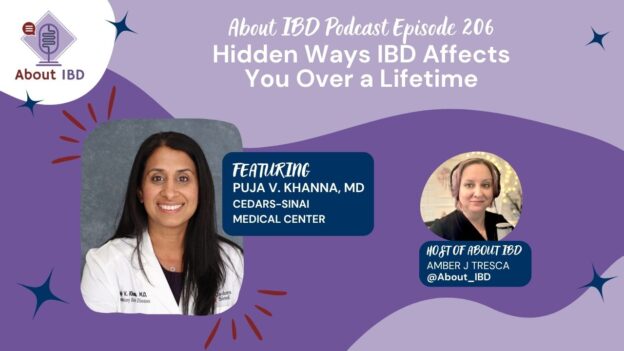
The truth about inflammatory bowel disease (IBD) is that it goes beyond the gut. In this first-ever live recording of About IBD, Amber talks with Dr. Puja Khanna from Cedars-Sinai to explore the extra-intestinal impacts of IBD, from skin conditions and eye inflammation to debilitating fatigue. Learn how sex-specific factors affect women and why building a multi-disciplinary care team is the best strategy for long-term health.
Listen and Subscribe to About IBD: Apple Podcasts | Spotify | Overcast | Castbox | All Other Podcast Apps
What you’ll learn:
- Why IBD must be viewed as a systemic immune-mediated condition that affects the joints, skin, eyes, and liver.
- How hormonal fluctuations during puberty, pregnancy, and menopause affect disease activity in women.
- Why persistent fatigue can happen even when lab results show “normal” numbers, and how to address it.
- Why fixating on daily symptom tracking can trigger health anxiety, and how to take a bird’s-eye view instead.
- How a collaborative, multi-disciplinary care team that includes a dermatologist, rheumatologist, dietitian, and other healthcare providers changes the treatment game.
Find Dr Puja Khanna at:
- Instagram: @pujakhannamd
- Bluesky: @pujakhannamd.bsky.social
- Twitter: @PujaKhannaMD
- LinkedIn: Puja Khanna, MD
- Cedars Sinai: Dr Khanna
Find Amber J Tresca at:
- AboutIBD.com: About IBD
- Verywell: Verywell Health
- Facebook: @aboutIBD
- Twitter: @aboutIBD
- Pinterest: @aboutibd
- Instagram: @about_IBD
- LinkedIn: Amber J Tresca
- YouTube: @AboutIBD
Find Mac Cooney (mix, sound design, and theme music) at:
- Facebook: @maccooneycomposer
- Instagram: @maccooneycomposer
- Web: Cooney Studio
- YouTube: @MacCooneyComposer
- Theme music, IBD Dance Party, is from ©Cooney Studio.
These show notes may contain affiliate links. If you choose to purchase after clicking a link, Mal and Tal Enterprises, LLC may receive a commission at no extra cost to you.
Chapters:
- (00:01): Amber introduces the first-ever live recording of the “About IBD” podcast, recorded at an event in Los Angeles.
- (01:31): Amber and guest expert Dr. Puja Khanna are introduced, detailing their backgrounds and expertise in the IBD space.
- (03:26): Dr. Khanna discusses common extra-intestinal manifestations of IBD, including issues with the eyes, liver, skin, and joints.
- (05:45): A discussion on how women are uniquely affected by IBD, including hormonal influences during puberty, pregnancy, and menopause.
- (06:30): Dr. Khanna explains the importance of a multidisciplinary care team and open communication with your gastroenterologist about all symptoms.
- (08:00): The importance of discussing reproductive health early, even in adolescence, to gather information and make informed decisions later.
- (10:18): Dr. Khanna offers advice on managing fatigue by addressing sleep, mood, nutrition, and energy conservation, even when labs are normal.
- (14:23): Amber and Dr. Khanna discuss the fine line between pushing through illness and recognizing one’s capacity to avoid overexertion.
- (15:47): Dr. Khanna advises focusing on trends rather than daily details to avoid anxiety while still providing useful data to doctors.
- (20:04): Guidance on when to send a portal message versus seeking immediate care, emphasizing that patients should not hesitate to reach out.
- (22:41): How patients can understand that issues like joint pain or eye problems can be connected to their IBD.
- (26:01): Dr. Khanna explains the detective work involved in distinguishing between medication side effects and extra-intestinal manifestations of IBD.
- (30:00): Dr. Khanna discusses a multidisciplinary treatment approach that incorporates nutrition, mental health, and physical therapy alongside medication.
- (32:27): A discussion on the long-term safety of modern IBD medications and the genetic risk of passing Crohn’s to children.
- (35:34): Dr. Khanna explains the role of diet, the microbiome, and specialized nutrition in managing IBD.
- (38:31): Dr. Khanna shares personal details about her family, her life in Southern California, and her experience as a triathlete.
Transcript
[00:01] Amber Tresca
Hey, it’s Amber. Welcome to About IBD. What you’re about to hear is the first-ever live recording of About IBD, captured in front of an incredible audience at Telescope Studio in Los Angeles on Saturday, May 16th. It was part of a community event with Connecting to Cure, which included guided meditation, line dancing, so many great snacks, and an incredible goodie bag. Because this was a live event, the audio was going to be a little different than usual, and a few moments aren’t studio-perfect. But my guest was Dr. Puja Khanna from Cedars-Sinai, and she was incredible. So I know hearing what she has to say is going to outweigh any audio blips.
If you want to see all the action from this recording instead of only listening, the full video version is also up on the About IBD YouTube channel. Check the show notes for a link.
Okay, let’s go to LA.
[Music: IBD Dance Party]
[01:03] Amber Tresca
I’m Amber Tresca, and this is About IBD. I was diagnosed with ulcerative colitis as a teen and had J-pouch surgery 10 years later. Now, I help people with Crohn’s disease and ulcerative colitis understand their disease and feel seen. On About IBD, you’ll get real talk on symptoms, treatment, and life with IBD, straight from patients, caregivers, and experts. You’ll learn, feel less alone, and even have a laugh along the way.
[01:32] Stacy Dylan, Connecting to Cure Executive Director
I’m just going to introduce our two guests.
Amber Tresca is an inflammatory bowel disease patient who was diagnosed with ulcerative colitis in 1989 at the age of 16 and underwent two-step J-pouch surgery in 1999. Today, she is a speaker, facilitator, and advocate for people with IBD and works as a medical writer and editor focusing on patient-facing content in the digestive and rare disease space. And this is the first live recording of her podcast. Her podcast is about IBD. You should all check it out. She has a wide array of guests talking about this topic.
And then we have Dr. Puja Khanna, who’s a GI and inflammatory bowel disease specialist dedicated to advancing comprehensive patient-centered care for women living with IBD. She completed her medical school training at the Albert Einstein College of Medicine in New York and completed her internal medicine residency and IBD-focused gastroenterology fellowship at UCLA. She then returned to Cedars-Sinai in 2024 as the Clinical Director of Women’s Health in IBD, where she’s developing a comprehensive women in IBD program focused on unique issues that face women with IBD. And we’re very excited to have her today.
So Amber and Dr. Khanna, why don’t you come up?
[02:45] Amber Tresca
Hi, everyone. Before we get started properly and I start peppering poor Dr. Khanna with questions, I have two questions for the audience. The first question is, who has heard of the About IBD podcast? Awesome, awesome. See my husband there in the back with his hand raised real high. And who has listened to an episode or two? Okay, good. That’s really great. Although, you know, you can lie to me about that. You could tell me you’ve listened. I have no way of knowing 100%. That is one of the beautiful things about podcasts is that nobody will ever know what you’re listening to. So you can listen to whatever you want.
First off, thank you to Connecting to Cure for inviting us here today. This is really very special. And I hope that it’s going to be, I know it’s going to be an educational experience for everybody, myself included. And so welcome to a body owner’s guide to IBD, because we want to talk about the things that are sort of like outside the digestive system, because we hear a lot about that. But let’s talk about some other things to begin with.
So To that end, Dr. Khanna, what are some of the more common ways that you find that IBD shows up outside of the gut?
[04:01] Puja Khanna, MD
It’s a really good question. I think a lot of patients are focused on the inflammation within the gut. And IBD is an autoimmune-mediated disease. And although it starts within the gastrointestinal tract, it certainly has appearances elsewhere. We have classic extraintestinal manifestations that we talk about. Some of them are eye disorders or inflammation of the eyes. Patients can have inflammation involving their liver. So things like PSC or primary sclerosing cholangitis is one manifestation of that. It can involve the skin. Women especially have skin issues and IBD. So erythema nodosum are these large red raised papules that people get on their legs. And so those are, and there’s joint manifestations as well. So there’s inflammation in the joints and people tend to have achiness or stiffness. So those are all the classic extraintestinal manifestations that we talk about, at least clinically. But there are also other things that I think as time and research goes on are being more regarded. In terms of extraintestinal manifestation. So fatigue, mood, sleep disorders, these are all things that are also disturbed in IBD as well. And I think we’re starting to learn more about them and address them more.
[05:18] Amber Tresca
Yeah. And you mentioned how women tend to be affected differently or more so than men. And that’s, you know, obviously something that you’re very interested in. Could you talk a little bit more about how women are affected, especially by these extra intestinal manifestations?
[5:35] Puja Khanna, MD
Definitely. So the disease presents differently in women. More recently, there’s been a lot of sex specific identification of the disease and where the inflammation is in women. So women are more likely to develop Crohn’s disease. And interestingly enough, there’s this upswing around the time of puberty in young women, and we think that’s hormonally related. They’re also likely to experience certain extraintestinal manifestations, like I mentioned, skin disorders. They’re also more likely to develop eye disorders. So those are important things, like if you have inflammation in your eyes, to kind of think maybe it’s connected to your IBD.
Women also experience a lot of difficulties during pregnancy. Sometimes your disease can be really well controlled and then suddenly in pregnancy it can flare. And then menopause is another time of hormonal fluctuations where women experience changes in their disease activity as well.
[6:27] Amber Tresca
Those are all really important things that people should know. I’m wondering, though, what should patients think about living a lifetime with IBD in order to make sure that they’re caring for their skin, their eyes, their liver? Should we have specialists to care for all of these things? What should we address with a gastroenterologist like yourself? And what should we be going to see perhaps a dermatologist about?
[6:56] Puja Khanna, MD
I think because as IBD specialists, we recognize that this disease involves much more than just your GI tract, at least starting the discussion with us about different things that you have, different symptoms that you have can be really helpful. And I think sometimes patients don’t necessarily know what to bring up with their gastroenterologist or not. And the way I approach it with my patients is, look, It’s an open book. You can tell me anything and allow me to kind of filter things out for you so that I can say, okay, this is the best doctor, or maybe I can take care of an issue that you have, whether it’s with your eyes or your liver or whatever it may be.
I think IBD care as sort of multidisciplinary is really where we’re going, right? That’s so, so important because it’s not just one part of you. And so especially for the women’s program, we have involvement from OBGYNs and dermatologists and rheumatologists, and they’re all sort of connected to these issues that these women face. So I think that’s really important. It’s a comprehensive, multidisciplinary care team. I can address all of these issues for you.
[7:59] Amber Tresca
You. Well, I love that so much. That’s like, I was diagnosed in the long, long ago. So like that was not a thing that would come up or that we would even discuss. I remember one of the very first things that I had asked My doctor, not long after being diagnosed, was like, I can’t be this sick and think about ever having a family. You know, I was 16, 17 years old then. So how early should women think about that? And then what are some of the things to think about as we transition through our life cycle and going from puberty all the way through to postmenopausal?
[8:42] Puja Khanna, MD
I think as IBD physicians, we have that discussion with patients too late. I think usually women, when they’re in that reproductive error, we start talking about it then. And I think that that’s too late. So I think having the knowledge and I always say information is power, right? That allows you to be able to make the best decision for yourself. So starting to address these issues, even in sort of late adolescence, I think is important because parents of young women or even parents of young men are always wondering about how their medications can affect them, how their medications can affect lots of different parts of them, whether it’s a young girl who wants to get pregnant eventually, or even when it’s a young man, and medications can affect young men as well. So I think having that discussion earlier rather than later And I tell my patients, look, you can go see a reproductive endocrinologist, for example. It’s not that you’re doing anything about it, but you’re just getting information. And I think it’s that information that empowers women to take care of their health in all of these different aspects, whether it’s their reproductive health, whether it’s their skin or rheumatologic and dermatologic, like all of those different areas.
[9:49] Amber Tresca
I think that’s very important. I love the way that you phrased that, that we’re gathering information and we’re not necessarily making a decision in this moment. But the more information you have, the more informed a decision you can make. If you come to that crossroads in your life, because I think it does happen. So, you know, oopsies happen and you want to make sure that you’re thinking about it even before, you know, something like that might happen. So you have the best possible outcome that you can have. So I love the way that you phrase that. It must make your patients feel more comfortable about seeing a specialist, for instance.
[10:26] Puja Khanna, MD
I hope so. I think my biggest mantra is that, is information is power. And you need to gather as much as you can to educate yourself. Because I think it’s that education that empowers
[10:37] Amber Tresca
You. Agree 100%. And so switching gears a little bit to something that we all deal with. And I think it’s been really one of the most difficult things that I have dealt with through all the years of living with IBD and the different things and first the colitis and then having surgery. Is fatigue. There’s never, for myself, there’s never been a good answer as to why it happens. I’ve been told living with a J-pouch that perhaps there’s a vitamin deficiency or some other kind of deficiency and something that we just haven’t defined or pinned down yet. Which is maybe not very helpful for me in the moment as I’m trying to raise children and be a productive adult.
Do you have any advice? Is there something that you help your patients with when they come to you with fatigue?
[11:33] Puja Khanna, MD
Yes. I mean, I think fatigue is a very real thing. And it’s a common problem amongst IBD patients. And it’s debilitating for a lot of individuals. I wish there was one test that could tell us exactly what’s going on. But I think there’s so many different things that can contribute to IBD. And I think it’s also like pieces of a puzzle where you can address each individual piece. And I think overall, that might help sort of the overall fatigue. So we obviously think about inflammation as part of it. We think about nutrition as part of it. We think about malabsorption and vitamin deficiencies. But people can still feel fatigued even though all of their labs are normal. And I know so many patients that tell me, That’s so frustrating because my doctor keeps telling me, well, everything’s normal. I’m testing and everything’s normal. But I think if you kind of take a step back and approach it as sort of there’s so many things that can cause it, and it might be just a little bit each of these pieces of the puzzle, then addressing each individual piece may sort of get you across the finish line, I like to say, right? One step at a time. So I try to talk to my patients about sleep and sleep hygiene. I talk to them about their mood. I talk to them about movement. And that doesn’t mean going out and running a marathon, but it’s just meaningful moments, walking, mindfulness, like we talked about today. And I think all of those things help. And then IBD patients are so resilient, right? They push through everything. And so we talk a lot about energy conservation and trying to recognize that you don’t have to do everything and recognizing when your body is telling you like, hey, maybe take a step back and sit down and relax or maybe just have a nice night in and watch TV or whatever it may be. But I think all of those little pieces can kind of help address this underlying issue of fatigue.
[13:31] Amber Tresca
Yeah, I agree. What do you do when your patients come to you and say, oh, I’m not doing all of that? Like, do you have any advice for that? Or what do you think?
[13:41] Puja Khanna, MD
I think that’s the hardest thing because it’s true. They tell me like, I’m not stressed. I’m not anxious. I exercise. I eat well. I eat clean. I drink lots of water. And so, you know, in those situations, I tell my patients to give yourself a little bit of grace and just recognize that you’re not necessarily going to have the solution at that moment. And it’s not going to be necessarily a lasting thing, but to focus on the wins and on that one day where you’ve had more energy to do things and then let your body sort of experience that fatigue the next day and have more of a low key day and then try something else. And I think it’s that variability that helps patients.
[14:16] Amber Tresca
Yeah, and something that I addressed in a recent episode about IBD was the idea of pushing through And then the idea of living within your capacity. And I don’t think I’m saying anything untruthful when I say that IBD patients do, as you stated, do push through, do try to do everything, do try to say, I’m not going to let this stupid disease stop me from doing whatever it is that I want to do. But I think that there’s a fine line between pushing through and then incorporating what’s happening and saying to yourself, maybe I don’t need to push through everything. Maybe I need to consider what my capacity is and then what I’m doing is enough. So that’s a hard thing to come to.
Yes, it’s very, very good advice. And something that is kind of funny, which happens when I go to see my own gastroenterologist, or any of them, honestly, that I’ve had throughout my journey, is that they will ask me, how many times do you go to the bathroom a day? And I will say, I don’t know, because I don’t count. Because I don’t want to think about it all day long. So I am wondering if there’s anything about tracking symptoms. And okay, I think you do need to track symptoms because things can really get far out of control and you don’t realize it because it’s insidious. But at the same time, you don’t want to be living a life where you’re constantly thinking about your IBD Yet we also want to make sure we’re giving the right data to our team, to our healthcare team, so that they can help us. So do you have any thoughts on that? Like what’s helpful to you as far as tracking symptoms? And is there any advice that you offer to your patients? Because I also think that there can be harms in thinking about it too much and really tracking like every little thing that happens. So I’m very interested in your thoughts on this.
[16:26] Puja Khanna, MD
I think with technology advancing the way it has and smartwatches to track your heart rate and all of these different things and apps that focus on sort of digestive disorders, it’s really easy to get into all of that data and bog down with all of the details. And I try to tell my patients to kind of take a bird’s eye view and trends are really important. And even in a clinic visit, when I do an intestinal ultrasound, for example, I try to emphasize to my patients, like, look, this is one moment in time. And so trying to focus too much on one moment in time can give patients, and sometimes physicians, a lot of anxiety about what’s happening. And I think focusing on trends is the bigger thing. And so otherwise you’re so hypervigilant on the day-to-day. And so I think having a check-in for a minute, you know, a couple minutes a day or even just once a week about how do I feel how have I been feeling this week and just kind of thinking about a few symptoms that may be pertinent to your disease, whether it’s the number of times you went to the bathroom, whether we’re talking about blood, whether we’re talking about fatigue, whatever it pertains to you, because we’re all different, right? And so we have to make sure that we’re addressing it to us and not everybody. And having that check-in and using that information to kind of then give that to your doctor and say, you know, this is what I think about how I’m feeling. And also recognizing that one day isn’t necessarily going to be consistent. So you may not feel so great one day, or you may feel exceptionally great one day. And it could be for a number of factors. It may not actually have to do with your disease at all. And allowing those fluctuations to happen can help reduce anxiety.
[18:16] Amber Tresca
Yeah. Is there a difference between being in remission, whatever that looks like, clinical histologic, whatever it is, and in an active flare? Does that matter?
[18:29] Puja Khanna, MD
I think patients, when you’re living with this disease for so long, you know your body the best and there’s never any doubt about that. But I think sometimes patients have a hard time when they know that they have symptoms kind of separating those two. And I think that there’s such a big overlay between IBS and IBD and it’s one of the things that I’m trying to focus on in my patients and so trying to understand whether or not you are in remission and you know in the IBD world we really talk about endoscopic remission so making sure from the inside everything’s healed. And although the way you feel is very, very important, it’s our job to make sure that your medicine is doing the right thing for you. And then if it is, it’s then also our job to address those other symptoms that you’re having and try to figure out why are you having it? How is that affecting your quality of life? What we can do to improve that for you. And so I think understanding those two aspects are really important.
[19:25] Amber Tresca
Yeah, I agree. And so something that’s sort of tangential to that is that because IBD is insidious, because IBD patients, and because I am one, I will say we’re type A, we push through things. I think sometimes there is a danger that things get very far progressed before we call in our team and let them know what’s going on. Because if you’ve been doing well, Maybe you’re only seeing your gastro once a year or every six months, whatever it is, but a lot can happen in that time. So how do you counsel your patients on what are symptoms that it’s a patient portal message versus I need you to come and see me versus yeah, let’s talk about getting you to the emergency department.
[20:20] Puja Khanna, MD
I think, again, knowing your body and knowing your own symptoms and then paying attention to trends are really important. I think that patients can get bogged down in the details. And so I want to remove that anxiety and that stress for them. So I tell them a lot of times, if you have any question, just send me a message. Send me a portal message. And let me be the one to filter, to call you and say, OK, look, this is what I think you should do. But we all talk about what we call our alarm features. If you notice that things are getting worse day after day, then that’s where you really push to come in and say, hey, wave that arm and say, I need you now. I need you now. But to try to eliminate that stress and anxiety before you get to that point, most of us are very happy to have these discussions, especially through messaging. And I always tell my patients, let me filter through it. You can send the messages you want, and I will respond in the way that I feel like is the right way to respond and to address what your concerns are and your needs.
[21:22] Amber Tresca
I love that so much. Because I think we also worry sometimes about that we’re bothering people and that maybe it’s not that serious and things like that. And so I think that that’s one of the many reasons that we tend to hold things close to the vest. Plus, you know, we’re not always, you know, most people don’t like to talk about what’s going on in their bathroom, you know. I mean, not me, though. Like, it’s a dinner table conversation all of the time, my poor children. But to that end, we do need to have a care team that will, if you give me permission to send you a portal message, then I’ll do it. Do you know what I mean? If I don’t have that explicit permission, I might not do it. So I think that’s maybe something that’s maybe a little bit more for your colleagues, for the other gastros to think over.
[22:15] Puja Khanna, MD
I think we try to do that so that they know that patients feel welcome to message us. And it’s my dinner conversation, too. I have young children who call me their butt doctor, so it’s good.
[22:25] Amber Tresca
Amazing. Amazing. I mean, you know, if we’re not talking about it and laughing about it and really getting it out in the open, I mean, this is how things get too far afield, and then people get very, very sick. So it’s like, let’s bring it out of the toilet. You know what I mean? Let’s talk about these things.
[MUSIC: About IBD Transition]
Amber Tresca
All right, so today we’re talking about things that are happening mostly outside of the bathroom, though. And so, especially when I was first diagnosed, it was kind of like, okay, you see your gastro, and then, you know, he looks at my colon. And that’s it and we’re done okay see you next year whatever it is um because i don’t know if everybody didn’t know or i didn’t know or he didn’t know that all these other things that could be happening um outside of the gut and that they can be connected to the ibd because the inflammation effects can affect us everywhere and it’s not just the gut. And so I think there’s not a real through line between, oh gosh, why is my eye all red? All of a sudden I woke up and then, oh yeah, well that can be part of IBD. It’s connected to the IBD. So I’m wondering how can patients feel comfortable, or even just understand that the joint pains, some weird skin thing that nobody seems to know what it is, you have an eye problems, like all of these things can be… Connected to your gut and also mental health let’s not forget about that and nutrition which you already brought up so how do we help the patients understand to bring that to their gastro and then if you don’t mind like you know for your colleagues how do we get the how do we get the gastros to encourage us to come in and talk about those things with them
[24:33] Puja Khanna, MD
I think for my patients and for patients within the IBD center, at Cedars especially, we encourage them to come with a list of concerns. And I tell them, because I get this question all the time, I had this issue and I’m not really sure, could this be related to my Crohn’s disease? And so I think that just having an open dialogue and at least having that welcoming conversation with your patients will allow them to open up and bring up these other issues. And there’s certainly issues that they bring up that I say, oh, I don’t think that’s the right person to address. I don’t think that’s related to your IBD. But at least they brought it up, right? Because I think communication, again, going back to power, communication and information is power. And so, you know, bringing your list of concerns and just being frank with your physician. Say, look, I don’t know if this is connected. This is why I’m here. Please feel free to tell me if it’s not. And if it is, then how do I go about getting this addressed? Is it with you? You know, do you have a multidisciplinary team? Do you want me to have a colleague that sees your IBD patients? I’ve developed relationships with all these different specialties. And so there’s a consistency where… I send my IBD patient to this dermatologist or these few dermatologists or these few rheumatologists. And I think assembling that care team and then allowing your patients to be open about that conversation will help them determine what’s related to their IBD and what’s not. And then who’s the best person to address that? At least somebody that is well-versed in IBD, but from this other standpoint, right? That’s not necessarily from the GI tract standpoint. Right.
[26:06] Amber Tresca
Right. Yeah. So on top of that, and then this is going to be a really tricky thing to discuss, but Is there a way that you look at these extra intestinal symptoms or manifestations and then think about it in terms of the medications people are on? And is it a medication side effect? Is it from the gut? Is it, okay, it’s none of those things and you have to go and see this other specialist. Is there a good way to do that? Or how might you go about it? Being a detective really is what you are.
[26:41] Puja Khanna, MD
That’s a really good question. And I think that… We are now understanding sort of the systemic manifestations of this disease. And I think when we start to think about how a lot of these autoimmune diseases, they cluster, so patients can sometimes have more than one, we do think about it with therapies. So is there going to be a therapy that can cover your gut and your skin? Is there going to be a therapy that can cover your joints and your gut? So looking at all of those different types of medications is really important.
But you brought up a really good point about medication side effects. And that’s especially important when it comes to things like fatigue or some of the other malabsorption or anemia or things like that, understanding sort of the side effects that are related and to try to understand whether or not the symptoms the patient has is coming from that medication and what can you do about it. Do you change the dose? Do you change the medication? Do you add something? These are all these different options that we think about as physicians.
[27:40] Amber Tresca
Yeah, that’s perfect. Yeah. Thank you so much for answering. I know that is not an easy thing to figure out and it can take some time. So I’ve got one more question for you, Dr. Khanna, but I want to let everybody know that then I’m going to open it up to the floor for questions. So if you have something that’s been burning that you really want to, I’m assuming that people are going to ask Dr. Khanna questions. I mean, I’ll answer them too, but you know, I’m like AI, I might not give a correct or useful answer at all. But if you have any questions, please do. There’s a mic up here that you can come and ask your questions. And I will tell you, and I did not tell anybody I was doing this, but I brought some giveaways. So if you ask a question, I have a little goodie in my bag for you.
All right, so my last question for you, though, Dr. Khanna, is our topic today is a body owner’s guide to IBD because IBD affects our whole body, although we talk so much about the gut. So is there one thing that you want people to understand, patients with IBD or their care partners, about how IBD affects us outside of the gut?
[28:49] Puja Khanna, MD
I think we talked a lot about how the inflammation in our gut can drive other symptoms. So understanding that there are things that you may feel that may not be related to your gut inflammation but still may be linked to IBD. And then truly listening to your body. I think that’s the biggest piece of advice I have for patients is you know your body the best. Your doctor can’t tell you what’s happening to you. And you need to advocate for yourself and you need to, you understand what your symptoms are. And to bring that to the attention of your physicians, I think are really important, whatever they may be, whether it’s related to your GI tract, whether it’s joint pain, whether it’s a new rash that you have, whether it’s burning in your eyes, whatever it may be. Just you know your body the best.
[29:39] Amber Tresca
Thank you so much for that. That’s the quote. That’s the pull quote. That’s the real. We’re going to put that on social media. You know your body best. So I would love to open it up to questions. Whoever has a question, come on up. Be brave. I have a really great giveaway for the first person that asks a question. You can come right up to the microphone.
[30:01] Lowell Dylan
I’m Lowell, hi. Just about, you talked about obviously treat IBD with medication and also other things, sleep hygiene, diet and exercise. A lot of patients have fatigue, things like that. I guess I wanted to ask when you have a new patient, and say they have symptoms, do you put them… Like, is your first initial thing that you do to put them on a medication? Or do you sort of talk to them about all the things that they could be doing without medication? Or I guess my question is, for me at least, I’ve been on medication for IBD all my life, but those other things sort of came later for me. Can you talk about that?
[30:48] Puja Khanna, MD
Yeah. No, I think… There’s been an evolution in care for IBD. And I think we, for a long time, just tried to treat the immune system with medication. But I think now we understand a lot more about the dynamics between the brain and the gut and how important nutrition is, about how IBD in terms of the environmental factors that can act as triggers for the disease. And so I think when you come to our clinic specifically, We have a multidisciplinary sort of treatment approach. So we have a nutritionist that talks about nutrition, how important that is. We have a social worker that can address, you know, resources for patients that experience a lot of stress. We have physical therapists in patients. For example, we have a pre-hub program for patients that had surgery where we talk about physical therapy. So we really try to focus on all of these different things. I think more natural therapies are coming into the mainstay as part of our toolbox in And so we’re incorporating all of those things for women who have hormonal changes that are contributing to their disease. We talk about hormones for them. So we’re really trying to address all of these different issues rather than just talk about, you know, immune modulating medications. And I really think that we’ve come a long way. And I think for patients like yourself who were diagnosed maybe at a younger age and have developed some of these symptoms, like you said, later in life, addressing those now are just, you know, extremely, extremely important and can help change the trajectory of our patient’s disease.
[32:27] Bette Fruchtman
My name’s Bette, and I have two questions that are unrelated. So I have a son who has Crohn’s. He’s been on his medication for 11 years, starting at the age of 19. So he’s going to live hopefully for 60 or 70 years, and I’m would like to understand about being on that medication for that long a period of time. And then my second question is about reproduction and the likelihood of his children getting Crohn’s.
[33:02] Puja Khanna, MD
I think we’re understanding a lot more about sort of the genetics of IBD. I think we do know, especially with Crohn’s disease, that there’s an increased risk of your offspring having the same disease, although the absolute risk, the actual number, the actual likelihood is low, even though there’s an increased risk compared to sort of other people getting it. I think our medications, you know, up until about five years ago, I could count the number of medications we had on one hand, and I think that we are learning so much about this disease, and there’s so much research into all the different aspects of it, because it’s a very different disease for each individual. Some people have narrowings and blockages, and some people only have inflammation. Some people have these extraintestinal manifestations, and some people don’t. And so I think our toolbox is growing. And I think as more time goes on, we have a better understanding about the longevity of these medications. And a lot of them and especially our newer ones that are much more targeted and focused and have amazing safety profiles, are medications that people stay on for many, many, many years and do well, so much so that their risk of certain things that we thought they had really approaches that of normal individuals. Which is amazing, right? They get to lead these normal lives and they, I hope at some point in time, get to forget about the fact that they have this disease because they’ve been doing so well for so long. And just, you know, taking a look at women, women for so long, I think thought they couldn’t have families and they’re able to have normal pregnancies and normal children. And, um, And what’s so exciting actually is that we’re in this era of prediction and prevention now where we can actually see markers that show up in patients who have families of Crohn’s disease. And we can see those markers show up earlier on before they’re even diagnosed. And so now we’re in the stage where if we can predict it, can we actually prevent it? which is a really exciting time in IBD. There’s a lot of research going into understanding prediction and prevention, understanding all these environmental exposures that act as triggers, going back to what you mentioned, right? Diet, processed foods, viral illnesses that can act as triggers, heavy metal exposure that can act as triggers. So all of this is part of the next phase of research in IBD.
[35:34] Noah Gershoni, DVM
Hi, my name’s Noah. I am currently finishing up my last few months of veterinary school. And so during clinical year, IBD is something that we treat a lot in our veterinary patients. And there’s a lot of parallels there. One thing that I do want to understand on the human side is just a little bit more about your diet-related conversations. We’re lucky enough to be able to prescribe a prescription diet of hydrolyzed protein to a lot of our animals or atomized proteins. So I just wanted to know, when you’re taking into the account of the complexities of a human diet, what are you guys thinking about? Because our big thing is protein. But I’m sure for you guys, it’s a lot more. So I just wanted to understand that.
[36:21] Puja Khanna, MD
There’s a lot of research and understanding about the diet and microbiome and how your diet affects your microbiome. And we also prescribe diets in some individuals. So, you know, exclusive enteral nutrition is formula-based nutrition can actually help both in pediatric and in adult patients with IBD. And there’s a lot of, you know, there’s a lot of data on anti-inflammatory diets and natural and holistic therapies like turmeric, for example, or curcumin. I think that we have a nutritionist that is specialized in taking care of patients with IBD who see our patients on a regular basis. And so they can help address the individual dietary needs, whether it’s, you know, increasing fiber intake, whether it’s eating more anti-inflammatory foods.
One thing that we know is that there’s this concept of probiotics, and which probiotic can I take? And I think we’re trying to understand a little bit about whether or not taking something by mouth can actually get to where it needs to get to, because it’s got to go through the stomach, which produces a lot of acid, and then your small intestine, and let’s say it needs to get to the colon. But what we’re starting to understand is all of the certain compounds that are in food, for example, soluble fiber versus insoluble fiber, and how that delivers the nutrients that our natural, healthy microbiome needs to produce the compounds that it needs to produce to seal the intestinal barrier. We have those discussions, like eating fermented foods to allow your gut microbiome. Because even in IBD, although we know that there’s changes in our microbiome, we do know that the healthy bacteria are there. They just need to flourish more. And it can flourish if we give it the right diet.
[38:05] Amber Tresca
I’m so grateful that you are here working on behalf of patients and working for women with IBD because it’s so necessary and so needed. And you have such a calming presence. I really just appreciate, you know, I’m sure your patients appreciate that as well. I said it was my last question. I totally lied and I lie all of the time. But this is my last question for you. I just want to know a little bit more about you. I want to know a little bit more about Pooja. What kind of things do you and your family like to do? I am from the East Coast, so I don’t know anything about this area. I’m excited to learn. So what do the California people do for fun?
[38:47] Puja Khanna, MD
We have a lot of fair weather type of activities, which is really nice because you can’t beat the Southern California weather. I have three children. I have a 12-year-old, a 10-year-old, and an 8-year-old. Nice. So we like to go to the beach. We like to go hiking, any sort of outdoor activity. We went biking on the Strand last week. My husband and I have done triathlon. So I became a triathlete in 2018, which is really funny for me to say because I never ran a day in my life before then. Oh, wow. But yeah, so just being outside is really the thing that we enjoy the most.
[39:21] Amber Tresca
Yeah, I love that. So what’s the hardest part for you about the triathlon?
[39:29] Puja Khanna, MD
The running, which is the last thing you do. Everyone says the swimming is hard, but I was a swimmer growing up. And so the swimming is the easiest part for me. And yet it’s the shortest part. I wish it was longer.
[Music: IBD Dance Party]
[39:37] Amber Tresca
Yeah. Yeah. It’s the running. Yeah. I think you’re probably not alone in that. So thank you so very much for agreeing to do this with me and for agreeing to spread your knowledge with the community. It’s so important, and I really appreciate you. And everybody, can we just give Dr. Khanna a round of applause for being so great? Thank you. And so accommodating and asking all of my follow-up questions as well. So yeah, so that’s it. That’s a wrap.
Let’s print it, everybody. Thank you so much for your attention.
[40:21] Amber Tresca
Hey, super listener, check the show notes to find links and information about the topics discussed in this episode. Plus get a written transcript and much more on my website about IBD.com. If you enjoyed this episode, please consider sharing it with someone else or leaving a rating in your podcast app. Reviews and ratings help me grow this show and bring you more great content. Thanks for listening. And remember, until next time, I want you to know more about IBD.
About IBD is a production of Mal and Tal Enterprises.
It is written, produced, and directed by me, Amber Tresca.
Mix and sound design is by Mac Cooney.
Theme music is from Cooney Studio.