
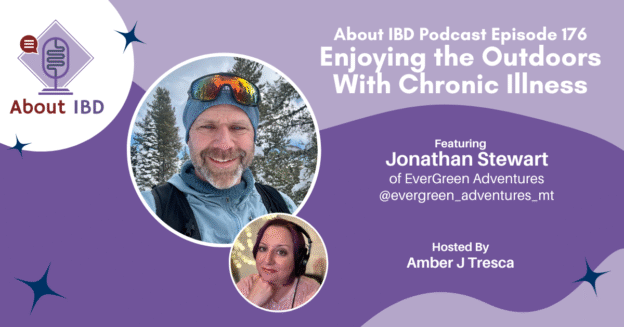
Jonathan Stewart, co-founder of Evergreen Adventures, a nonprofit focused on connecting the chronic illness community with outdoor activities, shares his journey with type 1 diabetes, ulcerative colitis, and sarcoidosis. Jonathan emphasizes the importance of staying active despite health challenges, describes the need for planning outdoor adventures, and encourages everyone to find joy in nature, no matter the circumstances.
Listen and Subscribe to About IBD: Apple Podcasts | Spotify | Overcast | Castbox | Amazon Music | All Other Podcast Apps
Concepts discussed on this episode:
- Personal experiences with chronic illnesses, including ulcerative colitis and type 1 diabetes.
- The journey of misdiagnosis and the challenges of managing chronic conditions.
- The emotional impact of surgical decisions, such as colectomy and living with an ileostomy.
- The importance of community support and advocacy for individuals with chronic illnesses.
- The significance of restroom access and related laws for those with inflammatory bowel disease (IBD).
- The role of outdoor activities in promoting physical and mental well-being for people with chronic conditions.
- The founding and mission of EverGreen Adventures to facilitate outdoor experiences for the chronic illness community.
- The complexities of living with multiple overlapping health conditions.
- The importance of self-advocacy and collaboration with healthcare providers.
- Encouragement to redefine personal adventures and find joy in small moments despite health challenges.
Information on Restroom Access Laws:
- Digital I Can’t Wait Card via Bladder and Bowel Support Company
- I Can’t Wait Card with membership via the Crohn’s & Colitis Foundation
- This Can’t Wait card via Guts UK Charity
- What is The Restroom Access Act? via United Ostomy Associations of America
- Help Pass a Local Restroom Access Law in Your Community via the Crohn’s & Colitis Foundation
- State Legislature Websites
Find Jonathan Stewart and EverGreen Adventures at:
- Web: https://www.egadventures.org/
- Instagram: @evergreen_adventures_mt
Find Amber J Tresca at:
- AboutIBD.com: About IBD
- Verywell: Verywell Health
- Facebook: @aboutIBD
- Twitter: @aboutIBD
- Pinterest: @aboutibd
- Instagram: @about_IBD
- YouTube: @AboutIBD
- Threads: @about_IBD
Find Mac Cooney (mix, sound design, and theme music) at:
- Facebook: @maccooneycomposer
- Instagram: @maccooneycomposer
- Web: Cooney Studio
- YouTube: @MacCooneyComposer
- Theme music, IBD Dance Party, is from ©Cooney Studio.
Episode transcript and more information at: https://bit.ly/AIBD176
These show notes may contain affiliate links. If you choose to purchase after clicking a link, Mal and Tal Enterprises, LLC may receive a commission at no extra cost to you.
Amber Tresca 00:00:05 I’m Amber Tresca, and this is Sbout IBD, the podcast that knows that everybody poops.
I’m a medical writer and patient educator who lives with a j-pouch due to ulcerative colitis. It’s my mission to educate people living with Crohn’s disease or ulcerative colitis about their disease and to bring awareness to the patient journey.
Welcome to Episode 176!
We know that getting outside and being in nature is an important part of our emotional health. We’re not meant to be inside all day, but the IBD can be a real barrier to getting outdoors.
My guest is Jonathan Stewart. Jonathan and his family enjoy being outside and participate in camping, hiking, mountain biking, trail running, fly fishing, and skiing.
This is remarkable because Jonathan was diagnosed with type 1 diabetes as a child, and ulcerative colitis and sarcoidosis as an adult. He had colectomy surgery in 2022, and lives with an ileostomy. Most recently, he had a pacemaker placed for cardiac issues.
Amber Tresca 00:01:08 He responded by founding Evergreen Adventures, a nonprofit that organizes outdoor programming and meetups for the chronic illness community. Jonathan tells us how to shift our thinking about getting outdoors and enjoy ourselves outside, no matter where we are in our disease journey.
Jonathan, welcome to About IBD.
Jonathan Stewart 00:01:28 Thanks so much for having me. I really appreciate it.
Amber Tresca 00:01:30 Oh, it’s my pleasure. So I want to begin with an introduction. So I wonder if you would take a minute to tell us a little bit about yourself.
Jonathan Stewart 00:01:36 Yeah, I’m Jonathan Stewart, I’m the co-founder of Evergreen Adventures, a nonprofit based here in Montana. I started out with my wife a couple of years ago, and our main focus is to facilitate connections and adventures for the chronic illness community.
Amber Tresca 00:01:55 Yeah, which is fantastic. I can’t wait to dig into that and find out more about it. But first off, there’s there’s a reason why you started this company, and, I, I think you collect different conditions. It’s like.
Jonathan Stewart 00:02:11 A connoisseur of sorts.
Amber Tresca 00:02:14 Only the best ones. Only the best ones for Jonathan. Yeah. so. But I want to start with getting an introduction to how you have found your way to forming this company. Could you tell us more about your diagnosis of ulcerative colitis? And then also what led to collecting my surgery?
Jonathan Stewart 00:02:33 Yeah. So it really started back when I was 11, I was diagnosed with type one diabetes. And so I kind of thought, well, you’re good, right. Like this is you’re good on the medical side. You’ve you’ve hit your your mark. That’s enough. That’s enough. Yeah. and this is back before, you know, continuous glucose monitors, insulin pumps were Prescribed, but not wildly. It was just a different time, a different thought process overall. Even even to the care provided. So it was it was difficult to say the least. but I, you know, thanks to support from family, and good friends, I was able to do a lot of great things throughout my life, both personally and athletically, across the board.
Jonathan Stewart 00:03:19 However, in my early 20s, that’s where things started. Like so many of you know, just running to the bathroom. And so, it started as like a week or two at a time, and it would go away for maybe a month, and then another week would start. But so I started doing the circuit, like so many of us. Well, you’re too high strung. You’re too stressed out. Oh, this is your doing. You need to, You’re running too much. That was another one. Just stop running that much. No, nobody should be running. And, I just for not only my mental health but also for diabetes care. Endurance sports were something I really enjoyed and really helped me feel good, so I didn’t make sense to me to slow it down. So fast forward to my late 30s. And, you know, in colonoscopies throughout my 20s and 30s were all normal. Nothing really of note. So it just continued of try Fodmap diet, try eliminating, you know, every grain, jump up and down three times on Wednesdays and only eat peanut butter.
Jonathan Stewart 00:04:25 Whatever the the latest and greatest ideas were, we tried them. And those couple days of running to the bathroom then turned into a week, turned into two weeks, turned into a month straight. Two months. So yeah, towards my late 30s, that’s where eventually I was diagnosed with colitis.
Amber Tresca 00:04:44 So all the previous colonoscopies showed nothing.
Jonathan Stewart 00:04:48 Nothing. Just, Yeah, just Everything’s well within the range. Nothing abnormal. Nothing to really concern yourself with. And that that sort of fueled the, You’re doing this to yourself, which so many of us across the board, whether it’s colitis or whether it’s another condition. you’re kind of met with. Well, this is your fault. your, your you are in this behavior, whether it be a healthy behavior or not, is causing this. And so you should really stop that healthy behavior. You should, you know, stopping running wasn’t an option for me. So it became I was an expert in every construction site, public restroom, anywhere. As construction companies started locking porta potties, it was, please, please don’t leave it for me.
Jonathan Stewart 00:05:42 I promise I’ll take care of your space. so it, it really was frustrating because There were no real answers. And. And we did, in our best faith, try to manage overall stress and anxiety and other elements of just everyday life. And nothing seemed to help until that that mark where not only did we find colitis, but then eventually we found by pure accident sarcoidosis on top of that, which is typically a disease that just comes and goes. For many people, it’s it’s a collection of white blood cells, kind of as I this is my non doctor summary. but my, my doctor and chronic illness benign for the most part collection of white blood cells kind of clumped together and they can usually traditionally it starts in your lungs and it impacts your breathing. And for me, that wasn’t the case. I Well developed golf ball sized lumps on my arms. And I was consulting with Mayo Clinic in Rochester at the time because my colitis was not responding to any treatment. We started from the very basic all the way through to infusions.
Jonathan Stewart 00:07:07 and nothing was responding. Actually, things were getting worse. And so a couple weeks in, like I said, months turned into I’m going to the bathroom 20 to 30 times a day and not obviously not feeling great. And so finding thankfully, a local provider was unwilling to just accept, well, this is just how things are. they did a biopsy of one of the growths and found that it was sarcoidosis, which perplexed everyone. It doesn’t make a whole lot of sense. it’s not in your lungs. It’s, Little did we know, it was throughout my colon. At one point in my heart. My liver. This was all to be found out later.
Amber Tresca 00:07:54 Yeah. So first of all, doctorate in chronic illness is really valid. And yeah, you know, because you might know more about well first of all, you know, more about your own body than anybody else does, but you. And you’ve probably found this, that sometimes you know more about the conditions that you’re living with than some of the health care providers that you’re working with.
Amber Tresca 00:08:18 Absolutely. Absolutely valid.
Jonathan Stewart 00:08:21 Well, it’s in my view, it’s a collaboration. I never and I realized that this is not the case for everyone. I know, generationally speaking, you know, some some people believe that the doctors wear the jacket and they have the white coat. They know what they’re doing. They went to school, listened to everything they say. But at the end of the day, it’s their opinion. It’s it’s their interpretation of of what is happening. And so I gravitate toward providers that are are collaborators with me and will hear me out and will deal with my questions and manage those questions and help me work through the treatment. So if I have a heavy handed, if you will, however you want to describe a provider that is unwilling or their potential ego is not able to handle my thought process or my desire to feel well, then I find another provider. I realize that’s not the case for everyone. You’re you could be limited, you know, in in Montana, obviously it’s a rural setting.
Jonathan Stewart 00:09:22 So you have to be very selective in your providers. As far as you know, some places it’s you have one provider that will be able to help treat your condition. we were in a fortunate position where we were willing to take on, unfortunately, massive amounts of debt in order for me to travel to places like Rochester, to see the folks at Mayo and other places, but I recognize not everybody is in that in that situation. So then it becomes what makes the most sense for you. And I’m not somebody. Even as a kid, I wasn’t focused on a cure for diabetes. And I realized that rubs people. Sometimes it has rubbed people the wrong way. I’ve never been focused on a cure. I don’t keep track of cures. Progress. I did at one point, and I. And it kind of bit me mentally. I had a, I was maybe 13 and I had a provider that was very big on, you know, as many diabetics have in five years, they’ll be a cure.
Jonathan Stewart 00:10:20 In five years, we’ll have a cure. So I counted down essentially waiting and realized this is not not going to happen. And I’m more focused on how can I live a the best day that I can, how can I get through today and do what means something to me, whether that’s running, whether that’s walking, whether that’s whatever your hobby is or and or your professional life, how you pay for all the medical goods. How can we live as decent day as we can? And I’ll I’ll worry about the cures another time. But I want to treat what’s happening now. And that was really the press on eventually treating and managing Sarcoid as well as all these other conditions.
Amber Tresca 00:11:07 Right. I appreciate that, that perspective. And I agree with it. We have to remember that we can talk about curing diseases or even finding better management options. You know, which I think you could say for type one diabetes has occurred for colitis, too. But at the same time, we we are all living with these right now and we have to find a way to get through the day.
Amber Tresca 00:11:38 So I think it’s okay if we leave finding a cure to other people while we’re managing this.
Jonathan Stewart 00:11:45 There’s only there’s just so much bandwidth that we have. There’s only so much. And so where do you where do you want to apply it? And and that’s really where my focus is, is as a, as a father, as a spouse, as someone that is eager to connect with others in the chronic illness community. That’s where I want my energy going. And then what’s left and that that can go to other places. It’s been a long road and it’s continues to be a long road. I’m about two weeks out right now from having a pacemaker implanted because of cardiac ramifications, most likely due to sarcoid. yet again, I don’t really focus exclusively on the why? but yet again, I’m grateful that we have the medical devices that we do to help. Like I said, we went from, you know, roughly 30 times, no exaggeration, of about 30 times a day going to the bathroom, not responding to drugs.
Jonathan Stewart 00:12:50 And it came to the point of that decision, Mark of, we believe that you’re obviously you’re colon doing colonoscopies, looking at everything is not in good shape. This will most likely happen at some point where you will need either an emergency surgery or a surgery at this point, if that’s the route you want to go, if you want to maintain and continue trying every new med that comes on the market and give each one six months to see if it does anything, that’s completely up to you. And I’m I’m grateful for the autonomy that I was given. I also had an opportunity to to meet with different surgeons. And, you know, the first one I just didn’t I didn’t connect with. And the second surgeon came in and he said, look, I don’t want to do the surgery. The last thing I want to do. However, I believe that you will need this surgery in a near term fashion. And I can do this. I can do it. Well, this is what I do.
Jonathan Stewart 00:13:49 And here’s what recovery looks like for you. Because I can’t dictate. I can’t tell you exactly how it’s going to go. But here’s my hope. And every body is different. And I’m going to treat your body as it’s yours. So we’re going to be proactive in our ability to get you back up and moving. so as soon as he left the room, I knew this this is my person. Like, this is, this is who I need on my side in order to, to do this. So relatively speaking, once we had all the information. And don’t get me wrong, this was months of the next infusion, months of, okay, let’s do these 14 tests. you know, I was I was pooping in every A box and nail, and we were running every test to make sure that we weren’t missing something very, I don’t want to say basic, but something that would be in front of us and everything just came back to. No, we don’t understand this. We don’t understand why.
Jonathan Stewart 00:14:48 And yet again, we didn’t realize that not only was this colitis, but also sarcoid lurking within my colon.
[MUSIC: About IBD Transition]
Amber Tresca 00:15:01 After the break, Jonathan describes his struggle to connect with the diagnosis of ulcerative colitis.
Getting outside with IBD isn’t always easy. For some reason, our society likes to pretend that people don’t ever go to the bathroom. It is really frustrating when you love to be outside, but parks and hiking trails don’t have public restrooms. For that reason, I want to make you aware of restroom access laws. These are sometimes called alleys law. Named for the teen with IBD who spearheaded the first restroom access law, which was passed in Illinois. At the time of this recording in 2025, 20 states have passed restroom access laws. Each state is slightly different, but in general, these laws mean that businesses must allow bathroom access to people who need it, such as those with IBD or other digestive conditions. Many IBD nonprofits, and even pharma companies have created small cards that explain IBD and the need for immediate restroom access.
Amber Tresca 00:16:10 These are often called Can’t Wait carts. They’re meant to be used in an emergency when restroom access is being denied. Restroom access laws aren’t well understood or enforced. I encourage you to research and understand the laws where you live so that you know your rights. If your state doesn’t have a restroom access law, you can help in getting one passed. past. I will put more information on the Restroom Access Act and links to printed and digital Cant Wait cards in the show notes and on the episode 176 page on my website about IBD.Com. Now back to the show.
Amber Tresca So you found the right surgeon for you and you elected to. Well, you didn’t elect to have a collective. It was kind of like, this is probably going to happen one day. Yeah, but you elected to have an ostomy and not go for a J pouch. Could you talk about that decision?
Jonathan Stewart 00:17:13 Yeah. And I’m grateful that we have options. Right. And it is elective. Right. This isn’t this isn’t an immediate life or death by, you know, within the next eight hours.
Jonathan Stewart 00:17:22 So therefore, truly, it is an elective surgery. I, I kind of chuckle with you though on it of like to your point, I think probably where you may be laughing as well of like, well, I’m going to the bathroom 30 times a day. So how elective is this?
Amber Tresca 00:17:38 Right.
Amber Tresca 00:17:40 And also you went through so many medications which, you know, you told me offline, I mean, you you said it here too, but really you did go through everything.
Jonathan Stewart 00:17:48 So we did. There’s no question that it was the right decision. So yeah. But to to answer your question, really, I’m grateful that we have options. For me, I’ve never been phenomenal, shockingly at healing. And again, I don’t really care why some some tell me, well, you’re diabetic. That’s that’s why I, that’s my body. I don’t recover easily from surgical procedures or from just general injuries and illnesses. I’m just my body just takes a little extra time. So when we looked at it, on on paper and then talked with folks that have had it, it just for me, it didn’t make sense.
Jonathan Stewart 00:18:27 It the J pouch surgery did not make sense from a recovery and a sustainment perspective just because of my body. And little did we know that it wouldn’t have been an option anyway, based on the state of my overall system and sarcoid. But I knew going into it. Yeah, I’m going to have a bag attached to me for the rest of my life, and it’s the best decision for us as a family. It’s the best decision for me to get back and enjoy a semblance of life. And while the J pouch was intriguing and I’m, I’m still amazed by the the skill and the capability of of the procedure, it just didn’t make sense for me.
Amber Tresca 00:19:15 Yeah. That. Yeah. And it’s so interesting too that you found out later about how much of your colon was affected. Was that basically after the surgery did they tell you, wow, we found a whole bunch of stuff in there.
Jonathan Stewart 00:19:27 Yeah. so. Yes. So I still, it’s, like so many of us, I don’t know what people, it’s it’s interesting what my brain, recalls what my brain has retained from the experience.
Jonathan Stewart 00:19:45 so I recall waking up and recovery and seeing Tara, my wife, kind of chatting, and then immediately looking down and seeing the bag and realizing that this is it. there’s literally no going back. and so, yeah, it was, a couple of days later before we ended up leaving Rochester. I mean, I was in the hospital, I had some recovery complications and as, as kind of predicted from me, so we spent a fair amount of time in the hospital. but when the report came back, it was, I had my rectum removed. so it was my rectum through to my appendix. again, not the scientific, but was riddled with, granulomas as well as obviously the colitis elements of it as well. So it was, it was not in good shape. I had several surgeons tell me he did the right thing. This was, this was not, not ideal to be living, let alone trying to then piece together, you know, a J pouch, connection. So it was it was.
Jonathan Stewart 00:20:55 I’m grateful to have the mentality going into it, of, you know, this makes the most sense for me, that I wasn’t, like, greatly disappointed, if that makes sense, that, that it wasn’t. It also added a little bit of validation to the decision of, of the elective elected surgery. It was also a little bit overwhelming of this is life now. This is what we’re going to do. And I’ve never been ashamed of it. I’ve never hid it. Much to the dismay of our teenage daughter, who, you know, it’s like at a public pool. You know, people are staring. People are staring at you like they are.
Amber Tresca 00:21:39 Are they? I doubt it.
Jonathan Stewart 00:21:40 I doubt it. My joke to her is it’s because I’m so ripped. They’re they’re looking at my muscles. and she just shakes her head and, goes away, but, deals with my jokes. yeah. Chances are, as I tell her, they’re not looking. And hey, if 1 or 2 are and 1 or 2 realize, like, oh, wow, this isn’t, this isn’t just like a and I hate to this isn’t a nursing home situation.
Jonathan Stewart 00:22:07 Yeah. Like that connotation of just quote old people, that there’s a lot of folks, you know, young folks that are ultimately healthier There and or their lives are saved because of the bag. Yeah, that’s that’s great. If they see it on me and maybe do some research on their own, that’s wonderful. But I’ve never felt an obligation to push people. I’ve never felt an obligation to tell other Austinites. You should feel this way. I think that’s inappropriate. And I at least for me, from my standpoint, to tell others how they should or shouldn’t feel. I’ve met some estimates that are incredibly embarrassed by their bag. And and I respect that as much as the others that want to show it to everybody.
Amber Tresca 00:22:56 Yeah. Whatever your feelings are about it, they’re valid.
Jonathan Stewart Yeah.
Amber Tresca And we do have to respect one another’s decisions as well.
Jonathan Stewart Completely.
Amber Tresca So yeah. Valid valid points. I want to ask you about something that you said to me offline. Yeah. Because I found it so interesting in the plant while we were planning this episode.
Amber Tresca 00:23:16 And you kind of put words to something that I also had, just this vague swirling in my brain. And you said that you have relationships with your diseases, but that you find it challenging to connect with the ulcerative colitis. And I really identified with that. And but I want you to tell me a little bit more about what what that means to you, what you mean by that.
Jonathan Stewart 00:23:43 Yeah, I appreciate that. It’s so diabetes, right? Like I understood. I know how it makes me feel when my blood sugars and range, I know how I feel. Thankfully, if it’s a little higher, a little lower. It ebbs and flows based on sort of my stress. My day to day, like, I. I get to know it. I understand how it impacts my body with the colitis. It felt as though having, as I joke, the ultimate colon cleanse. it happened very fast in that it was. And I’m trying to it was roughly two years. Three years? Yeah, three years, I guess.
Jonathan Stewart 00:24:26 from diagnosis to collecting me. Okay. Maybe a little less than I might be, but it doesn’t matter. The the fact was, I got very sick very fast. And we were really trying to again, try every drug. And it just felt as though, oh, it’s removed now, so it’s gone. And obviously that’s not the case. And that’s also something that I, I have a difficult time explaining to people that this wasn’t a cure.
Amber Tresca 00:24:53 yeah.
Jonathan Stewart 00:24:54 It’s I, my body is still, I still have a great deal of joint pain of other issues. my output is incredibly watery. So now we’re going through yet more work ups to try to figure out what else is going on. GI tract wise, I have diversion Colitis and the rectal stuff that was put together when my, during surgery. So now it’s a matter of, okay, how long are we going to hang on to this rectal stump? When is that going to be removed? If it needs to be. It just never felt like I had a time to connect with colitis.
Jonathan Stewart 00:25:30 And even though I in hindsight, and after I mentioned that to you, I kind of been doing a lot of reflection on it. It’s it’s in existence. It’s there. It’s here today. So trying to just, establish that relationship with it and feel connected. It’s it it’s almost like I feel like a frog and it’s like, well, I’m not really part of the colitis, you know, the, the IBD community because I had my colon removed. and that’s completely not the case. Not true. And the community as a whole is very welcoming and very collaborative, but it just it feels just different.
Amber Tresca 00:26:14 Yeah. I understand that having a J pouch is similar.
Jonathan Stewart 00:26:18 Right.
Amber Tresca 00:26:19 You’re part of the community, but you are also part of a slightly different community as well. And so it is challenging. And I gotta say, I don’t know that I’ve ever connected with ulcerative colitis when I think back on it.
Jonathan Stewart Yeah.
Amber Tresca And even with the J pouch, it still seems like it maybe because it’s not visible.
Amber Tresca 00:26:43 But when you see, for instance, a photo of what a digestive system is supposed to look like, and then in your brain you’re thinking, but mine doesn’t look like that anymore. Yeah, but it’s very hard to put that together in your brain.
Jonathan Stewart 00:27:00 Yeah, that’s a good point. It’s, Yeah, it’s, it certainly is a small segment of the population. Yeah. And for whatever reason, we we drew that card. Yeah. I don’t know. Again, it’s not it’s obviously not a cure, but it’s right where you don’t want to be. Right. And it’s not that. It’s not that it’s awful. And it’s not that it’s terrible. But ideally, if I could still have a colon, I wouldn’t mind that.
Amber Tresca 00:27:30 Yeah. All right. Agree, agree.
Jonathan Stewart 00:27:34 So I wonder how much of it to is is. Yeah. People see it and they’re like whoa. You know that’s that’s not where I want to get to. Oh, of course not.
Amber Tresca 00:27:41 Yeah.
Jonathan Stewart 00:27:42 Yeah.
Jonathan Stewart 00:27:43 Snd that’s okay. I don’t, I just, I don’t again, I don’t judge, I don’t. I’m grateful I’m here. I’m grateful that I, I have the opportunity to get outside and move. I’m grateful that I have so many experiences that I wouldn’t have had with my colon. It just wasn’t in the cards. And, I mean, we we look back and Having. We have three kids and dinner time is important to us, and it might only be five minutes long before someone’s crying or someone’s yelling at somebody else. Sibling wise. Whatever. It’s a zoo. however, every dinner I was, I would take a bite of food, and then I would all of a sudden, my stomach would cramp, and I, I, I missed a ton of dinners. I missed, like, if you just if I, if I really think back about all the things that I missed out on or the pain and the suffering that I went through, this is phenomenal. Like, this is this is so great.
[MUSIC: About IBD Transition]
Amber Tresca 00:28:49 Coming up, Jonathan tells us about Evergreen Adventures and gives advice on how you can get outside today.
Amber Tresca Jonathan, you founded a nonprofit called Evergreen Adventures. I’d love for you to tell me more about this group and your vision.
Jonathan Stewart 00:29:12 Yeah. So we it was actually a on a run. So six weeks after surgery, I was mountain biking again after I collected me, as soon as I was off blood thinners, I was I was riding again. And it’s important movement for me is is critical. And, for so many others. Movement becomes very difficult whether you’re regardless of what you’re treating. And so I was really looking for ways to connect with others and didn’t really. Didn’t really find the right flavor for me, per se. so I have a background in this area as well as communications and a few other aspects. And so you’d think I’d I’d have a plan and I’d do things correctly. And so I didn’t.
Jonathan Stewart 00:30:03 So I talked to my wife. I think we need to start our own nonprofit.
Jonathan Stewart 00:30:06 She’s like, great, let’s sit down. We’ll come up with a, you know, a five year plan, some fundraising, and then I’m like, no, the paperwork is filed. We’re we’re getting going. So it turns out when when you’re relatively broke, securing your 501 C3 is a little easier. the powers that be are a little bit more, apt to approve you, but my wife. so Tara came up with the name. so evergreen trees are very popular to in in my world. I enjoy being around them, just looking at them. I drive our kids insane because I. I love taking photos of them. They’re like, dad, how many pictures of trees do you have? Like.
Amber Tresca 00:30:50 Never enough.
Jonathan Stewart 00:30:51 So, but Tara really came up with the the evergreen, sort of the capital G for, you know, we’re always green. We’re always learning. We’re always evolving. Especially in the realm of chronic illnesses. But our push is also not only for the chronic illness community from a patient perspective, but also a caregiver.
Jonathan Stewart 00:31:12 I think a lot of times it’s lost the impact on people like Tara. The fact that, you know, my my health really did cost quite a lot, both financially and mentally. So how to manage that and support that? So our vision is, is to remove as many boundaries as possible to help people get outside. We have a a gear loan program where when folks are coming out to visit, you know, whether it be Yellowstone or Glacier National Park, they’re able to rent, borrow gear and for free and, you know, packs and tents and other things. It’s great to have that program. We have a fly fishing, element to us. So we’re able to tailor fly fishing excursions based on people’s health, but we also do remote support as well. So we recently just had a an IBD running group that we launched, so we’ll have that on a reoccurring basis. Or for folks that are trying to manage, you know, enjoyment of running and and IBD. So that’s really a passion.
Jonathan Stewart 00:32:15 It’s something I love doing. I also meet locally with both nursing students as well as med students to for the nursing students I show them. I do a bag change during class and I show them what a stoma looks like. I talk about, you know, skin, how it looks, how it feels, how to maintain it. And on the medical side, it’s talking to the providers to let them know that we’re not all just clumped into the same, that we’re all individuals. We all have our own way of managing diseases, and that I realize that they’re going to be stressed. I realize that they’re going to have very short timelines allowed to meeting with us. However, taking a different view of us as a community and giving them the perspective of not only are we managing the disease, we’re on the phone for hours with health insurance, with you name it, and trying to ensure that we have what we need. And so it’s for many of us, it’s a fight, a constant fight, not only for health but for support.
Jonathan Stewart 00:33:20 So just giving them a different perspective. And that’s one of my favorite parts is, is the outreach to patients and caregivers, but also to the medical community.
Amber Tresca 00:33:29 Jonathan, I think it’s really common for people with chronic illness to think that they can’t do outdoor activities or they can’t participate in sports, and that these things are just not accessible to them. So I’m wondering if you have any pointers or advice for people that will help them get outside?
Jonathan Stewart 00:33:46 Yeah, I think for for anyone getting outside, different adventures, it requires planning. Now, for us within the chronic illness community, it just requires a bit more. so for for me, if I’m going out for. For a full day, adventure or even just a couple hours or a couple of minutes, I usually have an emergency bag change with me. I have insulin pump supplies. I have food a lot. I’ve had several people laugh at me on the trail asking how many weeks I’m going out for. so I certainly pack, for the worst case scenario.
Jonathan Stewart 00:34:25 However, I also recognize and it’s taking me time, but I recognize the fact that, you know, an adventure doesn’t need to be, you know, a full day and adventure doesn’t need to be X amount of miles accepting what my body will allow. So everyone’s in a different position, you know, place right now. So if maybe a walk around the block is the most that you can get to and enjoy, that’s completely fine. Or if it’s a matter of just going out on your patio or or just sitting in the grass and reading a book for a few minutes and getting some fresh air. So I think it’s one accepting the fact of planning. And then to I’m still working on it. I’m getting there, accepting the fact that, oh, it may not be what it once was. And that’s okay. Where we are today is is really the most important. It’s a lesson I’m working on. I’m getting there. Like I said today, for me it may be a run of a few miles tomorrow.
Jonathan Stewart 00:35:28 It may be I can’t run because my body just. It’s not in the cards. So I’m going to sit to and enjoy a little time just relaxing outside. So I think that’s the biggest advice I have is, is find what adventure is to you. Could be maybe going outside and knitting could be maybe just going outside taking photos, whatever the the adventure is. Find something that you enjoy doing and doesn’t feel like one more thing on our plate that we have to manage.
Amber Tresca 00:35:56 And one more thing maybe to make ourselves feel guilty about.
Jonathan Stewart 00:36:00 I completely right. That’s such a good point of. It took me a while to realize that I was I was so I was comparing where I was a decade ago. I was comparing where I was even even more of where I used to run X amount of miles a week. I used to be able to hike X amount of miles, and it’s unfair. It’s just it’s it’s unfair and it’s and it’s not it’s not helpful either. So I’m really learning to enjoy what I’m capable of doing and what my body’s giving me, and really trying to fight back on the the constant comparisons of where I was maybe even an hour ago, let alone ten years.
Amber Tresca 00:36:47 That’s not easy to do. It really is a struggle. So. Yeah. but I love your outlook on it. And you’re so right. And you know, Jonathan, it’s been such a pleasure speaking with you. And also I’m enjoying your social media, so I want to make sure everybody can find you. Can you tell us where you hang out on the on the Instagram.
Jonathan Stewart 00:37:06 Yeah. So it’s evergreen underscore adventures underscore MT have some fun there and and are able to show some adventures that were on some some fun things. I mean a lot of times it’s just like any other chronic illness person, some, some times that aren’t exactly fun. but, it’s great to connect with everyone. It means a great deal to me.
Amber Tresca 00:37:30 Yeah, yeah, I love it. I want to ask you one more thing. What do you love most about living in Montana?
Jonathan Stewart 00:37:38 Access. Access to the outdoors. We can be, we can be without cell service very quickly. we can, be in the mountains very again within 15 minutes drive, but also have the creature comforts of stores and everything.
Jonathan Stewart 00:38:00 Right? Right here. it’s a it’s a beautiful landscape. And what I’ve learned, we’ve been here, going, I guess six years now. And what I, what I love are the people. The people are very much do your thing and I’ll do mine. It’s a remarkable set of people that really all, you know, in a world in a time of disagreements, it’s a group of people that can really come together on, on a unifying platform of, of open spaces and connection to the outdoors. So it’s it’s a lot of fun and just just the access, you know, being able to go for a mountain bike ride from my back door is, I don’t take it for granted.
Amber Tresca 00:38:47 Yeah, it sounds fantastic. Well, thank you so much for speaking with me and for telling us all of the different ways that we can think about getting outdoors. And I hope everybody takes your advice to heart. And even there are days when it’s for me personally, it is literally just going and sitting outside for a few minutes and getting some sun and, and trying to be okay with that because I can’t run like I used to, and that’s okay.
Jonathan Stewart 00:39:16 It’s completely okay. Right? And just that fresh air alone. I mean, it’s it’s wonderful. And I’m grateful to everything that you’re doing to connect the chronic illness community and, and provide different stories and different perspectives. And because there’s just no one right answer. So thanks for everything that you’re doing to help us.
Amber Tresca 00:39:39 Hey, super listener.
Amber Tresca 00:39:41 Thanks to Jonathan Stewart of Evergreen Adventures for taking the time to talk with me about his nonprofit and their mission finds them on Instagram as Evergreen Adventures MT and on the web at IG adventures. You’ll also find Jonathan’s blog there, which goes into far more detail about his experiences and his thoughts on being a person who is medically complex, who also just wants to go for a run. As always, links to a written transcript, everyone’s social media handles, and more information on the topics we discussed is in the show notes and on my episode 176 page on about ibd.com. Thanks for listening. And remember, until next time. I want you to know more about IBD.
Amber Tresca 00:40:26
About IBD is a production of Mal and Tal Enterprises.
It is written, produced, and directed by me, Amber Tresca.
Mix and sound design is by Mac Cooney.
Theme music is from Cooney Studio.
Thank you for featuring Jonathan’s story and the important work of EverGreen Adventures. As a fellow IBD athlete who also navigates training with an ileostomy, it was incredibly validating to hear someone else’s journey of maintaining an active lifestyle while managing complex health conditions. The message about redefining what “adventure” means and wanting to support others in that journey resonated deeply with me. Your work with About IBD continues to bring valuable perspectives and stories to our community.
Thank you! Getting outside is incredibly important to everyone, and it often gets pushed to the side when we’re not feeling our best. I hope to continue focusing on ways people can connect with nature, regardless of where they are in their disease journey.