
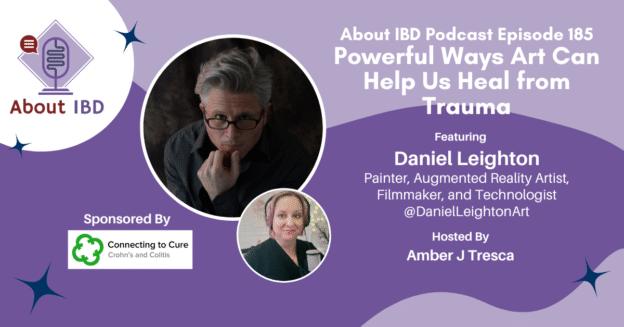
Amber interviews artist Daniel Leighton, who shares his journey living with Crohn’s disease from childhood. Daniel tells us how he didn’t think of himself as an artist, but painting became a vital tool for expressing emotions and coping with complex PTSD related to chronic illness. He offers some advice for those intimidated by starting a journey into creativity and describes how art validates the experiences of people with chronic illness. Daniel’s artwork, inspired by his medical journey, helps others with IBD feel seen and less alone, highlighting the role of art in emotional healing and community connection.
This episode contains a discussion of medical trauma and complex PTSD (post-traumatic stress disorder), so please take care when listening. Check the show notes for a description and time stamps, in case you want to skip certain sections.
Sponsored by:

Listen and Subscribe to About IBD: Apple Podcasts | Spotify | Overcast | Castbox | Amazon Music | All Other Podcast Apps
Topics discussed on this episode:
- The role of art as an outlet for expressing emotions related to living with inflammatory bowel disease (IBD).
- Personal experiences of living with Crohn’s disease, including diagnosis and surgeries.
- The therapeutic benefits of using art to process trauma and cope with chronic illness.
- Practical advice for using art as a form of emotional expression, regardless of artistic skill level.
- The importance of self-compassion and recognizing individual healing timelines.
- The impact of trauma on emotional expression and the need for safe spaces to feel emotions.
- The evolution of personal artwork and its connection to experiences with IBD.
- Encouragement to embrace intimidating activities as a means of personal growth and healing.
- The significance of creating visual representations of emotions, such as “pain charts.”
- The importance of community and connection in the journey of living with chronic illness.
Links to information mentioned in this episode:
- Miller-Ocuin JL, Dietz DW. The Evolution of Pelvic Pouch Surgery: Optimal Pouch Design for an Ileal Pouch Anal Anastomosis. Clin Colon Rectal Surg. 2022;35(6):453-457. doi:10.1055/s-0042-1758135.
- Morgan Check, NP: @morgancheckgastronp
- Taft TH, Bedell A, Craven MR, Guadagnoli L, Quinton S, Hanauer SB. Initial Assessment of Post-traumatic Stress in a US Cohort of Inflammatory Bowel Disease Patients. Inflamm Bowel Dis. 2019;25(9):1577-1585. doi:10.1093/ibd/izz032.
- Gomez DA, Ahmad-Waqar M, Brookes MJ, Kumar A. IBD-related mental health disorders: where do we go from here? Frontline Gastroenterol. 2023;14(6):512-520. doi:10.1136/flgastro-2023-102403.
Find Daniel Leighton at:
- Facebook: @DanielLeightonArt
- Instagram: @DanielLeightonArt
- Artwork: https://danielleighton.com/art-inspired-by-living-with-crohns-disease-ulcerative-colitis-a-deep-dive-into-personal-experiences/
- YouTube: https://www.youtube.com/channel/UCdxRCTh6aPaaEgX07agRsFg
- Substack: @danielleightonart
- Web: https://danielleighton.com/
Find Amber J Tresca at:
- AboutIBD.com: About IBD
- Verywell: Verywell Health
- Facebook: @aboutIBD
- Twitter: @aboutIBD
- Pinterest: @aboutibd
- Instagram: @about_IBD
- YouTube: @AboutIBD
- Threads: @about_IBD
Find Mac Cooney (mix, sound design, and theme music) at:
- Facebook: @maccooneycomposer
- Instagram: @maccooneycomposer
- Web: Cooney Studio
- YouTube: @MacCooneyComposer
- Theme music, IBD Dance Party, is from ©Cooney Studio.
Chapters:
- 00:01 Intro & Content Warning
- 2:40 Daniel’s IBD Journey & Surgeries
- 5:15 Early J-Pouch Surgery
- 6:24 Discovering Art as an Outlet
- 11:24 Art for Processing Trauma
- 15:21 Getting Started with Art
- 17:23 Art, PTSD & Chronic Illness
- 18:43 Connecting to Cure
- 19:57 Evolution of Artwork
- 21:30 Depicting Pain in Art
- 22:39 Trying New Things
- 23:44 Specific Artworks & Meanings
- 29:24 First Surgery & Trauma
- 33:12 Evolving Trauma Over Time
- 34:22 Art as a Bridge
- 38:08 Medical Restraint Trauma
- 40:52 Power of Not Feeling Alone
- 42:15 Lessons Learned the Hard Way
- 43:56 “Here Comes the Flood”
- 46:49 Self-Compassion & Healing Timelines
- 47:55 Ballroom Dancing & New Experiences
- 50:38 Where to Find Daniel’s Art
- 51:44 Closing & Credits
Transcript:
Hey everyone, it’s Amber.
You’re listening to this as an audio podcast, and I appreciate you! But if you want to see the artwork we reference in this episode, please head to the About IBD YouTube channel to see the video. Check the show notes or go to AboutIBD.com for more information and links.
A quick heads up, this episode contains a discussion of medical trauma and complex PTSD, so please take care when listening. Check the show notes for a description and time stamps, in case you want to skip certain sections.
[MUSIC: Digest This Beat]
I’m Amber Tresca and this is About IBD. I was diagnosed with ulcerative colitis as a teen and had pouch surgery ten years later. Today I help people with Crohn’s disease and ulcerative colitis understand their disease and feel seen. About IBD is real. Talk on symptoms, treatment and life with IBD straight from patients, caregivers and experts. You’ll learn, feel less alone, and have a laugh along the way. This episode is sponsored by Connecting to Cure. Connecting to cure is a nonprofit whose mission is to accelerate research, amplify awareness of Crohn’s disease and ulcerative colitis, and connect and support the inflammatory bowel disease community. You can find them at Connecting to Cure. And I am so grateful for their support.
Amber Tresca 00:01:25 Daniel Leighton is a painter, augmented reality artist, filmmaker and technologist who began programming at the age of 11. Born with Crohn’s disease, he faced mortality from a young age, leading him on a lifelong journey of emotional and artistic exploration. A central aim of Daniel’s art is to build a visual vocabulary of emotions, a way to externalize internal experiences that could be difficult to articulate. For Daniel, each piece begins in the body. His art is not just something to look at, but something to feel, an invitation to slow down, drop in and inhabit a deeper sense of presence.
Daniel, welcome to About IBD.
Daniel Leighton 00:02:27 Thank you. Amber. Great to be here.
Amber Tresca 00:02:30 I’m so excited to speak with you. Our topic is how art can be an outlet for our thoughts, feelings, and emotions about living with IBD. And you have been doing that for quite some time with exceptional success. But I want to start first with learning about your IBD journey.
Amber Tresca 00:02:50 You were diagnosed at a young age. Can you start there with telling us a little bit about that?
Daniel Leighton 00:02:56 Sure. Yeah. I was diagnosed originally. Originally I was actually diagnosed with ulcerative colitis. Later to be recognized with Crohn’s. when I was 20. But when I was five years old, I was when I was diagnosed, they said, you know, I must have had it since birth, given the issues I had had up to that point, I was at least the third generation on my mom’s side to have a form of IBD. So I think that went into, as well. And and then I yeah, I was in the hospital. I had a really traumatic, diagnosis. you know, probably around 9 or 10. I started getting much, much worse. And, you know, I was not growing. And, then when I was 11, I had the first of what would be six Major surgeries. The first, it was supposed to be originally just two parts, like a J pouch.
Daniel Leighton 00:04:02 So I had four surgeries from 11 to 15, I believe. And then, that one was like, okay, I’m gonna have an ileostomy, but I’ll still keep the structure intact of the J pouch. in case I wanted to go back. And then the last surgery, there was another one in between. And then the last one when I was 21 was me. Just saying. Forget it. I want it out and be done with this. I still have a lot of symptoms and things that I deal with on a daily basis, but I’ve been, mostly disease free, haven’t had any surgeries, and, you know, 30 plus years have had an ileostomy, you know, basically like for 40 something years. And, now I’m not on any medication because I’ve been, in clinical remission for about six years. I like to say I try to create the circumstances that will best support a healthy outcome. You know, as much as I can, I think that’s kind of the best, you know, I can do with an incurable chronic illness, right?
Amber Tresca 00:05:15 I would say that, yeah, that, you’ve done really well, especially given such a rough start.
Amber Tresca 00:05:22 I want to say that the J pouches started to be experimented with somewhere in the mid to late 70s, so early 80s. Yeah, that was early days. They, maybe didn’t have things quite nailed down yet, unfortunately.
Daniel Leighton 00:05:40 So I was told at the time that I was the youngest person to ever have that. I don’t know. I think they’re different flavors of it from different surgeons around the country, but at least the one that I had was the youngest at the time to have it. It was new.
Amber Tresca 00:05:57 Yeah, I don’t doubt it at all. so thank you for sharing those experiences. I know how difficult it is at times to explain these things and bring them up, but also that has led you to art to be an outlet for some of these things. So how did how did that start for you?
Daniel Leighton 00:06:24 Well, you know, I, I was always an artist, but I didn’t know it. Only, you know, now I look back and I see that I was I was always having these visual ways of understanding.
Daniel Leighton 00:06:37 So I’d have imagery around, like I’d be in therapy, for example, trying to explain how I felt, but I’d be referencing an image that I had in my head and trying to describe it to the therapist as a way of saying, this is how I feel. You know, and but but this whole time. Like early on, I had decided I couldn’t draw. And so I went to filmmaking and I would admire. I admire painters because it was so immediate, you know. But for me, I thought, oh, that’s not even an option. And when I was around 39, I just started drawing, just not expecting anything, but just as a way to get some of these ideas down. I had previously my wife’s a lifelong artist, so I had I was asking her to draw things, but but again, it’s like I’m describing an image that nobody can see. So, so. But she would try, you know, she would try. But then finally she’s like, cuz I’d be like, no, no, no, it’s not like that.
Daniel Leighton 00:07:49 It’s not like that. And I’d realize those are the things I’m trying to describe aren’t really possible to. To convey. So, she’s just said, you know, you do it. And I was like, okay, I can’t do it, but I’ll just start doing stick figures. And so I started doing that and it it felt good to, you know, just to get those ideas down. At least I remember drawing in those early days, like also just how my stomach felt, you know, or trying to depict like what I thought maybe was going on. What you know, what I pictured, going on in there and found that, it felt really good. And then I started actually liking what I was trying, which was shocking to me. And even I thought I remember one of my first, the first painting I sold ended up being the first painting I sold. I did it and I thought I showed it to my wife and I said, have I? Is this a copy of something or have you seen this before? Yeah.
Daniel Leighton 00:08:57 And she’s because I was like, this looks so familiar to me. And she said, it’s familiar because you’ve been seeing it in your head your whole life, you know. And having an iPad to do it with. When I was especially around that time, I was having a pretty prolonged, prolonged flare up, which really, looking back may have been not as much a disease based flare up, but a trauma based flare up. Yeah. You know, when I when I really think about it. so it was great having that, you know, being able to be in bed, have a whole like art studio on my lap, able to create right there. It’s been, it’s been an amazing journey. And it always makes me think that if I could be an artist, then anything is possible, because just a year prior to that, I would have said, there’s no way.
Amber Tresca 00:09:55 I love that your wife. I can just imagine that she was like, oh my gosh. Do it yourself. [laughter] As a wife. Yeah, yeah, I feel that deeply. Just do it yourself.
Daniel Leighton 00:10:13 Yeah. She’s. And she also, when we first kissed, she pushed me away and she said, I can’t be with an artist. And I was like, what? What are you talking about? I’m not an artist. I’m a business. You know, I had a web development company at the time. she saw it. I didn’t she helped me realize I was.
Amber Tresca 00:10:37 Yeah, I love that. We could do a whole other show about your relationship, but the central theme of what you’re telling us about is how art has helped you through some of the trauma that you’ve experienced, living with IBD.
Amber Tresca 00:10:57 And so I’m wondering if you can expand upon that and talk to me more about how that can help people, like anyone who lives with IBD or some other chronic illness. How can art help them cope and process their emotions and offer some stress relief? Maybe.
Daniel Leighton 00:11:24 Yeah. Well, you know, one of the things that was so powerful for me in, in being able to paint these traumatic experiences I went through to have like an active way to process it. Like to be able to be doing something And kind of my process is such that I’m taking what I’m feeling in my body, and I’m trying to move it through my body and on, you know, out of my, like, up through my body, out my arm, into my hand, onto the canvas. You know, prior to that, I was just trying to tell people and explain this thing that happened. And it just wasn’t it didn’t give me the movement I needed and, and and the words just always felt like they fell, you know, way too short being able to experience that. Like there’s one painting in particular I’m thinking of it as I’m talking about this, but it’s true of many of the paintings I’ve done. They were it was like, you know, eight hours straight, no eating, maybe a few bathroom breaks, of course, but being able to spend time with it.
Daniel Leighton 00:12:41 Move it. Channel that energy in a in a in a creative and positive way. allowed me to feel safer, I think at some level, and process it in just a completely different way than I have been able to previously. And as far as how, you know, people with IBD can use it as a way to express it. I would say, you know, just like I did, I mean, just start, take away the judgment, take away the expectation, and just, start moving. And again, you know, visualize if your stomach is hurting. Picture the feeling. Maybe. What’s the shape of that? Just try to let you can even close your eyes and try to feel, feel it moving out of your body and onto the surface. It doesn’t matter what it looks like. It’s really the process of doing it. That is the healing part. And if it does look like something that means something to you, you’re the only one that matters. By the way, you don’t have to show this to anybody.
Daniel Leighton 00:13:57 Think of it as a diary or as a journal, you know. If it does reflect something back to you that resonates the feeling. It’s it’s like no other feeling to create something that makes you feel validation that often, you know, we need to get from some outside source to be able to get that through. Your own creative process is incredibly powerful. Even though if you, you know, it doesn’t have to be anything special, it just has to mean something to you. That’s the key thing, you know? And really, again, it’s the end result doesn’t matter. It doesn’t matter. It’s just. You can throw it away. You can burn it. Whatever. Be safe.
[laughter]
Amber Tresca 00:14:49 I think too, you know, you have come through this process yourself from saying, I’m not an artist all the way through to being a successful artist, quite frankly.
Amber Tresca 00:15:05 So there’s that intimidation factor. So yeah, you’ve already given a couple of points that just start anywhere. And it doesn’t have to be something that you show in a gallery.
Amber Tresca 00:15:21 It just needs to be something that is taking you through the process. How can people think about, though, that they’re they’re thinking, I’m not an artist. I feel intimidated by even starting. Maybe they don’t know what medium to to use. Do you have any other advice to to help people? Just get over that. Get over that hump?
Daniel Leighton 00:15:45 Yeah, sure. I would use whatever’s available. You know, if it’s a pen and paper, do that. that’s what I started with, was like pencil and paper. Then I got some colored pencils, then I got some markers, then I, you know, some I was looking through some of my early, the earliest stuff I did, some of it’s just scribbling, you know, moving my hand furiously against the paper. Because even that movement feels better than just feeling stuck, feeling not well and not able to do anything about it. Even with, like, my computer programming work I’ve done. There’s something special about being able to, like, make something happen, you know? So even if it’s just a mark that you make once a day, whatever, you know, it’s like anything feels good and movement versus, you know, being static or being feeling stuck, which, you know, I, I will often say that everyone who has a chronic illness has PTSD and almost certainly has complex PTSD, because the very nature of a chronic illness is such that we have these recurring, if not actual incidents, then certainly the awareness and the fear that it can happen at any moment.
Daniel Leighton 00:17:23 Right. So we will get into freeze, we get fight, flight, freeze. And really, for any one of those states, if you’re in if you’re in flight, slowing down is great. that’s one thing that I would say is slow down, go really slow. Like let yourself feel it and notice in your body what’s happening. When I move slowly. So what I do is I press really hard against the surface I’m drawing on or painting on because I like to feel the connection and I move real slowly. And just even that slow movement is really powerful. you don’t even have to use. You could do slow movement and have it be powerful without even involving drawing or anything. But if you involve drawing too, it sort of gives you a focus point and it becomes like a meditation. And, when you’re in freeze especially, that can be really, really helpful. And again, I think really any of those three states. It will help with.
[MUSIC: Transition]
Amber Tresca 00:18:43 Connecting to cure is dedicated to connecting and supporting the IBD community, accelerating research and amplifying awareness of Crohn’s disease and ulcerative colitis through their connections programs.
Amber Tresca 00:18:55 Connecting to cure. Offers resources like peer mentorship, gut-friendly workouts, and support groups for IBD patients, caregivers, and family members. They also provide assistance to underserved communities, helping families cover the costs associated with their children’s medical care, and making it possible for kids with IBD to attend summer camp. Connecting to Cure funds cutting-edge research at leading institutions like Cedars-Sinai, Mount Sinai, and the Mayo Clinic. To learn more or to get involved, visit Connecting to Cure.
[MUSIC: Transition]
Amber Tresca 00:19:37 Daniel, I want to ask you about the evolution of your artwork over time. Because I think this is a great example for people who aren’t sure how or why they want to use art as an outlet. So I wonder if you would start by taking us through a few of your drawings.
Daniel Leighton 00:19:57 Okay. Yeah. So the bolder. So this one was basically I had, you know, again, because of PTSD, I, I remember, going being like, when I would be outside if I was out, you know, laying out by a pool or we went to the beach or whatever.
Daniel Leighton 00:20:18 And if I’d close my eyes, I’d immediately see a boulder just falling out of thin air toward my stomach. So this was one of my early drawings, just trying to capture that concept. And, you know, and then I think the fact that the figure is they have no eyes, arms, legs, it’s just the outline of a figure. And it’s also like it’s really just like a few squiggly lines and a bunch of, you know, that the boulder bunch of extra drawing inside a little shape. That was actually one of my early, things that I was encouraged about, like that my wife noted and told me. And because I would always be like, really? This is good, you know? but, I mean, I liked it because it, you know, it conveyed what I was trying to convey to whatever degree, you know, and, but she was like, it’s amazing that you can capture something with so few lines, you know, so it doesn’t have to be this really elaborate kind of thing.
Daniel Leighton 00:21:30 It can be really simple. And, you know, back to the sort of tips. Another thing you can do is you could draw your own pain chart. Right. We see I do a lot of faces and they have those those like ridiculous faces and all that, that on the pain chart. So you could do your own and you could say, this is how I feel and you could put a number or it doesn’t, it doesn’t have to be any particular thing. And in fact, sometimes I tell people like when when I was a kid and I mentioned that I, I draw, I decided my drawing wasn’t good because it didn’t look like everyone else. Well, when you get older and you draw and it doesn’t look like everyone else, it makes you stand out. Yeah. You know, so it’s like the opposite effect. You know, like, my, style is, Identifiable. And one more thing about the intimidation part I want to say is that it’s important to do things that do intimidate you, as long as you know that, you know, especially with things like this, that won’t hurt you.
Daniel Leighton 00:22:39 One of the last times I was in the hospital, I decided, you know what? I’m going to reset a lot of things in my life. I reset my diet, I started exercising, I took ballroom dancing. I was usually only the clown dancer who would make the wedding video highlights.
Daniel Leighton 00:23:02 But that was just a little, you know, it’s like. I mean, I was having fun and that was a way to have fun, but it was also like…
Daniel Leighton 00:23:08 I did have an urge to to do that. And and so I took ballroom dancing lessons, in part because I thought, oh, I could never do that. And I realized I was stuck in a rut of being doing too many things that I was used to and good at already, because I had done them so many times. If you’re intimidated, there’s another reason to start and just try it. And again, there’s no downside, right? I know the other one. Another one you wanted to talk about was, choked up.
Daniel Leighton 00:23:43 I’m trying to convey here the feeling of, like, my throat closing. Usually that’s accompanied for me with, by nausea. You know, you’ll see the eyes have this kind of, spirals in them, and, that’s about like the foggy brain or, you know, the pain or the discomfort. Nothing. Nothing fancy. Just, a few lines, some circles. And often the biggest, the biggest, guide for me is. Does it feel good? Does something in my body open up when I’m drawing this? And if I do spirals, does that, does that? Do I suddenly feel like, oh, this place in my in my belly that’s been stuck finally just gurgled and made it some movement, you know? You know, there’s to me that’s like, okay, I’ve hit the jackpot. I’m. And I keep doing this or or find the next thing. It may be something else after the first, you know, that may get one side, and now you’re going to do some other kind of line, and that’s going to open up another part.
Daniel Leighton 00:24:55 But any kind of opening or any kind of better feeling that you feel in your body when you’re drawing, use that as your guide and then, hope beyond the mountain. This was about my sixth surgery, and really, it wasn’t about the surgery itself, but really the process of getting to the place where I was able to recognize that I needed it. You know, I mentioned earlier that, after a certain point of them trying to fix my pouch, they left it in, gave me, nearly asked me, but left it in with the option of going back later. But I was having issues. I could tell it was inflamed. It was wearing me down. There were all sorts of other issues, and I went on like that for a while, because the thought of having another surgery was terrifying to me and just not something I could handle. And I was a teenager. I’d already lost so many of my teenage years to this stuff. I think I really just blocked it out. And then, there was this one night where I’m getting ready to go out with my friends and I’m, you know, doing my hair and looking in the mirror.
Daniel Leighton 00:26:10 And, I just sort of, like, suddenly realized I need to have another surgery. Re. And I realized, I’ve known this for years, but I didn’t allow myself to, you know, acknowledge it. but at that moment it was like, I could see just beyond this mountain, this, this previously unconquerable mountain. I could see just beyond that. I could see, you know what? There’s an after to this, and it’s better than the before. But I have to go through this journey to get there. And so that was, Yeah, that was another one. That’s not many lines. Simple, simple drawing, but trying to convey that feeling because these are things, these are things I was always trying to, like, tell people about and explain to explain what I felt, to explain what I learned in the process of going through these things. you know, because there, you see. Oh, that’s part of how the mind works. That’s why when we dissociate, that actually is a valuable thing that we need to do to take care of ourselves.
Daniel Leighton 00:27:36 You know, so that’s an important thing too, is that we can’t get down on ourselves, for dissociating, and we can’t get down on ourselves for not moving quickly enough. And, you know, sometimes you need to push yourself, no doubt. But you also have to have compassion. So it’s a it’s a balance there.
Amber Tresca 00:27:55 Like you said, not elaborate. Simple but powerful because they absolutely convey when you see these pieces, you know. Exactly. You know, maybe not your specific circumstances, but you can see, that it is it is hope on the other side of, a hill, of a mountain that you need to get over. And hope is on the other side, and it’s very clear.
Daniel Leighton 00:28:21 And if someone can, you know, it doesn’t have to be. You know, I have a lot of these are these they are based in my story, my history and all that. Just to what you said, it doesn’t have to be my story if it if you can interpret it in a way that matches your story and makes you feel validated or, you know, any, any better in any way than go for it.
Daniel Leighton 00:28:46 It’s that’s great. That makes me thrill, you know, that that’s that’s thrilling to me.
Amber Tresca 00:28:51 That’s a perfect segue into, what I want to ask you about next, because there’s one of your paintings in particular, is that you were so generous as to share many pieces of your art with me, and I was looking through them, and the one that stood out to me in particular, because I think a lot of people with IBD would see this and would relate to it. And it’s titled First Surgery. So I was hoping that you would tell me a little bit about this piece and what inspired it.
Daniel Leighton 00:29:23 Yeah. You know, I even remember where I was when I was drawing this. We were traveling, and I was drawing a lot of it on the plane, and it was, well, okay, so I was 11 years old. I know. I was like, I think I was like £50 underweight, something like crazy.
Amber Tresca 00:29:46 Yeah.
Daniel Leighton 00:29:47 I was like really, really weak.
Daniel Leighton 00:29:49 Fragile. And I was in ICU after the surgery, for a few days and, you know, so there’s in the painting, you see, the skin is looks very kind of thin and there’s a lot of fragility. there’s kind of like this broken heart, you know, I think like when I think of that, I think of seeing my belly for the first time, seeing my stoma for the first time, which they told me it was, you know, they told me everything that was going to happen, but.
Amber Tresca 00:30:27 It’s not the same.
Daniel Leighton 00:30:29 Yeah. This is the first anything I’d had. I had this little 11 year old body, and now I have this massive scar. And it was back far enough. Where? The scars. There was no laparoscopy or any of that. There was staples. There was Betadine covered on my stomach and, and then my stoma, which just looked like, you know, a piece of meat, you know, that that was just like hanging out.
Daniel Leighton 00:30:55 You know, it gets it gets prettier as it evolves. And then, and then having, you know, all these tubes, I think I had six tubes, in different parts of my body coming out and. And it’s one of these things, I think. you know, where it’s if it’s traumatic enough, you have to revisit it periodically because you kind of get it at certain levels as you’re, you know, as with like the Hope Beyond the Mountain painting, where I had to get to a certain level to see it. I think you build up, you know, you build up your resources, your, your strength in different areas, emotional strength. and then you’re able to revisit these things at different levels, at different times. But, you know, it’s what’s funny is that and cool is that when I look at them, I do feel a peaceful feeling to, you know, not just it’s not just like, oh, I don’t want to look at that.
Daniel Leighton 00:32:06 It’s actually comforting to look at it because, oh, this is this real thing that I experienced and no one knew it, that this was like. And now I can look at this and see it reflected back to me. And yeah, that’s really, there’s some truth there. And the truth feels, calming to me.
Amber Tresca 00:32:29 Yeah. I think that’s one of the real for me. One of the surprising things about getting older is you think you’ve gone through the experiences and you think that you have dealt with them, but later you think about them in a different way, and you’re processing them in an entirely different way all over again. And yeah, that complex PTSD that we have from all of these medical touchpoints that we’re having our whole lives, they don’t they hit a little bit differently. After you’ve had some time to reflect, I wonder if you’re recreating them if they would look different, you know, ten years later, as you’ve thought about it some more.
Daniel Leighton 00:33:12 Right. Yeah, yeah. Good point.
Daniel Leighton 00:33:15 I think they would. And, and even when I look at them, they evolve in my understanding of what they’re saying. You know there’s sort of an ongoing conversation with them.
[MUSIC: Transition]
Amber Tresca 00:33:40 Coming up: Daniel tells us how art helps us better understand one another.
Amber Tresca 00:33:56 So we were we were planning this episode. So some inside baseball we actually do a little bit of planning. and you told me that your art has helped people around you better understand what. What you’re experiencing, and you’ve described some of that. But I’m wondering if there was any particular piece that was particularly helpful, in explaining what you were feeling.
Daniel Leighton 00:34:22 You know, I asked because the main person, you know was again, my wife, Anna, and, she, I mean, it it spread from there when I say the main person, she was the first and only person I showed my work to. And then eventually I showed it to, you know, a smaller circle and then, you know, put it out in the public.
Daniel Leighton 00:34:45 But, yeah. the one that comes to mind for that, that sticks out. You know, there’s been a lot of them, but the one that sticks out is tied up at the hospital when I was five years old and I was diagnosed, but I was taken into a room without my parents. And, they tried to put a tube in me, and, I started fighting them off. And instead of, you know, explaining or talking to my parents or whatever, they actually restrained me and they tied me up. So many years later, it still impacts me. It it became so central to my experience of life. And I had tried to describe this so many times. I told her about it. We’d been together ten years when I when I painted that and, she so she’d heard about it, she knew, you know, because I’d refer to it often because I’d have, flashbacks or, you know, reactions that related to it. And she had heard about it so many times, but when I finally painted it, she was like, oh wow, now I get it.
Daniel Leighton 00:36:10 Like she it’s like I had no idea what you know. Now I see what you’re talking about. We should say for people who are just listening, it’s a figure on a blue background and the hands are, spread apart and, not necessarily consciously or intentionally. It’s kind of like a crucifix, you know, crucifixion type of, figure. And, and then there’s a part to the side where, there’s like this yellow area and, and there’s tears all encapsulated in that. And, and the yellow is like leaving the body and going there. And that was meant to represent the emotion leaving my body and dissociating into this little floating figure that contains the tears, the all the feelings that came up for that.
Amber Tresca 00:37:13 Yeah. You know, it’s interesting. I didn’t know what piece you were going to choose. And this one really speaks to me because I. I didn’t have the same experience as you, but similar enough that this is. Yes, this is what it feels like. This is what it feels like to be restrained prior to a procedure and be awake while they’re doing it.
Amber Tresca 00:37:45 it’s not great. So, but this is something that we can, you know, that that you’ve created to explain the experience. And, you know, we’re not the only two people that have experienced this. So I love that it’s in the world so that we can help other people understand what that feels like.
Daniel Leighton 00:38:08 Yeah. And we we had an we actually out here in Santa Monica, I helped I helped put together an IBD art show as all artists who had IBD and made work about IBD. And during that show, that piece was in it. one of our panelists, Morgan Cheek, who I wish I could remember. NP yes. Do you remember her Instagram?
Amber Tresca 00:38:33 I will definitely put it in the show notes because she is amazing. Yes.
Daniel Leighton 00:38:37 Yeah.
Daniel Leighton 00:38:38 Yeah she’s great. And she was telling we were doing a panel and the panelist asked, was there any piece that, you know, stood out to you? And she chose that one? And, you know, I thought it was a thing like, oh, it’s the 70s because this was 1975.
Daniel Leighton 00:38:56 And you think, oh, they just didn’t know any better. And this and that. And you’re telling me about the 80s and Morgan was it had just happened to her like a year prior to this panel discussion. And it happened twice. And it’s like.
Amber Tresca 00:39:12 Yeah.
Daniel Leighton 00:39:13 Do not. If you’re a health care practitioner, please do not do anything. But then.
Daniel Leighton 00:39:19 You know, it’s.
Daniel Leighton 00:39:20 Like we’ve got it. It’s not just a five minute. It’s not like, you know, you’re trying to save a few minutes to get the procedure done. But to us it’s a lifetime. It’s been 50 years now of trauma for me. And it changed the course of my life, you know. And and I’ve done a lot of work on it too, you know, and I’ve and it still had this huge impact. so yeah, it’s a shame that it’s still happening, but I’m glad it’s out there for people who’ve experienced it and can relate to it at least.
Amber Tresca 00:39:57 Yeah, and it’s difficult to uncover it and to talk about it.
Amber Tresca 00:40:00 I’ve not talked about my experience of having that happen really probably beyond anybody about my husband, truthfully. So, because I didn’t think it was a common experience. So it’s interesting and deeply upsetting that this kind of thing is still happening. And as you pointed out, it could be out of expedience, but it it has obviously profound effects on those of us to whom it has happened. And, it’s something that we that, that I’m glad we’re talking about it because there are, health care providers that do listen to this show and so that they can understand that that’s not, it’s not great. And it’s something that too many of us have experienced.
Daniel Leighton 00:40:52 And even just if I can say about what you just said. As far as, not thinking it happened to anyone else, you know, or that it was a rare occurrence. That’s part of this, too. You know, that’s a big part of whether it’s making art about it, whether it’s your show, which you’re talking about these things on a regular basis.
Daniel Leighton 00:41:17 It’s like helping people know that they’re not alone. I like to say that, if my work if I do it right, then someone can look at it and say, oh, okay, there’s proof that I’m not alone. And that goes so far because especially in this day and age where it’s like we’re so compartmentalized. I always think of like, apartments where all these people, each one, they’re probably in some kind of pain, but they’re not connecting and they’re right next to each other. That’s why connecting the care is called connecting the care Absolutely. Connection is slow. It’s critical.
Amber Tresca 00:41:56 Critical. Daniel. Everyone has had at least one moment where things didn’t go as planned. And they learned something that they’ll never forget. Can you tell me about something that you learned the hard way?
Daniel Leighton 00:42:15 I think I was not facing down. certain feelings that I thought. You know, with all this work, really, it’s like I was afraid to go near it, in a way. There were so many things that I just, you know, didn’t deal with and head on or didn’t really get into the meat of because I was just I was scared.
Daniel Leighton 00:42:40 You know. Yeah. And, you know, to some degree, I have compassion for myself because, you know, these are very difficult things, but finally facing them down and and going through the feelings, even if I haven’t processed everything yet, going through what I was able to access has been like, hugely rewarding. I would say. I think the avoidance of feelings is one of the most destructive forces in our world because, they’re there and, you know, we’ve we were talking in our pre meeting, I think about the body keeps the score. Maybe I think we were.
Amber Tresca 00:43:29 Yeah.
Daniel Leighton 00:43:30 So it’s either we’re going to channel it out or it’s going to come out in an unhealthy way. And one of the big ones for me, and it’s partially influenced by what I talked about earlier, tied up at the hospital. And there are other factors, some cultural, some families, some all sorts of things. I wasn’t able to cry. You know, for a long time. and we’re always like, you know, apologizing for emotion.
Daniel Leighton 00:44:02 and, and and I think that’s just so destructive. And there’s this painting called Here Comes the Flood, and there’s two figures in there. I mean, there’s the sort of anthropomorphized, tsunami like wave in a stormy atmosphere. But there’s two main figures in yellow or gold or orange. one is running away from the the wave. And that relates to me feeling like if I let myself cry, I it was going to drown me. And there’s another figure that’s kind of in a more meditative sort of pose. And right in the center of the wave. And that figure is more at peace. And, it reminds me of, I was having, night terrors for a long time where I’d wake up in the middle of the night, gasping for breath. and then being a panic, you know, kind of panicky feeling, because of PTSD. I remember this one moment where one of these times I. I just decided I couldn’t go back to sleep. I was, you know, groggy, all that.
Daniel Leighton 00:45:35 I was tired, my heart’s pounding, and I just decided, like, kind of like, let the wave overtake me. And. And I saw the image of the wave Covering me and then me still being there. Covered in water. Soaked. But right there. Strong. Standing straight. And the water had subsided. And that, you know, this painting reminds me of that. And that’s sort of the one of the things, you know, creating space to feel your feelings, as soon as you are able and, you know, with, with some kind of safety nets, you definitely need some safety nets, especially with severe trauma. But, you know, so that could be a therapist or friends or you need to sort of judge for yourself. And, but yeah, that’s something, you know, the earlier I wish I had done that earlier. and at the same time, you know, I could look at my life and say, well, I’ve been moving toward that. You know, and sometimes that’s the best you can do, right?
Amber Tresca 00:46:49 And having that self self-compassion to understand that your your timeline doesn’t look like anybody else’s or, you know, it’s just it’s your unique timeline.
Amber Tresca 00:46:58 And you came to it when you needed to and you met people along the way who who, you know, gave you little nudges here and there to get you there.
Daniel Leighton 00:47:09 Yeah. And that’s like the importance of just a little bit of compassion to your fellow human beings to or smile or something that helps the nudge. That’s what made me think of that, nudging people.
Amber Tresca 00:47:23 Yeah, yeah, yeah. Well, I want to nudge you to tell me something that that really has nothing to do with what we’ve just been talking. Well, maybe a little bit, but what we’ve been talking about. I want to ask you more about ballroom dance. the husband and I did some ballroom dancing when we were younger, before, I got pregnant with my first child and talk about intimidating. That was something that I never thought that I would do, but we enjoyed it immensely. What was your experience with it like?
Daniel Leighton 00:47:59 Yeah, similar. You know, I didn’t think I’d find myself in that position, but I had a blast.
Daniel Leighton 00:48:05 I would improvise a lot, so I’d do the the very structured stuff and then I’d improvised. They’d have, like one night a week where they’d do, like a dance party or whatever.
Amber Tresca 00:48:18 We had that too. Yeah.
Daniel Leighton 00:48:20 Yeah. And, so I would improvise, and then I’d see all some of the people getting all mad at me. You know, because I’d. I’d do the formal thing for a little bit, and then I’d just usually try to make the person that I was having fun, and I was trying to make the person I was dancing with laugh. And, you know, definitely they, you know, my partners enjoyed it and not everyone enjoyed it, but it was fun. It was a lot of fun.
Amber Tresca 00:48:50 It kind of doesn’t surprise me to learn that you liked to improvise. I used to get in trouble, and, this will not surprise anyone that knows me well, but I used to get in trouble because I had trouble following. I was always trying to lead.
Amber Tresca 00:49:14 So when I was dancing with my husband, you know. Well, he would get away with me too. But he would deal with it much better when I was dancing with one of the instructors. they would really just, like, let me have it. And that I needed to learn to follow, and that I needed to learn to accept what my partner was, was leading me to do, even if it wasn’t necessarily what I wanted to do. And that was. That wasn’t easy. I don’t think I ever quite got there. but at least we can go to a wedding and dance passively, to some ballroom. And sometimes I will hear music, and I will automatically start thinking to myself. That’s a cha cha, that’s a foxtrot. That’s a, you know, that’s or whatever. I’ll categorize them and I’ll start thinking about how, how to move. My, my absolute favorite always, though, was the swing. That was just the most fun.
Amber Tresca 00:50:21 So, Daniel, you have so much going on. You have so many irons in the fire. You have so much more artwork that we couldn’t get to all of it today, but I really want people to see it. So can you tell me where people can connect with you online or maybe even in the real world?
Daniel Leighton 00:50:38 Yeah. So best place is probably my website. Daniel Clayton. Com, which has links to everything and the social media that I’m most frequently, posting to his Instagram. So at Daniel Clayton Art on Instagram. you know, I’m on other ones too. I started with Substack, so that’s another good place to find me. but mostly, my website and Instagram.
Amber Tresca 00:51:09 Perfect. I’ll put all that information in the show notes and on my website so people can find you. And Daniel, thank you so much for talking with me and for going through some of these experiences, which are really difficult, but have informed your art so, so well. And I think I really do want other people to see your artwork, because it does really convey the emotions and the feelings of living with all these complex feelings and what we’ve what we go through with IBD.
[MUSIC: Digest This Beat]
Amber Tresca 00:51:44 And I think it’s a great way that somebody can, can point to a painting and say, you know what? That experience that I had, this is what it felt like, you know. So thank you so much for all of your work and for speaking with me today and for all of the work that you did in preparation for this episode. I really do appreciate you.
Daniel Leighton 00:52:05 Thank you. And likewise, your show is tremendous. And as I told you, pre-show, your preparation is fantastic. The best I’ve seen. And it’s just a pleasure getting to know you. You know, Macy’s told me about you, and I’ve seen you online and stuff. That just like, getting to interact with you directly is really a pleasure.
Amber Tresca 00:52:31 Thank you so much.
Amber Hey, super listener! Check the show notes to find links and information about the topics discussed in this episode. Plus, get a written transcript and much more on my website AboutIBD.Com. If you enjoyed this episode, please consider sharing it with someone or leaving a rating in your podcast app.
Amber Tresca 00:52:54 Reviews and ratings help me grow the show and bring you more great content. This episode was sponsored by Connecting to Cure and I am so grateful for their support. Thanks for listening and remember, until next time, I want you to know more about IBD.
About IBD is a production of Mal and Tal Enterprises.
It is written, produced, and directed by me, Amber Tresca.
Mix and sound design is by Mac Cooney.
Theme music is from Cooney Studio.