
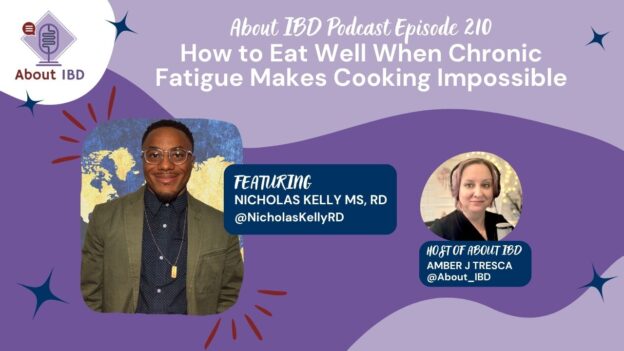
About IBD Podcast Episode 210 With Nicholas Kelly, RD
Cystic fibrosis (CF) is thought of as a lung disease, but it affects the entire body. Amber Tresca speaks with Nicholas Kelly, MS, RD—a registered dietitian, public speaker, and cystic fibrosis advocate. His diagnosis is a result of his mother’s advocacy and research. Nick describes how he balances wanting to fit in with his determination to stand out, how he navigates chronic illness disclosure in the workplace, and his “triple minority” experience within the CF community. Plus, Nick shares practical nutrition tips to help you rethink your relationship with food.
Listen and Subscribe to About IBD: YouTube | Apple Podcasts | Spotify | Overcast | Castbox | Amazon Music | All Other Podcast Apps
What you’ll learn:
- How cystic fibrosis (CF) impacts the digestive tract, pancreas, and nutrient absorption.
- Why Nick’s mother had to research and advocate for his diagnosis due to racial misconceptions in CF testing.
- The balance between striving for normalcy and using your platform to stand out through excellence.
- The accommodations that make higher education accessible for students with unpredictable health needs.
- A realistic philosophy on workplace disclosure when navigating chronic illness and employment security.
- Nick’s “chocolate cake” model for sustainable dietary habit changes without guilt.
- Three accessible meal hacks designed specifically for days when chronic fatigue hits hard.
- The latest advancements in triple-combo CFTR modulators and the campaign for inclusive access.
Find Nicholas Kelly, RD at:
- Web: https://nicholaskellyrd.com/
- Facebook: @nicholaskellyrd
- Twitter: @nicholaskellyrd
- Instagram: @nicholaskellyrd
- YouTube: @nicholaskellyrd
- Tik Tok: @nicholaskellyrd
- LinkedIn: @nicholaskellyrd
Find Amber J Tresca at:
- AboutIBD.com: About IBD
- Verywell: Verywell Health
- Facebook: @aboutIBD
- Twitter: @aboutIBD
- Pinterest: @aboutibd
- Instagram: @about_IBD
- YouTube: @AboutIBD
- Threads: @about_IBD
Find Mac Cooney (mix, sound design, and theme music) at:
- Facebook: @maccooneycomposer
- Instagram: @maccooneycomposer
- Web: Cooney Studio
- YouTube: @MacCooneyComposer
- Theme music, IBD Dance Party, is from ©Cooney Studio.
These show notes may contain affiliate links. If you choose to purchase after clicking a link, Mal and Tal Enterprises, LLC may receive a commission at no extra cost to you.
Transcript
[Music: IBD Dance Party]
[00:00] Amber Tresca: I’m Amber Tresca, and this is About IBD. I was diagnosed with ulcerative colitis as a teen and had J-pouch surgery 10 years later. Now, I help people with Crohn’s disease and ulcerative colitis understand their disease and feel seen. On About IBD, you’ll get real talk on symptoms, treatment, and life with IBD straight from patients, caregivers, and experts.
[00:27] Amber Tresca: You’ll learn, feel less alone, and even have a laugh along the way.
[00:34] Amber Tresca: My guest is Nicholas Kelly. Passionate, energetic, knowledgeable, and compassionate are a few words to describe Nick’s approach to life. His story began at three months old when his mother diagnosed him with cystic fibrosis. Growing up, Nick strove for normalcy, valuing himself as a person meant to stand out.
[00:55] Amber Tresca: Nick thrived despite his disease, obtaining a bachelor’s [01:00] and master’s degree from Bowling Green State University and becoming a dietician. In addition, he is an author, decorated speaker, and advocate. Nick’s life has focused on utilizing his abilities and knowledge to influence those around him while acting as a positive representation of the educational, artistic, and cystic fibrosis community.
[01:23] Amber Tresca: Nick, welcome to About IBD.
[01:26] Nicholas Kelly, RD: Hello, hello. Thank you so much for having me.
[01:29] Amber Tresca: It is my pleasure. And Nick, I wanna start out with your diagnosis because this show usually focuses on IBD, inflammatory bowel disease, and so I see a real opportunity here that we can help people understand more about cystic fibrosis.
[01:47] Amber Tresca: I wonder if we could start by getting some more information about what cystic fibrosis is.
[01:53] Nicholas Kelly, RD: So yeah, so cystic fibrosis is a genetic disorder that, as they tell you, primarily affects the [02:00] lungs, the pancreas, and the GI system. What they don’t tell you when you sign up for this disease, it can affect everything else.
[02:06] Nicholas Kelly, RD: And, uh, you know, talking about the stomach, that– when I was growing up, that was a lot of my issue was GI symptoms. It wasn’t ’til later in life that I saw to having more lung issues. So being able to have those different avenues affected and have those different elements affected by CF are all part of that CF journey
[02:27] Nicholas Kelly, RD: That’s interesting because there…
[02:28] Nicholas Kelly, RD: I mean, there’s a parallel with IBD there because IBD, we mostly talk about and focus on the gut, but it really can affect every part of your body. How has the medical community come to understand cystic fibrosis, uh, in your lifetime since you’ve been diagnosed?
[02:43] Nicholas Kelly, RD: There has been an evolution process. Really, one of the most obvious ones is that minorities can get cystic fibrosis.
[02:51] Nicholas Kelly, RD: The reason my mother diagnosed me is because 39 years ago, they didn’t think African Americans could have the disease, so no one would test me for it. So that’s a [03:00] huge, huge transition inside of the CF community, is that people of color are able to get this disease and are affected by this disease. So that’s one of the big things.
[03:10] Nicholas Kelly, RD: Is also just how the lungs are not the only things imp- impacted. You know, the GI system and pa- need for pancreatic enzymes, how that has influenced the overall health. Recently, we’ve seen introductions of triple combo drugs, so uh, gene therapy drugs that have affected people in a positive way. So there’s been a lot of progress that has occurred during my lifetime with cystic fibrosis.
[03:38] Amber Tresca: Okay, so as you said, your mom diagnosed you. So I definitely need to know more about that. And like, how did that all come about?
[03:48] Nicholas Kelly, RD: So I was a real sick child, and even though that wasn’t uncommon, s- I presented with some of the false negative symptoms. [04:00] So like, my chloride sweat test was originally false negative.
[04:02] Nicholas Kelly, RD: So it was actually my mother who did the research, and she learned the symptoms, and it was her who advocated for my diagnosis.
[04:11] Amber Tresca: So how did she do the research? Like, what did she do to try to, like, nail this down? Especially because it, you know, it sounds like you didn’t have really some of the sort of classic symptoms at the time.
[04:24] Nicholas Kelly, RD: You know, I always wonder, she, she… Mother’s intuition. You know, I don’t wanna say she got lucky, but ’cause she did do a lot of research to find it, ’cause, you know, there’s no Google back then. So she had to open up books and just really went for it, and she was able to navigate and find that information.
[04:43] Nicholas Kelly, RD: And like I said, without her, I may have never got diagnosed, or I would have got diagnosed too late.
[04:49] Amber Tresca: Is there a genetic component at all?
[04:52] Nicholas Kelly, RD: Yes. Okay. So it is a genetic disorder. Both parents are carriers. Uh, both my parents are carriers of the disease.
[04:58] Amber Tresca: Okay. All right. But then no family history in your case?
[05:02] Nicholas Kelly, RD: Correct. No family history. Uh, but I’m it. I’m the… I got all the cool diseases.
[05:08] Amber Tresca: Yeah. Yeah, ’cause, uh, the chances of two people having… I don’t know what they are, but probably not all that great. Um, and then, you know, her having to figure it out with no family history, I mean. Tell you what, you’re right.
[05:21] Amber Tresca: There’s nothing like a mom.
[05:23] Nicholas Kelly, RD: She, she’s special for that one. She’s definitely the GOAT.
[05:28] Amber Tresca: So Nick, um, I wanna get into, um, your take on standing out versus fitting in. Uh, since we’ve connected, I’ve thought a lot more about this concept, and I think people who live with chronic illness experience this idea i- in really challenging ways.
[05:48] Amber Tresca: Because you may wanna be like everybody else, but also you have a uniqueness, it should be celebrated. And so I wonder if you would talk a little bit more about how you have navigated this tension in your life between blending in and then standing out.
[06:05] Nicholas Kelly, RD: So for me, it’s always been one is more about mind state and one is more about action.
[06:10] Amber Tresca: Mm-hmm.
[06:11] Nicholas Kelly, RD: My, my mind state is that I want to be normal in the sense of I always… I never wanna be looked at as sickly or different.
[06:22] Amber Tresca: Mm-hmm.
[06:22] Nicholas Kelly, RD: So that’s where, like, the fitting in comes part. But the standing out, because of my action, I want to excel in a place that people recognize me for the excellent work I’ve put in and all the hard work I’ve put in.
[06:36] Nicholas Kelly, RD: Like becoming an author, becoming a speaker, becoming an artist. Like, those things all took my time, energy, and passion, so that’s where I’m meant to stand out, by the activities that I’ve done. So that’s where it, like, the split between the two comes in.
[06:52] Amber Tresca: Yeah, that makes sense to me, and I’m sort of thinking through this in real time, but to me, there’s an idea of [07:00] achieving something as a person living with a chronic illness versus achieving something as a healthy person.
[07:06] Amber Tresca: So I think sometimes there’s this idea that like, “Oh, wow, you’re doing really great for a person with a chronic illness.” Like, does that idea make sense to you? Versus, like, a healthy person, you would… People… They would just be celebrated for what they’re doing, not for what they’re doing despite obstacles.
[07:24] Nicholas Kelly, RD: There’s a caveat. You know? They, they… Everyone looks at it like, “But.” There’s, like, that but, like you’re waiting for it. Like, “Okay, you do this-” Because of this. Like, it’s amazing that you did this because of this, you know? And I’ve always had, like, mixed feelings about that.
[07:43] Amber Tresca: Mm-hmm.
[07:43] Nicholas Kelly, RD: On one hand, I appreciate being acknowledged for the fact that I do have a disease that causes extra struggles.
[07:50] Nicholas Kelly, RD: That’s just a fact. But I also don’t want it to be looked at as a crippling or a crutch. Like, I surpass my [08:00] limitations that were put on me because of my disease, but I’m still going to be excellent. I was determined to be excellent. I was determined to thrive despite my disease. My disease does not define me, but it has helped shape who I’ve become.
[08:16] Amber Tresca: That makes sense. On this show and in some other chronic illness spaces, we’ve been talking about this idea of pushing through things, uh, to coming to an acceptance about chronic illness and about capacity. And so I’m wondering if you can talk a little bit about what that shift has looked like for your life.
[08:39] Nicholas Kelly, RD: So I, I think that shift really has been… It’s really about the focus I’ve been able to put on and how it transitioned through my, my different stages of life, and really just focus on where I am today, where I wanna be tomorrow, and where I was yesterday and, and literally looking at these different aspects and kind of navigating through them.
[09:09] Amber Tresca: So you have a bachelor’s and a master’s degree in nutrition. While you were in school, was there anything that has come up in your life, um, in your schooling that, uh, helped you, um, to get some accommodations, or did you ever, um, have to deal with, like, the, uh, the office for accommodations? Well, I forget what they’re usually called.
[09:33] Nicholas Kelly, RD: Yes. So I had to deal with the office for accommodations. Um, the biggest, uh, accommodation was for missing classes for being sick. That was the one that was the biggest accommodation I needed because I mean, you miss classes. There’s nothing I can do about it. When my health is my health, there’s… you’re gonna miss days.
[09:55] Nicholas Kelly, RD: It just is what it is. So I needed that accommodation to be able to still be able to finish my work or be allowed to finish my work. So that was a big one. Increased test ti- was another one that may not be thought about- Mm-hmm … but because of like the issues I could have during like a long, extended period of time, you know, whether it be bathroom breaks, the need, desire for pain, things of that nature, uh, the longer testing was, was needed.
[10:24] Amber Tresca: Yeah. Those are two really important things. I’m glad you brought them up so that people know that this is something that they should ask for from their office of accommodation at their school, or maybe talk to their employer about them.
[10:34] Nicholas Kelly, RD: Yes. So that was always something. As far as my employer, I actually am a little different with my employer.
[10:40] Nicholas Kelly, RD: I don’t tell my employer about my disease until I have to. And when, I mean I have to, it means I’m getting admitted to the hospital.
[10:49] Amber Tresca: Mm-hmm.
[10:50] Nicholas Kelly, RD: But prior to that, they know nothing about my disease, because I know, I know what that looks like. I know, you know, whether we, we wanna admit it or not, I become a liability because of my disease, so I’m less likely to get hired, or I’m less likely to be given the, the grace that I need.
[11:10] Nicholas Kelly, RD: Or it’s like, “Oh, this has happened.” You know, uh, I’ve had jobs where, in my younger years where, you know, they found ways to let me go, and they used it under pretext of something job related, but really was, “Oh, I almost passed out at work.” And then the next day I got let go for something. So it’s like, oh, this…
[11:31] Nicholas Kelly, RD: But there’s no… I can’t prove it, because they let me go for another reason. But that’s just a, a realization that I came to early. So when it comes to my jobs, I make sure separation of church and state.
[11:44] Amber Tresca: Nick, you’re a speaker and an advocate for the cystic fibrosis community. Would you tell me a little bit more about that work that you’re doing?
[11:52] Nicholas Kelly, RD: Absolutely. So I love being an advocate. So I’m a big advocate in the CF community, because I wanna be, in many ways, the face of CF for minority populations. And not just minorities in the phrase of people of color. Like, I have a minority disease. I am a minority, and inside of my own disease I have a minority mutation.
[12:14] Amber Tresca: Mm.
[12:14] Nicholas Kelly, RD: So I’m a triple, I’m a triple minority. So I really just wanna be that person to be out there. And, and it’s not just in the CF community. I love advocating for the arts community, the benefit of arts, the benefit of having those things and being a part of those things. That’s really important to me. And so I’ve always wanted to try- And have those different elements and be a part of those different elements.
[12:39] Nicholas Kelly, RD: So also, one thing that I really love is being able to be a public speaker. So I travel the country doing different talks, and I talk to a lot of clinicians about really understanding what it’s like to bridge that gap between clinician and patient.
[12:52] Amber Tresca: Mm-hmm.
[12:53] Nicholas Kelly, RD: I also love to talk about how finding passion, utilizing purpose increases productivity.
[12:59] Nicholas Kelly, RD: [13:00] And really it’s just being able to understand that for me, passion is the single most important and single greatest element a person can have. Passion is what defines us. Passion is what navigates us. And for me personally, I always tell anybody, “If you wanna take anything away from Nick, if you… Any interview, any, any aspect, take away that Nick lived with passion.”
[13:23] Nicholas Kelly, RD: And that’s something that I pride myself on, and that’s the stuff I wanna advocate for, so people understand the importance of passion, people understand the importance of sharing knowledge and giving out information. And that’s why I love to do it. That’s why I love people bringing me in to talk.
[13:38] Nicholas Kelly, RD: That’s why I really appreciate you for having me on.
[MUSIC: About IBD Transition]
[13:46] Amber Tresca: Up next, Nick’s tips on how you can eat well even when you’re fatigued[14:00]
[14:01] Amber Tresca: Nick, something that you mentioned, and I think it’s something though that people aren’t really aware of, is how cystic fibrosis also affects the GI tract, which is something that we know about here on this show. Um, so I’m wondering, when you’re working with patients with gut issues as a dietitian, how do you help people rebuild relationships with food?
[14:21] Nicholas Kelly, RD: I, I take some different approaches than for me personally. One of the approaches I take is what I like to call a very realistic approach, and that seems simple, but let me give you an example. I call it my chocolate cake example. So I tell someone, you know, when they say, “All right, you have to eat less or you have to eat more,” you know, one of the things that I always tell people is, “If you tell someone who eats chocolate cake seven days a week that they can’t eat their chocolate cake and they need to eat chocolate rice cake, they’re gonna laugh you out the room, because it’s not the same thing.”
[14:54] Nicholas Kelly, RD: But what we can do is say, “Instead of eating that seven days a week, let’s go down to four days a week. And instead of eating a piece [15:00] this big, let’s cut that in half and eat a piece this big.”
[15:03] Amber Tresca: Mm-hmm.
[15:03] Nicholas Kelly, RD: But the next part of that step is what do we do for the other three days that we’ve got rid of that chocolate cake?
[15:10] Nicholas Kelly, RD: And then that’s when I give them suggestion of open up like a can of pineapples or fresh pineapples and have them readily available. And then someone’s gonna say, “But Nick, pineapples and chocolate cake aren’t the same thing.” I understand they’re not, but the sweet sensation they can provide you is similar.
[15:25] Nicholas Kelly, RD: So I say when you want that sweet sensation, go ahead and eat these pineapples, and you still get, on those other four days, you still get the chocolate cake. You just get a smaller amount. Because it’s not enough to give an option, you also have to give a solution. And so I go that with people who have gut issues or any type of, uh, issues.
[15:49] Nicholas Kelly, RD: It’s always about giving an answer and then a solution. And so I love to do that with my clients when I’m talking about the relationship with food is ’cause I want them to understand [16:00] there’s places and room to fit in what you want and what you desire. We just have to do it in such a way that benefits both your health and your desires.
[16:10] Amber Tresca: That makes sense. I know, uh, we talk a lot about, um, changing habits also. You know, so it’s kind of like e- expecting someone to wake up one day and completely change their eating habits, like that just doesn’t make sense, you know? But giving somebody a plan and an alternative, like that makes, that makes perfect sense to me.
[16:27] Amber Tresca: It sounds like that’s something that also realistically, uh, is gonna be more successful than just saying you can’t ever have chocolate cake again. And no, absolutely not. A rice cake is not the same as a piece of chocolate cake.
[16:39] Nicholas Kelly, RD: It’s not the same. And the people who like push on people like it’s the similar, it’s just ridiculous.
[16:45] Nicholas Kelly, RD: It’s not the same. And I like a rice cake just as much as the next one, especially the caramel ones, but it’s definitely not… It’s not a piece of caramel, I tell you that much.
[16:54] Amber Tresca: I like the approach very much the realism to it. And so I’m wondering too, you know, you learned all sorts of things in school.
[17:04] Amber Tresca: So is there anything that you learned that it just doesn’t make sense when you apply it to real people who are living with unpredictable chronic illnesses?
[17:15] Nicholas Kelly, RD: So really the thing that I learned, I think that doesn’t apply, is how we talk to patients. So it’s not specifically like something nutrition-wise that I can automatically say like, “Nope, this doesn’t apply.”
[17:29] Nicholas Kelly, RD: But I think it’s outside of the chocolate cake example. I… But I think it’s how we talk to patients, how we present patient information, and try to interact and combine those two things, is me being someone who is both a clinician and a patient, I live on both sides of the world, so I get to see things from a different perspective.
[17:48] Nicholas Kelly, RD: And I think the way we approach patient communication is something that, although there are a lot of benefits into the training we’ve had, I think there’s a lot of things that can be missed inside of it as well.
[18:01] Amber Tresca: It sounds like something that sort of came with experience versus it’s not really something that you could- Learn maybe at school.
[18:09] Amber Tresca: It was something that you learned as you developed your practice.
[18:13] Nicholas Kelly, RD: Yeah, but I, I do think as someone who teaches how clinicians should be better clinicians, I think there is a place for learning it, but we have to kinda break down what we stereotypically thought about how we view the patient experience.
[18:28] Amber Tresca: That makes sense. Something that we talk about a lot in the chronic illness community is conserving energy. In IBD, for instance, there are so many layers to this because w- it’s important to eat well. Uh, chocolate cake every day probably isn’t the best idea. Uh, but we’re also tired, and so I’m wondering, what are your tips for folks that they wanna eat well, but then they don’t have the energy, for instance, to make things from scratch?
[18:54] Nicholas Kelly, RD: So the number one thing I always tell people is drink your calories So drink high protein smoothies. So you can make your smoothies, make them with fruit, peanut butter, Greek yogurt, and, and add all your, your delicious, uh, fruits and veggies that you wanna add. Because when you’re too tired to eat, it’s much easier to drink your calories.
[19:16] Nicholas Kelly, RD: So that’s a, that’s a big one first. Milkshakes are a great option as well. So that’s one of the options. As well as, don’t feel the need to make everything from scratch. It’s okay to get a can of vegetables and open that up, throw it in the microwave, and have a three… put it on three minutes and have your sweet peas.
[19:36] Nicholas Kelly, RD: You know, I love peas, so that’s why I said peas. But, you know, whatever it might be. I do tell people if you do cook canned goods, um, get low sodium and then rinse them twice.
[19:46] Amber Tresca: Mm-hmm.
[19:47] Nicholas Kelly, RD: So that’s a little, like, trick to keep the sodium level down. Rinse them twice and get low sodium canned options. So but that’s something that doesn’t require a lot of time or energy for the person, and they can [20:00] still eat.
[20:00] Nicholas Kelly, RD: So those are things. A third one is meal prepping, but meal prepping the meat so you don’t have to meal prep the whole meal. But, like, on a Sunday, make your chicken, your beef, and then during the week, all you have to do is make two sides or make one side, and then that’s a lot quicker and that’s gonna be…
[20:17] Nicholas Kelly, RD: So those days where you don’t have the energy, you already have the meat ready to go. All you gotta do is make quick sides. So those are three, like, realistic things that people can do to try to combat those days where they just don’t have the energy.
[20:31] Amber Tresca: Yeah, I do that myself, actually. I don’t know. It’s, it wasn’t, like, something that I really thought too much about, but it just sort of presented itself over time.
[20:39] Amber Tresca: Like, I’ll make a lot of chicken and then, okay, then, all right, we have, you know, the chicken the one night and then the next night I’ll make, like, a chicken quesadilla and then, like, the next night I’ll make, um, some, like, chicken fried rice or something like that. And sort of it’s like, yes, it’s chicken three nights in a row, but we’re doing it in different ways, and it really does help a lot to ha- you know, to have the main.
[21:02] Amber Tresca: ’cause there’s nothing like having the main dish and then, yeah, you just open a can of peas. I also love peas. I will tell you something, we’re sleeping on peas. I think a lot of people are sleeping on peas.
[21:12] Nicholas Kelly, RD: Exactly.
[21:13] Amber Tresca: Peas have so much nutrition, and then also they have protein in them. Like, a lot. Like, a lot of protein.
[21:20] Amber Tresca: Like, I didn’t realize.
[21:26] Amber Tresca: So, all right, these are great tips. Thank you for sharing them with us because I think that we feel like we have to go to these… We have to, we feel like we have to go to these extremes, and there are shortcuts that we can find that are, you know, it’s just, it’s fine. It’s fine. Frozen vegetables are fine.
[21:46] Amber Tresca: Canned vegetables are fine, and I love your tip for rinsing twice. I do always buy the low sodium, but I don’t think I rinse them twice. I just do them once, so I appreciate your tip on that.
[21:55] Nicholas Kelly, RD: Hey, all the tips, that’s what I’m here for, dropping, dropping little gems wherever I can.
[22:00] Amber Tresca: I love it. I love it. All right, Nick, you have so many resources available for people, and I want folks to be able to connect with you and to find all the great tips that you have put together.
[22:14] Amber Tresca: Can you talk a little bit about your social media and talk a little bit about your website and where folks can, uh, get more information about you?
[22:22] Nicholas Kelly, RD: Yeah. So first, my website is nicholaskellyrd.com. So that’s Nicholas Kelly, K-E-L-L-Y R-D, so registered dietitian, .com. All my social medias are nicholaskellyrd.rd, and then my email is nicholaskellyrd@gmail.com.
[22:40] Nicholas Kelly, RD: So if you haven’t noticed, there’s a little pattern there. If you wanna get ahold of Nick, it’s Nicholas Kelly, RD. That’s how you get ahold of Nick. And, you know, I really just use my social medias to curate part of my life and part of my advocacy and part of the information that I want to share.
[22:57] Amber Tresca: I love that.
[22:58] Amber Tresca: That’s not easy to do, to have all of your social media and everything the same. It’s actually quite difficult.
[23:04] Nicholas Kelly, RD: Yeah. Yeah, it is. And you say I wanted, I wanted some continuity for myself, and I got lucky enough that I was able to get it.
[23:12] Amber Tresca: Yeah, because your name is a common one. So, uh, I, you know, but I’m so glad that you worked that out so people can find you easily.
[23:18] Amber Tresca: And of course, I’ll put all that information in the show notes. Nick, I wanna ask you something, though. Um, we were talking a little bit about the evolution of the understanding of cystic fibrosis, um, over your lifetime. And so I’m wondering, over the next year, like is there anything in particular that is like really giving you some hope for the cystic fibrosis community?
[23:41] Nicholas Kelly, RD: Absolutely. So, those modulator drugs, um, which I talked about earlier, those triple-combo modulator drugs, they’ve been miracle drugs for some people. Like, they’ve taken people’s lung function from 20% to 50% in some people. Like, un- unbelievable.
[24:00] Nicholas Kelly, RD: And I’ve seen the impact it has on my friends. I’ve seen the impact it has on people I love, and so that gives me great excitement that although I’m not a candidate for these modulators, that someday I will be a candidate, and it will be something that will help for me.
[24:20] Nicholas Kelly, RD: And more importantly, it draws us closer to a cure-
[24:23] Amber Tresca: Mm-hmm …
[24:24] Nicholas Kelly, RD: with, uh, evolving this information, evolving this research. So it gets me very hopeful because I get to watch the people I love not suffer, watch the people I love not die. So it’s, it’s amazing. There’s hope on the horizon.
[24:38] Amber Tresca: Mm-hmm. Mm-hmm. Yeah, and we definitely need that so much, especially right now.
[24:45] Amber Tresca: So Nick, thank you so much for connecting with me and for talking with me. I appreciate everything that you are putting out and everything that you’re doing for the cystic fibrosis community. And I’m also appreciating the synergy between our two communities, and, how we can learn from one another and help one another, and you’ve given some great tips, uh, for the audience today.
[Music: IBD Dance Party]
[25:05] Amber Tresca: So thank you so much for talking with me.
[25:07] Nicholas Kelly, RD: Absolutely. Thank you so much for having me. It’s been truly a pleasure.
[25:16] Amber Tresca: Hey, super listener. Check the show notes to find links and information about the topics discussed in this episode. Plus, get a written transcript and much more on my website, aboutibd.com. If you enjoyed this episode, please consider sharing it with someone else or leaving a rating in your podcast app.
[25:33] Amber Tresca: Reviews and ratings help me grow this show and bring you more great content. Thanks for listening. And remember, until next time, I want you to know more about IBD.
[25:48] Amber Tresca:
About IBD is a production of Mal and Tal Enterprises.
It is written, produced, and directed by me, Amber Tresca.
Mix and sound design is by Mac Cooney.
Theme music is from Cooney Studio.