
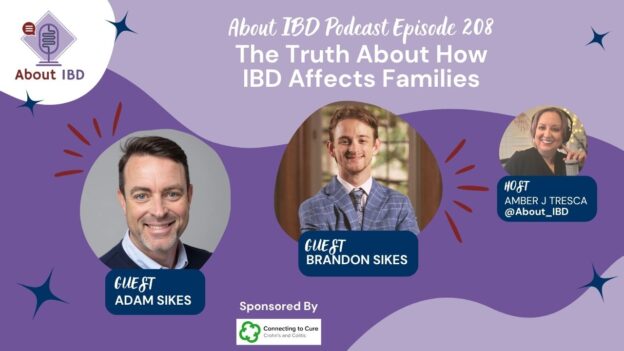
About IBD Podcast Episode 208 With Adam and Brandon Sikes
Adam Sikes was diagnosed with ulcerative colitis at 18 and later with stage 1 colon cancer. Along with his son Brandon, Adam shares how his family supported him through decades of illness, surgery, and recovery with a J-pouch. Adam and Brandon highlight how IBD affects families, the importance of screening, and the power of community support through groups such as Connecting to Cure.
Listen and Subscribe to About IBD:
YouTube | Apple Podcasts | Spotify | Overcast | Castbox | All Other Podcast Apps
What you’ll learn:
- The role of family dynamics in managing chronic illness.
- The involvement of children in patient education and advocacy influenced by a parent’s health journey.
- The importance of early screening and awareness for inflammatory bowel disease (IBD).
- The challenges of living with a chronic illness and the need for better support and resources.
- The impact of j-pouch surgery on quality of life and family interactions.
- How community groups like Connecting to Cure help families cope with IBD.
- The influence of chronic illness on the aspirations and career choices of family members.
- The importance of understanding medical conditions and procedures through research and education.
Chapters:
- [00:02:12] — Adam discusses his diagnosis of ulcerative colitis at age 18.
- [00:04:05] — Adam describes his colon resection surgery after a perforation.
- [00:06:17] — Brandon shares his childhood memories of his dad’s symptoms.
- [00:08:04] — Brandon recalls learning about his dad’s cancer diagnosis.
- [00:10:50] — Adam explains how a colon cancer diagnosis led to j-pouch surgery.
- [00:14:15] — Brandon describes the changes in family life after his dad’s j-pouch surgery.
- [00:17:05] — Adam talks about his concern that his sons might inherit IBD.
- [00:19:12] — Adam and Brandon discuss the importance of getting involved in advocacy.
- [00:23:56] — Brandon shares how he became involved with the Connecting to Cure.
- [00:27:08] — Adam shares how pouch surgery has given him a new lease on life.
- [00:28:21] — Brandon outlines how to engage with Connecting to Cure.
This episode sponsored by Connecting to Cure Crohn’s and Colitis:
- Web: https://www.connectingtocure.org
- Twitter: @connecttocure
- Instagram: @connectingtocure
- Facebook: @ConnectingToCure
Find Adam Sikes at:
- LinkedIn: https://www.linkedin.com/in/adamsikes
Find Brandon Sikes at:
- Instagram: @brandonsikesss
- LinkedIn: https://www.linkedin.com/in/brandon-sikes-214620348/
Find Amber J Tresca at:
- AboutIBD.com: About IBD
- Verywell: Verywell Health
- Facebook: @aboutIBD
- Twitter: @aboutIBD
- Pinterest: @aboutibd
- Instagram: @about_IBD
- YouTube: @AboutIBD
- Threads: @about_IBD
Find Mac Cooney (mix, sound design, and theme music) at:
- Facebook: @maccooneycomposer
- Instagram: @maccooneycomposer
- Web: Cooney Studio
- YouTube: @MacCooneyComposer
- Theme music, IBD Dance Party, is from ©Cooney Studio.
These show notes may contain affiliate links. If you choose to purchase after clicking a link, Mal and Tal Enterprises, LLC may receive a commission at no extra cost to you.
Transcript
Amber Tresca 00:00:05 I’m Amber and this is About IBD. I was diagnosed with ulcerative colitis as a teen and had pouch surgery ten years later. Now I help people with Crohn’s disease and ulcerative colitis understand their disease and feel seen on About IBD. You’ll get real talk on symptoms, treatment, and life with IBD straight from patients, caregivers, and experts. You’ll learn, feel less alone, and even have a laugh along the way.
My guests are Adam and Brandon Sikes. Adam was diagnosed with ulcerative colitis in 1995 at just 18 years old. The diagnosis shaped the next three decades of his life. After a partial colectomy in 2000, Adam faced a new challenge in 2019 when he was diagnosed with stage one colon cancer at age 41, leading to pouch surgery and a renewed fight for his health. Throughout it all, his family has been by his side as engaged and compassionate witnesses to the chronic illness journey. Today, Adam joins his son Brandon, sharing his story to raise awareness around IBD, the long-term risks it carries, and the importance of early screening and advocacy for patients and the families who walk alongside them.
Amber Tresca 00:01:26 Adam, welcome to About IBD.
Adam Sikes 00:01:29 Thanks for having me I appreciate it.
Amber Tresca 00:01:31 Yes. Excellent. I’m so glad to speak to you today. And of course, we also have your son with us. Brandon is a junior pre-med student and Danforth Scholar studying neuroscience and psychology at Washington University in Saint Louis. His dad’s journey with ulcerative colitis and colon cancer sparked his initial interest in medicine, and Brandon now sits on leadership boards in multiple organizations related to patient education and advocacy. He joins his father on the podcast today, where they will both share their perspectives on the family dynamics of IBD. Brandon, welcome to About IBD.
Brandon Sikes 00:02:10 Appreciate it. Thanks for having us.
Amber Tresca 00:02:12 Oh yeah, of course. I’m really excited to dig into your journey. This is an episode like no other that I have done before, because our topic is how IBD affects families, especially during a complicated disease course, which we touched on briefly. But I want to know more. Adam, I want to start at the very beginning of your journey, because when we were planning this episode, you told me your ulcerative colitis diagnosis came in 1995.
Amber Tresca 00:02:38 You were 18. I want to know how it affected you at that time. And did you have an understanding of what a chronic illness was and how it might change your life?
Adam Sikes 00:02:49 Yeah. Thank you. I did not have an idea what a chronic illness was, and I was not prepared for the journey I had ahead of me. I think I was surprised, a bit embarrassed that I was having any issues at all and just wasn’t sure kind of how to go about that. So, I spent the next several years dealing with it and learning a lot over time, but from the beginning I just — I don’t think I really realized what kind of a journey I had ahead of me.
Amber Tresca 00:03:18 So I remember, I was diagnosed as a teen as well, and nobody ever said those words like chronic, like nothing like that. Did anybody ever address that with you at all or. No, they just told you this is what it is. Take this medication.
Adam Sikes 00:03:33 I didn’t even get medication. Really? At the beginning.
Adam Sikes 00:03:36 Oh, wow. It’s strange. my father went through much of the same thing, but I. I didn’t have a real understanding of all that he had gone through. He wasn’t real open about what he had gone through. I mean, I did know, but not to the extent that probably Brandon knows what I’ve been through. But no, no one really told me this is what chronic illness really was. And so no, I, I don’t think I really had a good understanding of what was going on.
Amber Tresca 00:04:05 Yeah. I almost feel like you can’t, you know, but at the same time, it’s like you would hope that somebody would maybe give you a little bit of a clue, but it really wasn’t available, especially in the 90s. So, your journey took two major turns. The first was in 2000, and you had a perforation in your colon, which needed a colon resection. So, I’m wondering, how did that surgery change the symptoms of your ulcerative colitis?
Adam Sikes 00:04:34 To change it from being something that I just dealt with as an as a nuisance, and it changed it into something that became really a life transforming issue where I did not have the control that I had had before.
Adam Sikes 00:04:52 There was urgency and food affected me differently and things I drank affect me differently. Everything pretty much changed from that point forward for the next. We’ll get into the later stuff, but until my cancer diagnosis and pouch surgery, my life was just a matter of managing those flare ups and that urgency.
Amber Tresca 00:05:15 Did you ever think, I mean, it’s such a long time to be dealing with urgency that just never goes away. And the difficulties that come along with ulcerative colitis. Were you a little bit like this is just kind of what it is. And I have to deal with it because it also seems to me like, I don’t know, maybe somebody should have offered you some alternatives, but it doesn’t sound like there was anything.
Adam Sikes 00:05:37 Yeah. I got; the alternatives I got were the normal medicines that everybody gets. and so, I took lots of different medicines over time, and that was sort of the way I was supposed to manage it, I think initially when I had my colon resection and everything changed, I was very frustrated and probably had some anger and confusion or why I was having to go through what I was going through.
Adam Sikes 00:06:03 But then you do you kind of get to the point where you’re just like, well, this is just the way it is, and you start managing symptoms and handling it the way all of us do. Changing diet and eating less. Yeah, that’s kind of the way I managed it from the beginning.
Amber Tresca 00:06:17 Brandon, turning to you. You’re 20 now, and if I did all my math correctly, that means the first 13, 14 years of your life, your dad was managing all of these symptoms behind the scenes. Sounds like there was also quite a few medication changes. ups and downs. Was there a time or did you ever realize that your dad’s health was different from, like, your friend’s parents?
Brandon Sikes 00:06:46 Yeah, I’m not sure if it was ever one single moment. It was more of a series of going from thinking that it was normal to, oh my goodness, my dad is such a tough dude. because I remember as a kid it would be kind of like a oh, it’s just, that’s dad.
Brandon Sikes 00:07:04 He’s always going to the bathroom or whatever, whatever it would be at the time. Like we’d always have to pull off on, on road trips and whatnot. And as I got older and as I started asking Dan more questions and kind of getting into what he was dealing with, it was more of a, oh, wow, you’ve gone through a lot. And at that point, he just wanted to learn more. and right around when I started to ask a bit more questions, this when his cancer diagnosis came around. And so that really got me going. going on Google searches like crazy. learning as much as I could and kind of trying to get a little bit more involved with him and his health as anything I could as a middle school kid at the time. So, it wasn’t really one time where I thought, oh, wow, he’s different than most parents. It’s more of a building of a lot of experience.
Amber Tresca 00:07:59 So in doing Google searches, yeesh, that must have been really scary. Like, were you finding things that were really kind of freaking you out at the time?
Brandon Sikes 00:08:09 I remember the night that Mom and Dad brought my brother and me into their room, and they’re like, “Hey, here’s what’s going on. They’re saying it’s not the end of the world. They seem to have an idea of what to do, but that didn’t speak to me at the time. I wasn’t all the way in my right mind. I just wanted to learn as much as I could because I’m like, I can’t, I can’t help him. I can’t cure his cancer. But I felt like if I could learn everything that I could possibly learn at that time, I could maybe at least try to understand what was going on and from there be able to give it better support. How much I was helpful, I’m not quite sure, but that was kind of one of the entry points in my life to getting into medicine was a lot of searching on whether it’s starting sources and Wikipedia or that was the first time I ever went to PubMed. I think, was around that time.
Amber Tresca 00:09:04 Respect, respect.
Brandon Sikes 00:09:06 There is a lot that I was looking through. And so, it was a really eye-opening moment for me.
Amber Tresca 00:09:14 Was there ever a time that things that you were finding, did you ever bring them back to your dad, or maybe your mom or anybody else and just kind of be like, this is what I read and it’s worrying or I’m wondering about it. It’s anything like that.
Brandon Sikes 00:09:29 Not too much. I do remember asking my dad if he was going to need surgery or not. Because I was looking in a lot of the cures for early-stage cancers just to get the colon out, get whatever part had the cancer. I think that building of curiosity over the years, especially into high school after that, that situation was already over, getting into a lot of research articles sometimes, like I remember, a couple of times I text Dad with, oh, hey, here’s an article I read today about a new biologic that they’re looking at.
Brandon Sikes 00:10:05 It’s 50% more effective than colon cancer patients or whatever, or he’ll send me something. We’ve had a lot more sophisticated talks more recently, but I think that was kind of the seed-planting moment where my curiosity was able, like, hey, I can look at these studies and share them with dad and ask him questions and compare what they were saying in the data with his life experience and see how I’m seeing how they differed.
Amber Tresca 00:10:30 Yeah, that’s so interesting. I can understand why you did that though. I think we all go to Doctor Google whenever we have a question, whether it’s the right or wrong thing to do. that’s where we go. Maybe it’s also a little bit of control, too, that we want to get a little bit of control over something that we really don’t have any control over. So. All right. As Brandon was saying, Adam, your journey took that second big turn. It was 2019. You were diagnosed with stage one colon cancer. And at that point, they took the rest of your colon out.
Amber Tresca 00:11:05 And then you had something I’m familiar with two step pouch creation. So, how did that surgery change your life?
Adam Sikes 00:11:15 It has made my life something that is completely different and in a much better way. I feel basically like I felt before I was diagnosed with ulcerative colitis that I feel, completely in charge of my, my life, as opposed to being a sort of a slave to the, the, disease, for sure. It has given me freedom. That’s given me time. It’s given me a better health. it’s certainly extended my life, so it’s great.
Amber Tresca 00:11:50 So it’s interesting though, too, because, when I think back on my journey, like, I don’t really remember what it was like before. Ulcerative colitis so, but you had those memories to, to compare them to.
Adam Sikes 00:12:03 Yeah. I mean, I had the first 18 years, roughly of my life that I pretty much operated as a normal person. And then when I went to college and had those first symptoms, things changed and they weren’t terrible.
Adam Sikes 00:12:20 My, my symptoms in college weren’t really all that bad. Flare ups some, but not anything that was unmanageable. Like I said, I wasn’t on medicine for whatever reason. They didn’t put me on anything at the time. and it wasn’t until I was 23, that, that, that process changed, but it was nice to be able to go back to the way I felt before and have the freedom, to do life the way I want to.
Amber Tresca 00:12:57 This episode is presented in collaboration with Connecting to Cure Crohn’s and Colitis, as part of its 2026 awareness campaign, created to elevate voices within the inflammatory bowel disease community and increase understanding of what it is really like to live with IBD. Connecting to cure is dedicated to uniting and supporting the IBD community, accelerating research and amplifying awareness of IBD through its connections programs. Connecting to cure provides peer mentorship, support groups, and educational speaker series and other resources for patients, caregivers, and families. In addition, connecting to Cure helps reduce barriers to care by supporting underserved communities.
Amber Tresca 00:13:40 Sponsoring children with IBD to attend medically supported summer camp. Advocating for patients and families and funding innovative research at leading institutions including Cedars-Sinai, Mount Sinai and UCLA. You can learn more at connecting to. Brandon, you were old enough in 2019 to understand more about your dad’s health. And then of course, you are on PubMed, which is a lot for, you know, that age. How did things change for you and for the rest of your family after your dad had his pouch surgery?
Brandon Sikes 00:14:27 Yeah. I’ll start first by saying I remember right before the pouch surgery. When dad had the ostomy bag and he was kind of telling me how they were gonna restructure everything. I just could not wrap my head around the way that they were going to make the pouch. Eventually I got it, but I just remember that being a little mini struggle. But then I remember being so relieved that a large part of it was over. As he was talking about earlier, dad’s life was kind of night and day. as the effects of the surgery wore off and he became a little bit closer to normal.
Brandon Sikes 00:15:12 it was no longer the constant going to the bathroom, and he had so much control, and it was really awesome to see him get a little bit more of that autonomy back. be able to kind of live a normal life. I mean, he’s worked so hard. He deserves it. so that was something that was really cool to see.
Amber Tresca 00:15:34 It’s interesting that you say, Brandon, that you kind of had to wrap your head around understanding the pouch surgery. I often have to draw pictures, even for clinicians, even for healthcare providers. because it is really kind of a little tricky to understand. And I think the idea of the of the ostomy to jae pouch, and then that whole like the reversal process, I think that also trips people up like they don’t quite understand. Do you have something now that you use to explain it to, to other people?
Brandon Sikes 00:16:09 Not particularly with words. It’s kind of as you say. I show them a picture. it’s probably, for the people like me who like to see it get done.
Brandon Sikes 00:16:18 There’s probably a video on YouTube or something where the surgery is being done, and you get to see it happen. That’s kind of how I like to learn. but as you said, images mainly is what gets most people.
Amber Tresca 00:16:32 I’ve talked to a lot of different people who have had, pouches or other, specialized surgeries, and usually it’s their surgeon drawing them a picture that actually gets them there to help them understand it. So yeah, it can be very tricky. So, I identify with what you were, what you were saying. So, Adam, your son is now a few years older than you were when you were first diagnosed. And sometimes I mark my children’s ages based on my own diagnosis, which was at 16. So, I think that I will feel better when they are maybe in their early to mid-20s. Do you ever have any thoughts like that, or about how your kid’s lives would change if they were diagnosed with a chronic illness.
Adam Sikes 00:17:18 All the time. In fact, when I went through the cancer stuff, we checked into the genetic testing to see if there was something that I was going to pass on as a susceptibility issue, and thankfully it was not.
Adam Sikes 00:17:31 But yeah, I think when Brandon hit 18. You know any time he’d he’s a runner and runners typically. Well, we’ll have issues where they, you know, you’ve run for so long and then you’ve got to go to the bathroom. Yeah. And so those things always would make me worry that it’s this, is this running, or is this an issue that, like, I’ve had to deal with his brothers the same way. So, I have two boys and my younger son is 18, almost 19. And he’s sort of eclipsed that age, too. So as for what we can see right now, they’re both really healthy and not dealing with any of those issues, and I’m very thankful. But yeah, it was something for sure because my dad dealt with it, because I dealt with it. I was super concerned that it was something that they would have to deal with as well. And thankfully, at this point, they’re both doing great.
Amber Tresca 00:18:20 Yeah, I think that’s something that we don’t talk about a lot, because they think all of us that live with the IBD and we worry about our kids, we kind of do it silently.
Amber Tresca 00:18:28 Even though I know there’s not a huge risk of, you know, passing things on, it still really was very bothersome, and I worried. I worried about it a lot. I have a question, though, about the genetic testing. So, they put you through the genetic testing about the colon cancer. Did they ever find anything, or do they think it was related to the colitis?
Adam Sikes 00:18:50 They thought that it was just a kind of a chronic exposure to the inflammation that just ultimately developed the cancer?
Amber Tresca 00:18:56 Yeah. After so many years, it’s you know, your cancer risk does go up. It’s really, it’s really such a bummer. so well, there’s families listening right now to us who are in similar circumstances to yours. So, I wonder if you could give some advice for them. I’m interested to hear from both of you about anything that would have helped you in managing this journey. So, Adam, I want to start with you. Is there any resources or any information that would have helped you along the way?
Adam Sikes 00:19:31 I think probably the exposure to message boards and support groups there online, the online community was not something that I participated in as early in my ulcerative colitis.
Adam Sikes 00:19:44 I mean, the internet was just getting started. when I when I first started my ulcerative colitis journey. And I look at the resources that are available now and I’m really grateful. I know when I went in for the pouch procedure. there was a great community online and was able to plug in with that. And I’ve asked countless questions on there that I would have loved to have been able to ask. Early on, I probably would have gotten to the surgery sooner. I think if I if I’d had resources like that, had I known how great my life is today after addressing this medically with surgery, I would have. I would have done it years. Years before. I know this is not a kind of jade pouch promoting podcast, but I certainly am a benefit from that. And I would have would have done it much earlier if I’d known.
Amber Tresca 00:20:37 Yeah. I mean, I am happy to promote a J-pouch because, it, my journey did not quite have the exact same turns as yours, but similar, with a colon cancer scare and, yeah, I think same.
Amber Tresca 00:20:53 I think I was so afraid of surgery, but then once I had it, I could actually live a life, you know? So, Yeah, I’m. I’m happy to say that, I mean, we’d all prefer to, you know, be whole and not lose any organs. But at the same time, I think it’s a really good option. And it was for me. And it sounds like it was for you, too.
Adam Sikes 00:21:11 Yeah. For sure. it is a scary thought that they’re just going to do the, the whole process. But it’s amazing what our medical advancements are at today. And I’m super excited for Brandon going into the medical field and seeing where his journey takes him, he’s going to get a chance to do some really cool things. But yeah, it’s really amazing what they can do. It has changed my life for the better. Yeah, I think the more you talk to people and open up about your journey, the more people you realize are affected by it.
Adam Sikes 00:21:43 I think that’s another thing that I would have probably done sooner, is be a little bit more out there with what I’m going through. There’s a lot of people that are dealing with it quietly and managing it the best they can. But there’s a good community of people out there and there’s great resources and the message boards and all that are things that I have benefited from, you know, recently.
Amber Tresca 00:22:06 Yes, 100% agree. Brandon, how about you? Besides going on PubMed, you know, and reading all these research papers and everything. is there anything else that would have helped you as you were a teen and then now as a young adult.
Brandon Sikes 00:22:22 Yeah. I think I’ll echo a little bit of what Dad was talking about, where it didn’t realize how broad of a community this is until I got into college. You look at the numbers, I think it’s about 1% of Americans are diagnosed with HIV about, you know, like, oh, that’s 1 in 100. But then you think, on the other hand, that’s over 3 million.
Brandon Sikes 00:22:46 That’s a lot of people that are affected by this. And I’ve known a few friends with Crohn’s or colitis. I haven’t really had many conversations until a couple of years ago. I think one thing that I wish, not necessarily that I knew, but more necessarily I wish I would have done, is get involved earlier, see what I could do either within the community or find a space earlier. Luckily, I know dad found the pouch group online. but I think promoting those materials earlier. I’ve done some stuff recently with them, but getting involved earlier, I think, would be better for everybody to get as many people in the know as possible.
Amber Tresca 00:23:31 Yeah, I agree, I’ve never met anybody who said that. They that they wish that they weren’t involved in the community or that they wished that they had that surgery had held off longer. Like everybody says, I wish I’d had surgery earlier. I wish I had, you know, learned of what’s available to me earlier. So, yeah, really very important thing that you’re reinforcing here.
Amber Tresca 00:23:56 And so you did find community. You found community and Connecting to Cure, which is a non-profit organization that’s focused on families coping with IBD. Brandon, I think there’s a story in here. Can you tell me how you learned about connecting to cure and how you and your dad became involved?
Brandon Sikes 00:24:13 So initially when I went to college as a part of the program that I’m in. We had an early visit during our senior year of high school. And on that visit, I met Joseph, who is also a member of Connecting to Cure. And before long, we connected over the fact that he had Crohn’s and that my dad has also colitis and that we’re both kind of getting into he was further into it than I was as far as advocacy goes, but he kind of brought that out of me. And we were roommates our freshman year, and during that freshman year, he introduced me to Connecting to Cure officially. I applied for it on his recommendation, and here we are now. done a lot of meetings.
Brandon Sikes 00:25:03 I’ve written a few online articles, and now I have been connected with you here. There’s been so many incredible people in the organization that have done so many amazing things, whether it’s out in LA or online, raising a lot of money for families who really need it. And so, it’s a great organization and I’m happy to promote it here.
Amber Tresca 00:25:23 Yeah, I agree of course, 100%. After working with connected to Care for several years now. probably more than I can remember actually. I think I went to the first. I went to the New York Rock the night in 2017. I think that was the first time that I met, Stacy, who was one of the founders. and literally one of the best concerts I’ve ever been to in my life. so, it was great. So. All right, I want to I, you know, I want to know a little bit more. You guys have said a couple of things as I’ve been talking to you, that I kind of want to know a little bit more, about, Brandon as a runner.
Amber Tresca 00:26:02 Can you tell me about this? Can you tell me about. Did you run track? Like, is it part of, your college, journey now?
Brandon Sikes 00:26:09 Yeah. So, I started running track and cross country in middle school. but I really started getting serious about it in high school. Did cross country all four years. Had a lot of fun time over there at Free State. ran track my junior and senior year. and I’ve transitioned now to in college, I played baseball for the club team, but, so I’m no longer running, like on a team or anything, but on occasion I’ll get out, run in Forest Park or wherever else in Saint Louis.
Amber Tresca 00:26:39 And it sounds true, like you’re a visual learner. So, you were saying that you might go to YouTube? Are you in the habit of, like, going to YouTube and watching, like, surgical videos and things like that.
Brandon Sikes 00:26:47 All the time? Actually, yeah. one of my coworkers was making fun of me a while ago, but I was sitting there with my lunch, and we were watching a brain surgery, him and I, so it was great.
Amber Tresca 00:27:00 I love it. well, we need people like you, obviously, because somebody has to do the surgeries, and it’s not going to be me. so, Adam, I’m wondering, you’ve got this new lease on life that you’ve been given after having pouch surgery. Is there something that you have been able to do that has surprised you or that you’ve been really excited about? Anything in particular that comes to mind?
Adam Sikes 00:27:22 Yeah. Anything outside is great. My wife and I like to get out and walk and travel and do all kinds of things. We’ve taken the boys on lots of trips and, we do a lot of car rides, too. A lot of car trips. And it’s amazing to be able to drive. We drove straight from where we live in Kansas, out to South Carolina, and I think we stopped twice to get gas. and I probably went to the bathroom once or twice on that trip. Maybe most. So yeah. Being able to just have that freedom back and to be able to, live life, without a lot of worry.
Adam Sikes 00:28:02 it’s been great.
Amber Tresca 00:28:03 I love that, I love that. It’s such a great story. I mean, I wish that you had never had to go through any of this. Of course. but I’m glad that you finally found, the treatment that was right for you and, that you’re enjoying your family life now so much more. Brandon, I wonder if we can go through some of the social media for connecting to cure and talk about how people can get involved with the group?
Brandon Sikes 00:28:30 Yeah. as far as I’m aware, they have a website you can go to there to search up connecting to cure Crohn’s and colitis. It’d be probably the first thing that shows up. They have an Instagram. they will post and I believe we have a other series miniseries coming up, but we will occasionally do promotional materials on there. I know the leadership team and Joseph went up to Chicago for a conference up there, and they have a lot of their findings and a day in the life post on there. So, every once in a while, we’ll come out with new materials and we’ll post those on our social media.
Brandon Sikes 00:29:10 Pretty cool stuff on there.
Amber Tresca 00:29:12 Yes, I agree wholeheartedly. It is not easy to talk about these things, and so I appreciate both of you being so candid and open with your experience and talking about how IBD has affected you individually and then as a family. And so I know that your story is going to be impactful and is going to help people feel seen and understand more about how these diseases affect us beyond just what goes on in the bathroom. So, Adam, Brandon, thank you so very much for speaking with me today.
Adam Sikes 00:29:44 Thank you. I appreciate it. It’s great to be able to touch on this and say a special thank you to all the families out there that are supporting the folks going through this. I know I’ve had an incredibly supportive wife and kids and, I know there’s a lot of really great families out there supporting those that are going through this as well.
Amber Tresca 00:30:06 Hey, super listener! Check the show notes to find links and information about the topics discussed in this episode.
Amber Tresca 00:30:12 Plus get a written transcript and much more on my website About IBD. If you enjoyed this episode, please consider sharing it with someone else or leaving a rating in your podcast app. Reviews and ratings help me grow this show and bring you more great content. Thanks for listening and remember, until next time, I want you to know more about IBD.
About IBD as a production of Mal and Tal Enterprises, it is edited, written, produced and directed by me, Amber Tresca. Mix and sound design is by Mac Cooney. Theme music is from Cooney Studio.
I have a cat that just broke into my office. So, I’m going to eject a cat, and I will be right back.