
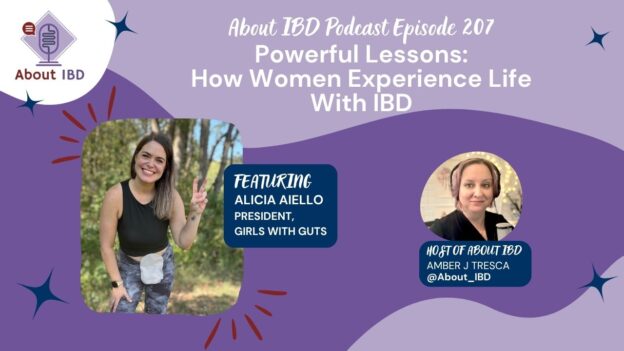
Featuring Alicia Aiello of Girls With Guts – About IBD Podcast Episode 207
Alicia Aiello, president of Girls With Guts, shares her journey with IBD, which began in childhood. She discusses major surgeries, including a proctectomy that resulted in an unexpected loss of her fallopian tubes and an ovary, and the early onset of perimenopause. Alicia opens up about navigating rectovaginal fistulas, feeling dismissed, and the importance of knowing when to switch providers.
What you’ll learn:
- The impact of inflammatory bowel disease (IBD) on women’s health.
- Why proctectomy surgery might be used, how it affects women, and some potential complications.
- The challenges of rectovaginal fistulas and their effects on intimacy and mental health.
- The importance of self-advocacy and seeking second opinions.
- Some of the gaps in healthcare for women with IBD, especially regarding reproductive health and menopause.
- The role of community support and organizations such as Girls With Guts.
- How multidisciplinary approaches are important in managing women’s health issues.
- Some personal coping strategies and hobbies outside of IBD advocacy.
- Upcoming events and resources for women living with IBD.
Key Chapters & Timestamps:
- [01:12] — Introduction to Alicia Aiello, president of Girls With Guts (GWG).
- [03:01]: Alicia describes her abrupt diagnosis with ulcerative colitis at age 14.
- [04:36]: Alicia explains a proctectomy and details her surgical history, including rectovaginal fistulas.
- [07:26]: Alicia discusses her decision to seek a permanent ostomy.
- [09:19]: Alicia shares the unexpected outcome of her proctectomy surgery.
- [13:43]: Alicia talks about the lack of mental health support and reproductive care.
- [22:40]: Alicia shares the physical and mental toll of fistulas.
- [25:34]: Alicia offers advice on trusting your gut and advocating for yourself when you feel invalidated or rushed by a provider.
- [35:42]: Alicia outlines how providers can improve care for their patients.
- [38:24]: Gaps in care, including isolation and lack of information on aging with IBD.
- [40:49]: Alicia details the upcoming GWG annual retreat and highlights the Cedars-Sinai Women’s Health Conference.
- [45:54]: Alicia shares about her hobbies outside of advocacy.
Find Alicia Aiello at:
- Instagram: @alicia_aiello
- Facebook: @AliciaMarieAiello
Find Girls With Guts at:
- Instagram: @ibdgirls
- Facebook: https://www.facebook.com/IBDgirls
- TikTok: @ibdgirls
- LinkedIn: @ibdgirls
- Web: www.girlswithguts.org
- YouTube: @IBDgirls
Find Amber J Tresca at:
- AboutIBD.com: About IBD
- Verywell: Verywell Health
- Facebook: @aboutIBD
- Twitter: @aboutIBD
- Pinterest: @aboutibd
- Instagram: @about_IBD
- YouTube: @AboutIBD
- Threads: @about_IBD
Resources:
- What is a Fistula? — Amber Tresca via Verywell Health: https://www.verywellhealth.com/what-is-a-fistula-1941776
- Girls With Guts retreat information and registration: https://girlswithguts.org/calendar/gwg2026/
- IBD & Women’s Health Conference: https://www.eventbrite.com/e/your-life-your-hormones-your-ibd-womens-health-at-every-stage-tickets-1977517412815
Transcript
Host: Amber Tresca
Guest: Alicia Aiello
[Amber Tresca]: Hey you, it’s Amber, the host of About IBD. I’m popping in at the start of this episode with Alicia of Girls With Guts to give a quick content advisory. We discuss some of the difficult circumstances that Alicia has experienced throughout her disease journey, including surgical complications which have affected her reproductive system. If you’re not sure that this is something you want to listen to or watch or you’re concerned it might not be appropriate for a tween or a teen, you can always go to my website, aboutibd.com, for a transcript that can inform your decision.
Okay, on to the episode.
[MUSIC: IBD Dance Party]
[Amber Tresca]: I’m Amber Tresca, and this is About IBD. I was diagnosed with ulcerative colitis as a teen and had J-pouch surgery 10 years later. Now, I help people with Crohn’s disease and ulcerative colitis understand their disease and feel seen. On About IBD, you’ll get real talk on symptoms, treatment, and life with IBD, straight from patients, caregivers, and experts. You’ll learn, feel less alone, and even have a laugh along the way. My guest is Alicia Aiello. Alicia is a multimedia storyteller whose work sits at the intersection of creativity, community leadership, and health advocacy. Her creative practice includes photography, marketing, and digital media, driven by the goal of crafting thoughtful, compelling narratives. Alicia serves as the president of Girls With Guts, a national nonprofit dedicated to empowering women living with inflammatory bowel disease and ostomies. This role is personal because Alicia lives with IBD and has navigated complex pelvic disease, rectovaginal fistulas, and major surgeries, including a proctectomy and loss of reproductive organs, which led to early perimenopause. Alicia utilizes her skills to amplify patient voices, counter medical gaslighting, and build a connected, meaningful community. She is dedicated to telling stories and bridging the gap between patients and clinicians. Alicia, welcome to About IBD.
[Alicia Aiello]: I’m so excited to be here. Thank you for having me.
[Amber Tresca]: Oh, I really appreciate you so much. And I’m excited to learn about what you have to say today and hear a few stories because our topic is how IBD affects women. And how patients can better advocate for themselves. Recently, we’ve been having a little bit of a discussion on the interwebs about how also providers need to do a better job of advocating for us. So, I’m sure we’ll get into that as well. So, it’s not all on us. All right, Alicia. So, let’s get started about first learning more about your journey with IBD. Your bio went through some of the complications you’ve experienced. I know there’s more than that. But let’s first learn a bit about how you were diagnosed.
[Alicia Aiello]: Absolutely. So, you know, I was symptomatic through my entire childhood. I would say… Most of my symptoms started at around five. I was calling home from school every day with a stomachache. You know, my mom was running me back and forth to different doctors. They were kind of brushing it off as anxiety. She doesn’t want to be at school. I had more symptoms throughout my youth, growing mouth ulcers, and I had different skin rashes. It felt like my entire childhood was a big question mark. No one was giving us answers. And then the symptoms would go away. And we were like, oh, it’s probably just growing pains or something weird like that. Over time, those symptoms became more frequent. And it wasn’t until I was 14 that I was formally diagnosed very abruptly.
One summer between turning 13 and 14, I was having this intense stomach pain. I was having a lot of bloody stool on the toilet. I could hardly walk after a certain period of time. And eventually my mom, after I had lost so much weight and we couldn’t write it off as like a stomach bug anymore, she brought me to the pediatric ER in the area and they hospitalized me. And I woke up the next day with a shiny new diagnosis of ulcerative colitis at the time. It’s been a long journey for sure. I was rediagnosed with Crohn’s disease in my 20s. So, between the two periods of time, a lot has happened.
[Amber Tresca]: Yeah, yeah, yeah. I would say that because you’ve had a number of surgeries and I’m sure each comes with its own stories. But I want to focus on the proctectomy because… You woke up from that surgery with hearing some really difficult news. You lost your fallopian tubes, and you also lost one ovary. And so, I’m wondering if you would first describe what a proctectomy is for folks that word is unfamiliar and then share a little bit about how you coped with the outcome of that particular surgery.
[Alicia Aiello]: Absolutely. So, a proctectomy is the removal of your rectum. And in my case, my anus was also removed, what we lovingly refer to as a Barbie butt in the community. So, I do live with a permanent ostomy now.
But to paint a little bit of my surgical history before I jump into that a bit more. You know, when I was diagnosed with ulcerative colitis during that first hospitalization, I ended up having a scope, having emergency surgery and woke up with an ostomy at 14, you know, within six months of my diagnosis. And that happened. Changed the entire, you know, trajectory for me, not only of my, you know, youth, but my life. And waking up with this new diagnosis, I didn’t know how to manage it. I didn’t know if it meant that I had something like cancer. I was still trying to unpack what having ulcerative colitis meant. And now I was dealing with living with an ostomy. And I really struggled to navigate that initially. But at the time, because my diagnosis was UC, my surgeon said, well, there’s something called a J pouch. So, we could do that. You know, went through the whole series, had a lot of complications, ton of rectovaginal fistula popped up. They sort of wrote those off as surgical fistulas. So, for a long time, I was, you know, not treated with any medication. And that sort of launched me to the journey I’m at now with the proctectomy and the Barbie butt, because after many years dealing with rectovaginal fistula, different types of repairs, you know, I’ve had muscle removed from my leg to try and do advanced flap repairs of scars all over my body because of the attempts to, you know, make the J pouch work. Um, And then after I was diagnosed with Crohn’s disease, it was essentially like, well, you know, the Crohn’s will attack the J pouch. And so, it’s not a matter of if it’s a matter of when. So, we can treat with different medicines until then. But, you know, we’re not sure that we’ll be we’ll ever be able to treat the fistula while you actively have your J pouch done. I had multiple temporary ostomies. And, you know, one thing for me with my ostomy is that I always felt better. You know, as much as I struggled with having to deal with the appliance on my body, I always felt better. I felt like it gave me my life back. I was actually the one that advocated for the permanent ostomy.
[Amber Tresca]: Okay, well, take me through it. Was it a series of surgeries? Did they place the ostomy and then do proctectomy? Or did you already have an ostomy? Or what was the landscape there?
[Alicia Aiello]: Yeah, absolutely. So, to get to that point, I had a J-pouch reconstruction. It was sort of my one last try to see if they reconstructed it, if I could live with it. So, I did have an ostomy from 2019 to 2024, which is when I had the proctectomy. What happened between those two surgeries was I had a surgeon who was convinced that he could fix the fistula. He had made this grand attempt with the J-pouch redo. The fistula redeveloped pretty soon after that. And I mentally was done. I said, I can’t I you know, I want to make this ostomy permanent. And he said, let me try again. And, you know, that was a turning point for me because I said, I’m coming to you telling you that I’m done tapped out. It’s been, you know, 15 plus years of surgery. I want my life back. This has taken over so many years of my life, my teens, my 20s. And so it was at that point that I sought out a new surgeon out of Penn. And she had incredible bedside manner. She validated my feelings immediately. And so, we went forward with scheduling the proctectomy with her. It was a long journey to get from point A to point B. But I think advocating in that moment to switch surgeons was, you know, the best possible outcome, best scenario for me.
[Amber Tresca]: I want to circle back to a surgeon asking you for a second, third, fourth chance. I don’t know. But before that, when you went into the project to me, did they have any idea that they might get in there and find things that they didn’t know were there were surprising and that they might have to do more work than they thought?
[Alicia Aiello]: Yeah. So, you know, this was a new surgeon to me. She had never made a cut in my body. So she was, you know, planning based on different imaging. So, she said, you know, based on your verbal history, that sounds very complicated in your surgical history. I’m not sure what kind of scar tissue we’ll be dealing with when we get in there. So… I was prepared for a long surgery. I was prepared for a long recovery, potentially, you know, a hernia repair, a lot of scar tissue removal. Sure. She advocated to have a gynecologist in the room just in case something… So smart. Something else needed to be done. And so, I yeah, I woke up from that surgery being told that they had to remove both my fallopian tubes and an ovary. And that that was the best-case scenario by this male gynecologist that I’m just meeting. Up to that point, I was pretty sure that I did not want kids. But waking up and, you know, losing the choice. Kicked off a level of grief that I was not expecting alongside that surgical recovery.
[Amber Tresca]: Your other surgeon, the one that you decided you needed a second opinion, which I’m always for, but also, it’s very easy to say, go and get a second opinion. We can say that all day long. It’s very difficult. It can be difficult geographically. There’s nobody available. It can be difficult because Maybe you’re already seeing the surgeon that’s the most qualified. J-pouches are not common. Yeah. And, you know, all of that going on. But then you had somebody who really wanted to take you down a path that you weren’t ready to go down again. And I want to pull at this for a minute because… Because I’ve heard it before. And I’m sure you have too, where, gosh, I mean, I don’t want to paint a broad brush or anything like that. But sometimes like, there are folks, I don’t think that they’re not trying hard. But the skill isn’t there. The ability isn’t there. And I think, especially with fistula, like the technical knowledge isn’t there. It’s just a really difficult thing to fix, for lack of a better word. And so even though there’s different ways to try to go at it, it sounds like you had most, if not all of them. So, it’s a little bit like, why… Why did this person think, first of all, that you wanted to go through another surgery to try something that probably would not work because success rate is not great anyway. And then also think that they had the skill to do it when you had already given several chances. I feel like I’m working myself up into a lather because…
[Alicia Aiello]: You and me both. I yeah, I’m remembering it so clearly of how dismissed and invalidated I felt at that appointment where I internally had finally reached the point where I was making this permanent decision. And this doctor was saying, no, I think we can do it again. And I’m like, hey, I’m saying no, I don’t want to do it again. I really struggled with that, especially. Yeah. Like you’re saying, rectovaginal fistula, they’re very hard to treat, very hard to deal with. I went in having a repair thinking, you know, maybe with the J pouch redo, this one will work out. It kind of proved the point that after all this time.
[Amber Tresca]: Yeah. I feel like you squeezed all the juice out of it, Alicia. Yeah. I really do. Yeah. So, like going at it again, I mean, sometimes I think the hallmark of a really good clinician is knowing when to call it, quite frankly, you
[Alicia Aiello]: Know? Absolutely. Yeah. Or, you know, saying maybe I’m not the most experienced to be making this call. Yes. I would love that. I would love that level of honesty. It would take me a beat to be like, OK, well, that sucks. I have to find someone else. But you’re advocating for me, for me to find a better option. So, at that point, I would I would really respect that.
[Amber Tresca]: Up next, Alicia describes the fallout after losing an ovary.
[MUSIC: About IBD Transition]
[Amber Tresca]: Okay. All right. Well, you know, circling back again, you know, had to take a little diversion there. You went through a lot of grief with what you experienced. I don’t know if there’s anything that would have helped you because you were kind of going into it knowing that stuff could happen. Yeah. But it sounds like maybe that wasn’t enough. Is there anything do you think that would have helped you to through either these surgeries that impacted you so immensely or being confronted with early perimenopause, which is not great.
[Alicia Aiello]: Yeah. Yeah. Yeah. That was one that I, you know, we had no conversations around. I was not expecting those symptoms to be popping up as soon as they did. Yeah. So that’s been a tough one for me, for sure. But, you know, some of the things that I wish that I had earlier on were conversations around mental health support. You know, I’m 20 years into my journey. I’ve gone through a lot of surgeries. Not once has a doctor brought up, hey, are you seeing a therapist? Or, you know, should we talk about mental health support? Do you have support outside of family and friends? Honest conversations about all of these risks or impacts to women’s health. I… Started having surgery very young where I was not having those discussions. My parents were. But even when I was of age, I feel like I should have been brought into the conversation much earlier. But even when I was of age, you know, conversations about fertility, hormones, pelvic floor, like I had a lot of surgery, and I didn’t go to pelvic floor therapy until 15 plus years later. Down the line after, you know, I finally knew and advocated for it. Or, you know, things like what do I want about my future being asked what my goals are long term? How will this stuff impact intimacy, body image? It’s just there aren’t a lot of questions being asked that feels very obvious within the community. But it’s just It’s not talked about enough, especially knowing that women face these unique challenges. Like our reproductive symptoms are complicated enough. So, when you start cutting into them, that turns into a whole other thing.
[Amber Tresca]: Yeah. And I don’t think I knew when I was younger, like… What perimenopause… I mean, I knew what it was, and then you hear from other women about the hot flashes, you know, or you watch a show, I think one of the most famous being Sex and the City, where Samantha starts having hot flashes because she’s dealing with breast cancer diagnosis and treatment. And so, like, you see that part of it. But I don’t think anybody ever, like, sits you down and says that perimenopause is because your ovaries are starting to have a going-out-of-business sale. So… And then if you lose one, it stands to reason that you might enter into a perimenopause-like state earlier, especially if the ovary that’s left is maybe not operating on all four cylinders. I don’t know. It just seems to me like somebody should have given you a clue before.
[Alicia Aiello]: Yeah. One of the things that I do remember, the gynecologist that I spoke to for approximately 15 minutes post-op after having such a major part of my body taken out, was that my periods might be weird, but everything should level out because the ovary will take over the functioning of the other ovary. Oh, okay. And I was like, okay, I’m glad you could speak to that. I don’t know you that well. OK, like that was that was it. That was all that I got when my first period after surgery was not normal. It was so painful. I was like, oh, my God, what is going on? OK, this is not, you know, what I was like, like promise. This is not what, you know, he alluded to. Why is he even giving me advice? You know, my reproductive parts, you know, he should have referred me back to my GYN. I don’t know. So, yeah. Yeah, I was having a lot of symptoms, a lot of pain. Ended up going to my GYN, having a conversation about it, being put on hormone therapy to try and, you know, regulate some things. But yeah, I was not anticipating that so early on. I mean, I just turned 36. I know that it can happen in your mid to late 30s. But yeah, those are some new symptoms that I was not expecting and, you know, have been navigating.
[Amber Tresca]: Okay. Couple follow-ups. Yeah. I’ve spoken to several women for this show who have had their eggs frozen. Was that ever on the tables? Anybody ever ask you if you wanted to do that?
[Alicia Aiello]: No, it wasn’t. Yeah, it was not. I don’t know if people around me thought it was a sensitive topic at the time. I like luckily up to then I kind of was pretty firm and not wanting to have kids. But again, it was like nobody asked. Why didn’t anyone give me the choice to, you know, prepare myself? There was just a big lack of support in that area. Mm
[Amber Tresca]: Hmm. I’ve talked to women on both sides of it from the family planning aspect and women that are like, I definitely don’t want any children. So, I need my gynecologist to stop asking me questions. About that every time I go in, it’s upsetting, asked and answered, you know, right, move it along. Yeah. And then women who do want a family someday are also saying, but no one ever really brought that up with me. And I did not even know that my body would have behaved differently. And I should have known, you know, sometimes a whoopsie happens, you know, things like that. So, I guess I’m wondering, like, it was known that you weren’t interested in having children, but like, Do you think somebody still should have asked just kind of a, hey, by the way, so egg freezing, like yay or nay on that, you know?
[Alicia Aiello]: Absolutely. Oh, my gosh. Yeah, for sure. Like, because that would have take that…I mean, that would have been a big preparation to do. And so, at what point after losing my ovary, do we talk about if that is an option with my one, you know, lingering ovary hanging out there? Yeah. So, yeah, I absolutely feel like that should have been brought up in conversation well early.
[Amber Tresca]: Yeah. Yeah. I appreciate you being so transparent and candid and talking about this. I know it’s extremely difficult, but I do think it’s important for it to get uncovered and that women can listen or watch or read, you know, what we’re saying on this episode to make sure that they’re recognizing that that’s something that should be on the table. Yeah, you know, because you don’t have to do anything with the eggs, but you know it’s just like, especially to do it when you’re younger before you I don’t know what the technical terms are, you know your eggs start being…not as I don’t know that is pristine you know I don’t know what to say you know, that maybe it should be on the table a little earlier it’s especially when you had surgery in your teens, you know? And I’m assuming that because of the nature of it, that it was quick, you didn’t necessarily have like specialized care. I think my surgeon, when I had colectomy in j-pouch, like, I don’t know what he did, with my ovaries and my fallopian tubes, wrapped him in bubble wrap. He did something. Um, so that everything turned out great, but that was always part of the plan. Right. And I told him from the beginning, I would like to use these things in, in life later. So, like, it was known he was asking me and, and Alicia; this was in 1999. So, I don’t know why…
[Alicia Aiello]: Yeah.
[Amber Tresca]: …we haven’t come a little further. So, I’m a little dumbfounded.
[Alicia Aiello]: Yeah, I do remember. I don’t know what kind of anesthesia, you know, fog I was in post-surgery when I was 14. But I do remember as we were discussing the J-pouch, you know, my dad actually asked the surgeon. I remember hearing him ask her outside of my room, will she be able to have kids? And at that point, I wasn’t even thinking about it. And she kind of assured him like, Yeah, she’ll be able to have kids just fine. But, you know, obviously, we could not anticipate the millions of complications to come after that. And what my surgeon said at the time with, you know, the information that she had. Right. Yeah.
[Amber Tresca]: Which was not necessarily incorrect, I would say is slightly incomplete, but not necessarily. Yeah. Yeah. Incorrect. But I mean, good on dad for looking out for you then. He was thinking about it. I would, you know, honestly, I would have asked the same if my daughter were undergoing any pelvic surgery. I think I would have asked. She would never have thought as I did to ask it, but you’re hoping that the adults in the room are asking
[Alicia Aiello]: These questions. Yeah, yeah, yeah.
[Amber Tresca]: Absolutely. So, all right, coming back to the rectovaginal fistulas, as everything in your life does, I suppose. Can’t get away from them. It’s one of those complications that it’s like, it’s not only physically difficult because they’re so hard to treat, but it’s also mentally difficult because of the nature of them and the symptoms. And I’ll make sure that I put some more information in the show notes so that we don’t have to go through all of it here. But I’m wondering… What do you think that patients should know? What should women know about this complication?
[Alicia Aiello]: For me, you know, when I developed the first one, I thought I had done something wrong. I thought that I wasn’t managing my disease in some way. I absorbed the shame for some reason. So, I think… One of the biggest things is that it’s not your fault. It’s a very unfortunate complication, extraintestinal manifestation of Crohn’s. And it is, it’s incredibly isolating. It affects intimacy, confidence, your mental health, your relationship with your body. And it is, it’s very hard to struggle with, especially if you’re navigating it alone.
So, one of the things for me was finding someone else in a community online that also had a fistula It took, you know, many moons to do that at the time. But once I connected with someone else who was experiencing it, a weight lifted from me because I was like, oh, my God, I can talk about this. It’s so painful.
Like, what are your tips and tricks? How many times a day are you doing a sitz bath? Like, how are we navigating this? I think trying not to take on the hat of the complication is realizing that there are a lot of people in the community that do experience this complication and trust your gut and don’t accept baseline care when it comes to those. They’re very complicated. Do your research. You know, you might need some multidisciplinary care. Beyond just seeing your gastroenterologist or colorectal surgeon. So yeah, it’s hard to deal with. It’s very isolating, but there are options out there. Thankfully, now there are medication, you know, there are treatments. I feel everyone’s concerns, you know, when you’re, you develop one and the grief that comes with it too.
[MUSIC: About IBD Transition]
[Amber Tresca]: Coming up, Alicia gives advice and tips on living with fistulas.
[Amber Tresca]: Alicia, you have experienced the frustration of not being heard by your healthcare providers. You explained how you switched surgeons, which was absolutely the right way to go. And I think it’s pretty common for people with chronic illness to need to change up their team, you know, either big swings or little tweaks. So, I’m wondering if you have any advice for anybody who is thinking that they might need a second opinion or maybe anybody who thinks that this is not working out and I need a whole new situation completely.
[Alicia Aiello]: Absolutely. So, I transitioned into adult care at 17. So, I was kind of forced into bigger picture thinking I moved from a pediatric care to an adult hospital, realized very quickly that the adult hospitals have about 10 to 15 minutes for you to ask your questions and to have conversations that require much longer conversations. So, I kind of jumped into this guise of, well, how can I get what I need answered in this 15 minutes? So, you know, my sort of self-advocacy started earlier than I would have wanted or, you know, needed, but it’s helped me throughout my journey.
One of the things that I would say is to trust yourself. If you are sitting in an office and you are feeling invalidated, if you’re feeling rushed, if you’re feeling frustrated, anxious even, that might be a sign to seek out another physician. It’s hard because as patients, we’re dealing with symptoms. We might feel unwell. Finding another doctor is a time suck. It takes a lot of time. It takes a lot of energy to build relationships with doctors, period. So, to find a new one, sometimes we get into the habit of just like hanging on longer than we need to and accepting that care. But for anyone listening, you deserve compassionate care, you deserve partnership with your team, you deserve respect. And I think the couple of times where I needed to choose a new specialist, I did not regret it. I was like, I felt validated in my choice by how the new, you know, specialist reacted to me, answered my questions, responded to me. So, I would say trust yourself, trust your gut. I know that’s ironic in a conversation like this, but you know, through experience, speaking up and saying, Hey, I’m not feeling right here. I know this, you’ve been like, we’ve been in this partnership relationship for six months now, but I’m not feeling like this is going in the direction I want it to go in. And so those are the times where I’ve said, Okay, I’m not going back into that office, because I, I don’t feel like I’m getting what I need out of those appointments. It takes a little bit of time. It takes some soft self-advocacy, asking yourself those questions. Like, am I feeling, am I being heard? Am I being rushed? Like, those are some of the questions that I like to ask because there are appointments where I’ve been 10 to 15 minutes where I feel like the person on the other side genuinely wants to support me. And then there are other appointments where I’ve left being like, oh, I’m just, you know, I’m just a number in the machine for the day that they’re trying to rush out. So, you know, it takes a lot of internal thought, care. This is your health. So, at the end of the day, you deserve to feel well, and you deserve to be heard. I
[Amber Tresca]: Agree completely. And Alicia, you shared something with me off mic that was really, really recent, fresh experience. But I, so I don’t want to leave this topic before you have the chance to describe what happened most recently, where you were seeking care, ended up and seeking it kind of on an emergency basis and were not listened to and heard and treated with compassion. So, I wonder if you can tell the story of what just happened recently.
[Alicia Aiello]: Absolutely. So actually, two days ago, Friday, I went to a local urgent care after not hearing back from my GYN. I had a bit of a cyst on, you know, my vagina area. I have a history of Bartholin cysts. And so, I was concerned that there was an infection that I needed antibiotics and I was just having a lot of pain. And so, I hadn’t heard back, said, okay, let me go somewhere locally and see if I can get at least antibiotics to hold me over until I do hear from my doctor’s office. So waited about an hour and a half, was brought back into a room, and I was met with a lack of empathy from a doctor that I have not experienced in a long time. And, you know, he invalidated me from the moment I walked in the door. But because it was an emergency and I had waited so long and I was in pain, I had to make some quick decisions where I was like, I kind of need this dealt with now. So, I’m going to have to internalize it and deal with it afterwards. But I walked in. He asked me if there’s any chance of pregnancy. That’s a typical question. I said no. No, I’m a lesbian. So that’s not like a concern. To which he immediately responded with, well, it only takes one time. And I thought, oh, no,
[Amber Tresca]: Sir.
[Alicia Aiello]: I thought, I thought, oh, no.
[Amber Tresca]: Are you there for that one time? Because I think you can tell whether or not there was one time. Right.
[Alicia Aiello]: I was like, well, in my head, I was like, well, I am 36. I think I would know if something happened. Yeah. Yeah. So, I was appalled. I as soon as he asked me that I kind of started to dissociate. I was fuming you know the nurse in the room kind of cringed and so he did an exam he was very rough he said I have to drain this let me get supplies he walked out of the room left the room the door wide open my you know my lady bits were just exposed for all to see the nurse hurried up and closed the door she looked back at me like I don’t know what’s going on but I’m so sorry about that and then Yeah, then he came in and did the procedure. It was extremely painful. I was sobbing, squeezing the nurse’s hand, who thankfully was in the room with me and was extremely, you know, empathetic and compassionate. And then, yeah, at the end, he kind of stood up after making some crude remarks during that appointment and just left and told the nurse to clean it up. And I… I was still sobbing. I, you know, I had some medical PTSD moments that were triggered. I was like, oh my gosh, like I have to, you know, I, I can’t believe this is happening. So, he came back in, he wrote me a script for antibiotics. I walked out of there and I immediately opened my phone to send an email with, to report this doctor because of the way that he made me feel. And it took a long part of my day to sort of like, get myself through those emotions. I felt like it was just like old trauma was brought to the surface with this fresh trauma. And… I was truly appalled by the experience. And I don’t want anyone who walks into that urgent care to ever feel that experience again. So, for me, while it was an emergency situation, I used my self-advocacy skills in a different way to try and help future patients avoid an experience with that physician because he should not be there. And… Yeah, it was rough. It was a really rough couple of days in processing that.
[Amber Tresca]: Well, there’s no shortage, I’m sure, of you hearing how courageous you are. I mean, I kind of don’t know what else to say because I’m kind of like, you sharing this is impactful for a number of reasons. It’s the type of thing that I think a lot of women… Have experienced certain, you know, layers of what you did as well and would probably not want to address it further and maybe even not even discuss it with anybody, you know, a partner, a therapist, probably maybe nobody. Yeah. Um, and yet it’s important that we do, even though it’s re-traumatizing to do that. And that, that was like, none of that was okay from beginning to end. And I’m so sorry that you had to go through even more. You’ve been through enough. Yeah. Um, I think you’re now, whether you want it to be or not, you’re kind of like the face of women’s health and IBD like that.
[Alicia Aiello]: Yeah.
[Amber Tresca]: Not the role you wanted, I’m sure, but it’s kind of where we are. And it’s also wild to me and important that we point out as well that like, you’re the president of a foundation that is dedicated to bettering the lives of girls and women that live with these conditions. And you still can experience care. Like, I don’t even know what to call it. It’s suboptimal for sure, you know? But, you know, invalidating, as you stated, like, you know, none of us are immune from this, you know. So, did they send you a survey?
[Alicia Aiello]: They sure did. And I never clicked zero stars faster.
[Amber Tresca]: Yeah, I
[Alicia Aiello]: As I laughed as soon as that came into my inbox, I was like, Oh, do I have some feedback for you? Yeah, but yeah, yeah, it I mean, it was traumatizing, but it did, you know, reignite sort of the purpose. Like you said, girls with guts, like, I don’t want anyone to walk into that office and feel a fraction of how invalidated I felt.
[Amber Tresca]: So, on the other side of that, I’ve asked you how patients can prepare themselves. I think we’ve just gone through several examples of how not to doctor. Do you have anything that you would like to share that maybe how lessons that providers can take away about what are ways that you can better care for women with the type of things that you’ve experienced?
[Alicia Aiello]: Yeah, I mean, for women specifically, everything connects. So, your GI, your, you know, GYN health, your hormones, your sexual health, mental health, all of that intersects and it should be treated as such. You know, our health doesn’t exist in silos. It’s not, you know, you go here, here, here. It’s all connected. And I think the sooner that we start with that, you know, multidisciplinary care, the better. I know over the… Past two decades that I’ve had this disease, it has changed. The landscape has changed, but it has not changed enough. Another thing I would say is to believe patients earlier. My symptoms were written off between my childhood and my teenage years as anxiety. You’re too young. That’s normal. Those are, you know, you might be getting your period soon. It’s just, and again, which points to the fact that it’s all connected at the end of the day. And to ask better questions from start to finish. I was the one asking questions in that appointment in urgent care. Like, okay, you’re going to lance it. What are the steps for lancing it? What are the, you know, what do I have to do after? I was like, you’re about to cut into my body and you’re not asking me any questions, telling me what to expect. Will there be pain? We’re people. We are human beings. Some of these procedures are tremendously painful and met with a severe lack of empathy. And I think that if you are a physician, you are a nurse, don’t take this job if you can’t walk in the door with empathy for another human being. Like, I know there are stressful days. I know that, you know, You could be a doctor for many decades, but you have a purpose to treat people with kindness and compassion. And that is what you sign up for when you become a doctor or a nurse. Ultimately, quality of life is the goal. And so there needs to be a better job done around that for sure.
[Amber Tresca]: After the break, Alicia tells us more about Girls With Guts. All right, so Girls With Guts is the foundation of which you are the president. They do incredible work supporting women with IBD and living with ostomies. So, I’m wondering from you, from your role as a president, what are some of the biggest gaps that you’re seeing? Yeah. When it comes to women living with IBD?
[Alicia Aiello]: Yeah, so I think one of the biggest is still isolation. Another is that, you know, we are experiencing this disease through different life stages and different life stages need different support. So, aging with IBD, that’s a topic that I feel like I can find articles on in one hand. Like where is the information about that? Where’s the data? How are we tracking patients to see the outcomes as you age with IBD? And then again, it’s the lack of whole person care. I think that, you know, we’re really dropping the ball on women with IBD and ostomies in this space. At Girls With Guts, the way that we try and fill that gap is that, you know, we create peer support and education to… Help people navigate their journey in different areas. So, we have life stages on our blog to help you navigate your period, fertility, menopause, things like that. One of the questions we get asked before people join is, do I fit into this community if I haven’t had surgery yet? And one of the things that I always say is, I want to reaffirm that you don’t have to be in crisis to belong in our group. You know, our goal is for women to find us before they feel completely alone and isolated with this condition. Yeah, those are some of the biggest gaps. I could write an entire book on the gaps and quite a long list for women in healthcare, but those are the top three that come to mind.
[Amber Tresca]: Yeah, yeah. As for writing a book, keep my number in mind, you know, because there’s a…
I’m 53. So, the aging thing, yeah, you’re right about that. There’s not a lot of information out there to understand it. And yet we are all actively aging while living with these disorders, not to mention the people that are diagnosed later in life. You know, there’s not a lot out there for them. Either. So, um, yeah, super, super important points. So, thank you for bringing those up.
So, let’s talk though more about girls and guts in general. You have an annual event that’s coming up.
Uh, and then there are some other events that I think that you want to highlight that are, that are coming up, especially the women’s health conference at Cedars Sinai in Los Angeles with Dr. Khanna, who…friend of the show.
So, tell me some more about these things.
[Alicia Aiello]: Yeah, absolutely. So, our, we have an annual retreat and this year it will be in La Honda, California. So slightly out of San Francisco from October 23rd to the 26th. And our theme this year is nourish from within. So, we’ve talked about several of the themes that our retreat will be touching on. So, we want to bring in speakers that sort of focus on the different areas of whole person care. So, we will have GI psychologists, we’ll have an IBD dietician, sexologist, and pelvic floor therapist will be coming as well. And then we’re going to be doing some somatic therapy with yoga and meditation with Barry, actually, who was a guest on the show. A friend of the show. So yeah, looking forward to that. And, and then yeah, we’re tying our theme in together with a masquerade ball at the end to highlight the masks that we wear as women, not only as women, but as women living with IBD, as mothers. Patients, caregivers, full-time jobs. So, we really are looking forward to this event. It’s our first retreat in three years. We took a little bit of a break, but these are my favorite weekends of the year just to connect with other people who get it. It’s also one of those weekends where you’re not the only sick girl in the room. So, you walk in and you can leave that hat at the door and just hang out, talk with, laugh, bond with other people in the space who just get it. And it’s a really special and unique community. And yeah, the event at Cedars-Sinai, you know, we recently brought Dr. Khanna on to our medical advisory board. So, I’m very excited to start collaborating on some work there. But I believe this is the second year that she’s doing this conference. And I found it last year, but it was too late for me to register. And now this year, it’s a little too close to the retreat to travel west again, but we are supporting it from afar. Because I think it covers all of the topics that we’ve touched on today and more. And it’s very important to bring those practitioners and doctors into the space to be having these conversations for how to treat their patients. And then there is also, you know, a patient-focused portion of the day where patients can attend and learn and connect as well. And I think it’s incredibly important. And I’m really looking forward to hearing about that event.
[Amber Tresca]: Yeah. And it, well, first of all, Dr. Khanna, Amazing. Amazing. Ready to start a fan club for her. Because there… I don’t know if… If there are other conferences out there that are like this, I would very much like to hear about them. Because I… There may be one more, but other than that, that might be it. And yet… 50% of all the people that live with IBD, and it might even be a little bit more than 50%. You probably know those numbers better than I do. So, it’s kind of like, yeah, and it is not something that is only for women is it is it is for men. I think there might be a tendency, too, for male clinicians to be like, well, I don’t need this for women. Yeah, well, you treat women. Exactly. And there’s more male gastroenterologists. I don’t have the numbers in front of me. I’m going to look them up, though, after we get off mic, about how many female gastros there are. I have my first female gastro for the first time in my life. And I’ve had this disease for over 30 years.
They’re not that common. So, it’s like, you can’t just push all your patients off on a female gastro because there might not be one. So, everybody needs, needs to learn. So yeah, very exciting events coming up. I don’t want anybody to lose sight of how to get involved with girls with guts. So, I wonder Alicia, if you would take us through where you can be found online.
[Alicia Aiello]: Absolutely. So, you can go to girlswithguts.org. You can see our events on our calendar on there. We have some volunteer opportunities as well. Or you could sign up for our newsletter to stay up to date on our events, on our programs. A lot of fun things coming in the next year. So, we’re very excited to share about that. And then at IBD Girls on Facebook, Instagram, and TikTok. We’re trying to get our TikTok page up off the ground. So, if there’s any volunteers out there who want to help us with TikTok, Would love the support. But yeah, you could find us across most social platforms and on our website as well.
[Amber Tresca]: Great. Excellent. Yeah, don’t look at me for TikTok because I’m not… I’m sure at some point something will happen, and I’ll have to get on the tiki-taki, but I just… I don’t want to. I’m just kicking and screaming the whole way.
Alicia, thanks so much for going through all of this. I want to know a little bit more about you, though, as a person. We’ve talked a lot about your gastro tract and your reproductive organs and a lot of other things. You know, information that’s super important to discuss. But it’s not this is not who you are. You’re not IBD. You’re not fistulas. You’re not these things that you’re that you’re living with. Tell me about like what are some hobbies that you’re into? Like what do you like to do when you’re not advocating for women and girls?
[Alicia Aiello]: Absolutely. So, I have a background in photography, so I love to take my camera out. I also love to be outside. And, you know, with my ostomy now, I have a lot more freedom to do that. So, I love hiking, kayaking, things like that. I also have a propensity for miniatures. I love making miniatures. I love collecting miniatures. That passion really started as a kid and then reignited in 2020 when I was 18. Alone in the house and needed a hobby to keep myself busy. But yeah, I mean, I love cooking. I love visiting new coffee shops. I love to read any kind of craft that you put in front of me. I will happily sit and do so. Yeah, I love anything like that.
[Amber Tresca]: I have more than one hobby myself of similar nature, needleworking, and basically, like you said, just about anything. Anytime anybody’s like, oh, they’re having a craft night at whatever, I’m like, okay, what time? Yeah. I’ll be there. Yep. I’ll be there.
[Alicia Aiello]: Immediately on the calendar.
[MUSIC: IBD Dance Party]
[Amber Tresca]: Yeah, for sure. I can’t say enough about having these kinds of hobbies to help you cope with everything that’s going on. And then they can be solitary or you can do them with other people. So whichever way it goes. Yeah. Exactly. Yeah. Alicia, thank you again so very much for going through all of this such important information. And I’m so sorry that you’ve experienced all of these things. But I think sometimes the thing that we can pull from it is that you’re able to help other people. So hopefully that is something that is sustaining you through these things that you’ve been through. And then thank you for coming on my show. I really appreciate it.
[Alicia Aiello]: Absolutely. I’ve had a wonderful time chatting on here and I’m, you know, looking forward to future conversations and maybe a collaborative book in the future.
[Amber Tresca]: Like I said, don’t forget my number. Absolutely. I’ve been known to string a sentence together.
Hey, super listener, check the show notes to find links and information about the topics discussed in this episode. Plus get a written transcript and much more on my website about IBD.com. If you enjoyed this episode, please consider sharing it with someone else or leaving a rating in your podcast app. Reviews and ratings help me grow this show and bring you more great content. Thanks for listening. And remember, until next time, I want you to know more about IBD.
About IBD is a production of Mal and Tal Enterprises.
It is written, produced, and directed by me, Amber Tresca.
Mix and sound design is by Mac Cooney.
Theme music is from Cooney Studio.
[Amber Tresca]: Is there going to be gas? [Laughter] No. Okay, good. All right. All right, here we go. Okay. Very serious talk. Okay. Okay.