
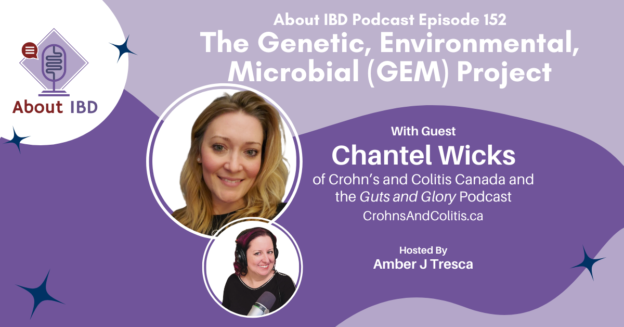
What is being done to help prevent inflammatory bowel disease (IBD) in the next generation? The Genetic, Environmental, Microbial (GEM) Project is a research study from Crohn’s and Colitis Canada (CCC) focused on finding possible causes for Crohn’s disease by following healthy people who are at a higher risk for developing the disease. To talk about GEM, Amber interviews CCC volunteer Chantel Wicks. Chantel is the chapter president for the Durham Region in Ontario and the Chair of their Gutsy Walk, which is a fundraiser and event that takes place every year in the first weekend of June. Learn more about how the GEM Project is uncovering important information on the development of IBD and how to get involved in CCC and The Gutsy Walk.
Find Chantel Wicks on the Guts and Glory Podcast at:
- Web: https://gutsnglory.ca/
- Facebook: @GtsNGlry
- Twitter: @GtsNGlry
- Instagram: @gtsnglry
Find Crohn’s and Colitis Canada at:
- Web: https://crohnsandcolitis.ca/
- The Gutsy Walk: https://gutsywalk.ca/
- Facebook: @getgutsycanada
- Twitter: @getgutsycanada
- Instagram: @getgutsycanada
Find Amber J Tresca at:
- AboutIBD.com: About IBD
- Verywell: Verywell Health
- Facebook: @aboutIBD
- Twitter: @aboutIBD
- Pinterest: @aboutibd
- Instagram: @about_IBD
Find Mac Cooney (mix, sound design, and theme music) at:
- Facebook: @maccooneycomposer
- Instagram: @maccooneycomposer
- Web: Cooney Studio
- Theme music, IBD Dance Party, is from ©Cooney Studio.
These show notes may contain affiliate links. If you choose to purchase after clicking a link, Mal and Tal Enterprises, LLC may receive a commission at no extra cost to you.
Listen and Subscribe to About IBD: Apple Podcasts | Spotify | Overcast | Castbox | All Other Podcast Apps
Transcript
Amber Tresca (00:05):
I am Amber Tresca, and this is About IBD. I’m a medical writer and patient educator who lives with a J-pouch due to ulcerative colitis. It’s my mission to educate people living with Crohn’s disease or ulcerative colitis about their disease and to bring awareness to the patient journey. Welcome to episode 152.
(00:22):
There are many ways that we can participate in the IBD community as patients. There are opportunities for working with patient advocacy groups, either as a volunteer or a participant. I encourage you to do so because being an engaged patient can have a variety of benefits. My guest is Chantel Wicks. Chantel holds a variety of roles at Crohn’s and Colitis Canada. She is the chapter president for the Durham Region in Ontario and the chair of their Gutsy Walk, which is a fundraiser and event that takes place every year in the first weekend of June. Chantel is also the host of the Guts and Glory podcast, which focuses on IBD and where no topic is off limits. She tells me about her disease journey, her involvement in Crohn’s and Colitis Canada, and about the GEM Project. The GEM Project is a research study focused on finding possible causes for Crohn’s disease by following healthy people who are at higher risk for developing the disease. That probably got your attention, so let’s hear from Chantel Wicks.
(01:25):
Chantel, thank you so much for coming on About IBD.
Chantel Wicks (01:28):
Thank you for having me, Amber. I’m very excited to be here.
Amber Tresca (01:31):
Yeah, this is long, long, long overdue, because you run a show of your own, which I’m sure you will tell us about. So let’s start there. Let’s start by having you introduce yourself.
Chantel Wicks (01:43):
So hello everyone. My name is Chantel Wicks. I live in Toronto, Ontario, Canada. I was diagnosed with IBD over 17 years ago now, so it’s been a bit of time, I’m aging myself. And I have been volunteering with Crohn’s and Colitis Canada actually for over 10 years of that.
Amber Tresca (02:02):
Chantel, yeah, so you have had a journey with IBD and you detail some of it on your show. So I know a little bit, but I want to know more. Tell me about how and when you were diagnosed, for starters.
Chantel Wicks (02:16):
Yes. So can I go back into the memory bank? 17 years ago. So I was diagnosed at the age of 20, so I’m 37 now. So I was diagnosed at 20. I was right in the middle of university at the University of Toronto. My diagnosis came, I’m going to use the term, say, fairly quickly, in comparison to some of the people that I’ve met who have really struggled for quite some time into the years, even, before a diagnosis came, I would say that’s not what happened with me.
(02:46):
I would say maybe a month or two, I was pretty sick. I was having trouble eating, diarrhea, nothing was staying down, blood in the stool, things like that. But that progressed very fast and I ended up needing to go to the emergency department at my local hospital. And from there they did, I think it was a flexible sigmoidoscopy they did first. They took some biopsies and it was a pretty quick diagnosis at that point. And I don’t recommend people do what I do, which is waiting an extended period of time before you go to the hospital. Do not wait until you’ve lost significant amounts of weight and you’re crawling out the door. Maybe go get help a little bit sooner.
(03:27):
But I was young and I was in university, and I was afraid. We don’t talk about symptoms in the bathroom, let’s be honest. So I also had the stress of, “My gosh, when am I going to have time to go to the doctor, because I have class,” and I was working three part-time jobs to pay for university and all of these things. So unfortunately, I got pretty sick pretty quickly, but that also led to a very quick diagnosis. And even though a diagnosis is quite a blow to the system and it’s a difficult pill to swallow, I always try to tell people that at least when you have a diagnosis, there’s steps and there’s a way forward. There’s treatment, there’s plans that can be put in place. So for that, I’m grateful, because I started my care plan quickly, in my journey.
Amber Tresca (04:13):
It’s almost a relief, in a weird way, to get a diagnosis.
Chantel Wicks (04:17):
Yes, totally. Yeah, so my initial diagnosis too, I was told I have ulcerative proctitis. So for those of you who don’t know what that is, it’s just the very low end of the large intestine or the colon closest to the rectum. That was the first initial diagnosis that came from the emergency doctor. But then afterwards, after I got to see a gastroenterologist, they said, “You have ulcerative colitis.” But then many years of living with IBD and an extensive spreading of my disease, I shall say, it’s impacting my esophagus and my mouth, even my stomach in some cases, my small intestine, my large intestine, kind of bounces between, what is it that you have? Is this Crohn’s disease or is this UC? I like to hashtag it with #itscomplicated. So I just go with, I have inflammatory bowel disease.
Amber Tresca (05:05):
So in the United States, you’re in Canada, and it might be a little bit different. In the United States, they really like to see you come down on one side or the other, Crohn’s disease or ulcerative colitis. Is that the same there, has that problem for you in terms of what the official diagnosis is?
Chantel Wicks (05:26):
That’s a good question. I do think in the medical community we very much like a black and white.
Amber Tresca (05:31):
Yes, 100%.
Chantel Wicks (05:31):
I think it makes it, yeah, nobody’s sitting on the fence. I think it a lot easier, especially with drug approval here in Canada, and likely in the United States, medications will be approved for one or the other or both, and there’s not really what happens if you’re kind of in the middle. So officially on paper, it says ulcerative colitis for me, but I have noticed in the last couple of years, I will say, when you do the questionnaires and you fill out the information, there’s a lot of, I’m seeing a lot now of Crohn’s disease, ulcerative colitis, indeterminate colitis, or Crohn’s colitis. So that’s telling me that at least there’s a shift, because there’s so many. There’s also perianal disease, and there’s so many different caveats like inflammatory bowel disease. Yes, umbrella term for two main diseases, Crohn’s disease and ulcerative colitis. But realistically, there are so many levels and layers of IBD and of each of those.
(06:28):
So yes, I agree. There’s definitely been a, is it this or is it that? But I do see the community shifting, at least here in Canada, especially in terms of the forward-facing documents and stuff that patients are filling out, and how they identify themselves.
Amber Tresca (06:46):
And hopefully one day we’ll get to a different classification, and I’ve seen various ways of doing it. And I asked a specialist one time, after your post-surgical with ulcerative colitis, but the disease continues, what is that? And the answer was-
Chantel Wicks (07:06):
What are you called?
Amber Tresca (07:07):
Yeah, where do you put yourself in this? And the answer was, “We like to say you have IBD.” And I was like, “That makes a lot of sense, that also does not help me.”
Chantel Wicks (07:18):
No, it’s not helpful. And we have to have surgery before we can just use the IBD term, is that how it works?
Amber Tresca (07:25):
I don’t know, because as you pointed out, there is indeterminate colitis, or I think sometimes there’s a few other terms that they use for it. Here’s hoping that we start to see more of a shift.
Chantel Wicks (07:38):
[inaudible 00:07:39]. Granted, there’s many of us who are very clear, clear Crohn’s and clear UC, but there’s also those of us who are a little bit more difficult, and we like to dabble in both.
Amber Tresca (07:53):
Oh, well, you have worn a lot of hats in your life, and in your IBD. And so, one of the hats that I want to get to is your volunteer work with Crohn’s and Colitis Canada. So tell me how you got started as a volunteer there.
Chantel Wicks (08:11):
Yeah, so gosh, I feel like Crohn’s and Colitis Canada, we’re in a very deep relationship.
Amber Tresca (08:19):
It’s probably been one of the longest ones of your life, right?
Chantel Wicks (08:22):
Yeah. I’ve been with Crohn’s and Colitis Canada longer than I’ve been with my husband, so that tells you something. And yeah, no, I have to share, my husband knows he shares my time with CCC. He knows that. So I would say the first three to four years of, maybe even longer really, gosh, of living with IBD, I very much lived quite ignorantly and in the dark. I didn’t care to learn about what was happening to me. I just listened to my doctor, “Take this, do this, come back here in this many months, put your head down.” Finished my undergrad, then I went to teacher’s college to get my Bachelor of Education, and I was just kind of like, “This is what I need to do.”
(09:07):
So for a long time living ill, I didn’t really do what I now harp on everybody to do, which is become a VIP, which I say stands for a very informed patient. Now I go and tell everybody, “You must be a VIP. You have to be a VIP. Regardless of your disease or ailment or diagnosis, it’s your responsibility as a patient to educate yourself, to learn about what’s happening, to be an informed person, to be included in the decisions about your health.” I was terrible at that when I was first diagnosed.
Amber Tresca (09:39):
You were also very young, so let’s give yourself a break.
Chantel Wicks (09:44):
Yeah, I was 20. I was overwhelmed. What in the world? I was eating poutine for breakfast off of a food truck outside of university, do you know? It was just-
Amber Tresca (09:50):
I do.
Chantel Wicks (09:52):
I was living life. #Poutine is amazing, by the way. Americans, poutine is amazing.
Amber Tresca (09:57):
It is. My son went to Montreal and came back. Literally, that was all he could talk about.
Chantel Wicks (10:04):
It’s a French dish, so that’s the epitome place to get it from, my goodness. So yeah, I don’t actually know who or how I ended up landing on Crohn’s and Colitis Canada, but my biggest memory is my very first kind of interaction with Crohn’s and Colitis Canada was a chapter meeting, it was a support group meeting in the region in which I was living. I showed up and that was really the first time that I met other people who had IBD and I listened to their stories and I shared mine. I was quite unwell at that time, I had recently just been out of hospital, lost a lot of weight, was really struggling. Met a staff person there from Crohn’s and Colitis Canada, along with other patients and caregivers.
(10:46):
And from that meeting, I was hooked. I was like, “These are my people.” I went home not even remembering who people’s names were, but I remembered what their diagnosis was, what their symptoms were, what they shared with me, and I was like, “This is my family.” So I went to all the monthly meetings after that. Not long after, I became the chapter president for our region here, Durham Region, in Ontario, Southern Ontario. And even less time after that, I think I became the chair for the Gutsy Walk. The rest is history, basically. And now it’s been over 10 years, and here I am, still going strong,
Amber Tresca (11:29):
Which is amazing. So just fortuitous for everybody that is in your chapter that you decided to go to that support group one day, and that you felt at home there and decided to stay.
Chantel Wicks (11:42):
Definitely.
Amber Tresca (11:42):
Because now you’ve done so much work. And so really, yes, we’re going to talk about more things with Crohn’s and Colitis Canada. We’re going to start though with the Genetic Environmental Microbial Project, which is the GEM Project, which is-
Chantel Wicks (12:00):
Way easier to just go with GEM.
Amber Tresca (12:02):
Way easier to go with GEM. And this started in 2008. It’s an ongoing study. It’s also hugely groundbreaking. So I want you to tell me a little bit about how it got started and what they were hoping to get from this study.
Chantel Wicks (12:21):
Yeah, so you said it right, Amber, the GEM study is truly groundbreaking, and it’s not even fully wrapped up yet, so I can’t even imagine what we will have out of this. But in terms of how it got started, so Crohn’s and Colitis Canada’s board basically went to the scientific community and asked the question, what do they need to do? What do we need to do? What kind of research do we need to support in order to find a cure or get closer to finding a cure? You let us know. You’re the scientific community. What’s the deal?
(12:56):
Essentially, their answer was, we need to study and we need to follow healthy people. The relatives of people who have, in the initial inception, it was actually Crohn’s disease because the evidence suggests that Crohn’s disease does have a stronger genetic link than it does for UC. So the idea was let’s look at first degree relatives who have Crohn’s disease and let’s follow their, if it’s a parent, follow their children. If it’s a child, follow their siblings. Because when the data was all tweak, tweak, tweaked and put into a spreadsheet and everything else, was spit back out, it had said to get a percentage of people who would likely be diagnosed, we would need to follow 5,000 people for X amount of time.
(13:44):
So that’s what they did. So they were like, well, all right, let’s embark on this extremely long study. So it started in 2008. In the Western world, we like things to happen really fast. We want things to, 10 days, I take these antibiotics and I’m better. And really understanding that research, especially of this magnitude, takes years and years and years. And it was a study for 15 years, I think, before it officially closed. So they followed 5,000 people with Crohn’s disease, their first degree relatives, so siblings or their children. As those people were brought into the study, they had to give samples like blood and stool. They took a gut permeability test, which, if any of you have done that, is not super great.
(14:34):
The research coordinators then followed them, followed up with them every six months to check in to see how they were doing. As well, a part of their initial screening was to do a survey that highlighted a lot of the things from their life, so where did they grow up? How did they grow up? In the types of environment, rural and urban? Did they have pets? All of these questions. So they had all of that preconception data from the very beginning, and they followed up with these ‘healthy’ people for the period of time, every six months.
(15:09):
And what ended up happening actually is that in the time that the study was happening, the GEM study was going on, out of the 5,000 people, 105 people developed Crohn’s disease, and then there was also an additional number of people who had developed ulcerative colitis as well. So though they anticipated that we would likely have some diagnosis of UC, we definitely got that data as well. So now that we’re in the data, looking it through, what did we find? Analyzing. They now have data of Crohn’s disease and ulcerative colitis. So amazing because we have what did the gut look like before, and what does it look like now?
Amber Tresca (15:49):
And I feel like we all owe those 5,000 people a huge debt. That is a lot to ask from people.
Chantel Wicks (16:01):
Absolutely.
Amber Tresca (16:03):
I think anyone who lives with IBD would go a long way towards facilitating research. And also if you are a parent, you definitely don’t want your kids to develop the disease. So knowing how perhaps that could be prevented, that is a question that I ask every specialist that I talk to.
Chantel Wicks (16:21):
That’s right.
Amber Tresca (16:22):
But still, having to follow up every six months is a lot, and then also all of the testing. Absolutely ambitious. I hope those people have gotten hearty thank-yous at the very least. Something better than that at the most. All right, so the study is ongoing. They’ve got data. They’re still combing through it. That if data from 5,000 people, over a number of years, taken every six months, and then maybe even at other inflection points, I would imagine.
Chantel Wicks (16:56):
Yeah. If you actually were one of the people who were diagnosed with IBD while in the study, then you switched from the essentially healthy line of people into the IBD line of people and that came with a number of other things, but yeah.
Amber Tresca (17:08):
Other things. Yeah. And then if you became pregnant, or if you moved, or you got a dog, whatever happened. So it’s a lot of data to comb through, so it’s understandable that we don’t know, I don’t think, too much yet, but there have been some things that they’ve discovered so far. There have been some outcomes. Are there any highlights that you can share with us?
Chantel Wicks (17:33):
Yeah, as you said, there’s still combing through the data. It’s going to be likely five to 10 years before this is officially released, and here it is. The team is working on validating the results of the status. So even though there are some highlights to share, that’s also take with a grain of salt, as this is a big process of analyzing all this data and looking at it. So one of the big things that have come out is that there has definitely been evidence suggesting the change in a person’s gut permeability. So the lay term for that is leaky gut. I’m sure we’ve heard of that before. So essentially, we see a clear change in gut permeability before disease onset, even before symptoms are shown, even before people have symptoms. So that’s a change. So of course, let’s all go out now and make sure we have our gut permeability tested every single day. No, that’s not what I’m saying at all. But yes, absolutely that there has been one of the biggest highlights is we can see the change in the gut permeability before disease onset, even symptom onset.
(18:44):
Another big highlight is very similar to permeability, but is the microbiome changes. Microbiome, buzzword, big word. Lots of commercials these days about yogurts talking about probiotic, and it’s going to help your microbiome. So yes, the population of different types of bacteria that are in our gut also changes and begin to change before and as you are developing symptoms.
(19:13):
So again, if we didn’t study healthy people, if we didn’t have that data beforehand, we wouldn’t know that there’s a change, because often everything out there right now, with the exception of the GEM study, as far as I understand, is we have the data once someone is diagnosed. We don’t have the before. So as I mentioned, they had pre and post questionnaires, where they were asked questions about their diet, where they lived, where they grew up, if they had pets, all those things.
(19:41):
And one of the things I like to point out, and we talked about it on one of our episodes over at Guts and Glory, was that there is a small correlation, a small correlation, that owning a dog, having a dog specifically, helped you with the prevention of developing Crohn’s disease. Now again, take that with a grain of salt. Of course, I heard that and I thought, you know what? Amazing. We have one dog, might as well get 10 more Already have IBD, so probably wouldn’t help me. There’s multi-factors. I’m sure people listening know that IBD is not just one thing, but there was some data, take with a grain of salt, that those who had a dog growing up helped with their prevention of developing Crohn’s disease. So I thought that was very exciting.
(20:28):
But also too, there was evidence that supports the idea of the hygiene hypothesis, which is basically developing your immune system by being exposed to germs as a kid, toughen you up, kicking you out in the mud, you’ll be okay sort of thing. So they did observe that kids who had more exposure developed Crohn’s disease at a much lower rate. But again, we’re at the very beginning stages of analyzing. I say we, not me, gosh, people way smarter than me, with much bigger brains than me, are at the very beginning stages of analyzing the data. So for example, they have just started looking at analyzing the data for ulcerative colitis. Once all those results are validated, the five to 10 year mark, I think there’s going to be, not I think, I know there’s going to be some really groundbreaking discoveries here that I hope will help all of us with IBD across the world.
Amber Tresca (21:21):
Absolutely, it will. And I know there’s going to be people that say, “Well, I had a dog growing up and I still developed IBD.”
Chantel Wicks (21:28):
I did too, girl. Me, I had a dog, I had a cat, hamster, birds. I’ll blame it on the cat.
Amber Tresca (21:33):
Rabbits. Yeah. But it kind of doesn’t work that way, it’s just it’s all percentages and chance, lowering your risk.
Chantel Wicks (21:46):
Yeah. Urban versus rural too. I know, if I remember correctly, some evidence just about being in rural spaces and how that may have been more helpful. It’s really the connection to pollutants. And we see that everywhere, right, Amber? We see that in health everywhere, with cancers and everything. Just your exposure to pollutants and how does that impact your body? And we have the highest rates of IBD in the Western world, and the connection to industrialization, how the disease and the things that have accelerated or have come up in industrialized countries that are not in other places.
Amber Tresca (22:18):
Right, in nailing all of that down, if you think about all of the things that you interact with on a daily basis, trying to figure out which of those are promoting health and which of those are perhaps having a deleterious effect on your health, good luck. If you’ve ever had to try to figure out what is causing an allergic reaction, it’s really, really, really difficult. So yeah, the people with the big brains, please go forth.
Chantel Wicks (22:50):
Yes. Not me.
Amber Tresca (22:51):
Figure this out.
(22:59):
Coming up next, learn about the Gutsy Walk, and about what gets Chantel out of bed.
(23:18):
All right, Chantel, let’s switch focus a little bit, because we have to talk about Gutsy Walk.
Chantel Wicks (23:23):
Absolutely.
Amber Tresca (23:23):
I think you said you’ve been involved with the Gutsy Walk… Or did you say? How many years has it been that you’ve been the chair?
Chantel Wicks (23:30):
Over 10 years.
Amber Tresca (23:31):
Over 10 years. Oh my gosh. So this is not going to be a new question for you. So tell me how people can get involved with the walk and how they can participate.
Chantel Wicks (23:42):
Yes. So the Gutsy Walk is a five kilometer walk that happens here in Canada, and it’s put on by Crohn’s and Colitis Canada. It started in 1996. It is the largest community event for people with Crohn’s disease and ulcerative colitis up here in the north. Since 1996, Crohn’s and Colitis Canada and the Gutsy Walk and all of our amazing volunteers and donors have raised over 52 million since its inception, and that has went towards research and programs, just like studies like the GEM Project. So it happens the first Sunday in June every year. So in Canada, we have one of the highest rates of IBD here. As you guys all know, Canada has a much lower population than you guys do in the US, but we have over 322,000 Canadians living with IBD here in Canada, and that number is expected to grow to over 470,000 by 2035.
(24:36):
So the whole point of the Gutsy Walk is to stop… We walk to stop Crohn’s and colitis. We encourage people to come out into their communities, to fundraise, to get involved. Yes, it’s about raising funds so that we can support research and programs, but it’s also about coming together as a community to highlight our strengths, to help those who need the extra support, to lift each other up essentially. And of all the Gutsy Walks I’ve done, I can tell you some days we are blessed with beautiful weather, and sometimes we are not, but rain or shine, the Gutsy Walk happens and people come out and we put on our ponchos and hold our umbrellas, until the wind blows them away. And we walk our five kilometers and we join hands and we come together as a community. So it’s really been something that has been near and dear to my heart that I’ve been involved with since I’ve been with Crohn’s and Colitis Canada.
(25:33):
For those of you who are interested in either donating to somebody, or joining, if you’re listening and you’re in Canada, if you go to gutsywalk.ca, that’s where all the information is, that’s where you can register. You can find locations, you can make a donation, you can read more about the history of the walk. But I encourage you all to come out. There is a virtual walk, so hey, join virtually if you like, and do your walk in your own community. But yes, I think I will… Not I think. I will be doing the Gutsy Walk until they tell me there’s a cure and I don’t have to do it anymore.
Amber Tresca (26:08):
Oh, that would be such a day. Oh, we can dream about that day.
Chantel Wicks (26:13):
What a day.
Amber Tresca (26:13):
And as you said, community is so important, and I think getting involved, even if you don’t volunteer, but going to a support group, going to an event like a walk, you are going to meet people sometimes for the first time in your life who truly understand what it is like to live with these diseases. Your family and friends love you, but if they don’t live with an IBD, sometimes it can be hard to get that deep of an understanding until you meet community.
(26:44):
So also in the interest of fostering community, and one of the other of the many hats that you wear is you are the host of the Guts and Glory podcast.
Chantel Wicks (26:55):
I am.
Amber Tresca (26:56):
And I know we could talk about this, we kind of have already, talk about podcasting for a very long time, but tell me about your show. Tell me about how you got started with your show.
Chantel Wicks (27:08):
Yes. So I was actually speaking at an event, telling my patient story and my patient journey and really just sharing, even including what are my frustrations and how can we be better at supporting patients? And there was a media company that was doing the production of this event, Bang Albino Communications, shout out Bang Albino Communications. I had also worked a little bit later after that event with Bang Albino Communications to do some patient videos, just sharing the patient journey and the patient story. And the founder and CEO of Bang Albino Communications, his name is Mark Ashdown, approached me and said, “Hey, you should have a podcast about IBD.” I’m going to admit this out loud right now on this show. I was like, “What in the world is a podcast? I’m supposed to do a what now?” And he was like, “It’s like a radio show on the internet,” and I was like, “Oh, I can do this from my bed if I want, in my pajamas, like a radio show. Nobody sees me. Perfect, no problem.”
(28:15):
And then from there, we worked out the fact that I wanted this to be unfiltered, raw, getting information out there to people about IBD. So that, as I mentioned at the beginning of this episode, I lived in the dark for a very long time, and that’s exactly the opposite of what I want people to feel, what I want people to do who have IBD. So from there it started and we interview researchers and scientists and doctors and patients and caregivers and other healthcare professionals, allied healthcare professionals that support us on our journeys with Crohn’s disease and ulcerative colitis and everything in between.
(28:53):
And I’ll selfishly admit, Amber, and maybe you can agree, it’s very cup filling for me to be a part of this community and to give people a platform to share their story and to express themselves, and more importantly, being able to educate the public on things that they might not normally hear about. I’m very grateful for all of my connections in the inflammatory bowel disease world. I get invited to speak at a lot of places, I go to a lot of conferences like yourself, we’re very connected. But not everybody has that privilege. So I take it very seriously that I’m in this role and I’m very grateful to Bang Albino Communications and Mark Ashdown who continue to support the Guts and Glory podcast to make it happen.
(29:37):
We’ve now moved to video as well. Some of our episodes are available on video through our YouTube channel and streaming on all the streaming things, which is amazing and fantastic. A little bit sad for me because now I actually have to brush my hair and wear presentable clothing, but that’s okay. I also know if one day I rolled into studio looking like a hot mess, that I think the best community to accept me in that way is the IBD community.
Amber Tresca (30:05):
Completely cosign everything that you said, except that nobody approached me and asked me to do a podcast. You may be the only person I’ve ever known that was actually approached and asked to do it.
Chantel Wicks (30:19):
And I didn’t even know what it was at the time. I was like, “What?”
Amber Tresca (30:23):
That is so very funny. Well, I know that I am always so excited to see Guts and Glory come through, to see an episode come through on one of the many apps that I use to listen. It’s always a great time and always super informative, especially when you guys are going through things that are happening up there in the great white north that I don’t know anything about, because we’re down here.
Chantel Wicks (30:45):
Absolutely.
Amber Tresca (30:46):
Anyway, so do you have any highlights? What are some high points of your podcasting journey so far?
Chantel Wicks (30:54):
Gosh, I don’t even think I could pick one.
Amber Tresca (30:56):
It’s hard, isn’t it?
Chantel Wicks (30:58):
Just because, yeah, it’s so hard. We’ve had such amazing guests. We’ve had guests, mental health professionals. We’ve had people from Crohn’s and Colitis Canada. We’ve had doctors and researchers. We’ve had children. We’ve had parents of children. We’ve had patients of various situations. We’ve even had people with celiac disease, who have come in to talk about their connections and really trying to just educate the world. To be perfectly honest with you, I think every episode is the highlight for me, every guest I have the privilege and the honor of speaking to and allowing, giving them a platform to share the information that they’re coming to share. The connections that I’ve made with people, even after the episode ends and it airs and it is been many, many years, still connecting with those people to see how they’re doing and checking in with them has really been the most fulfilling thing for me.
(31:50):
I have a full-time job that is not in the IBD world. I was a teacher up until last year, and I’ve just recently changed careers. And it’s not something we don’t record on a regular basis, we don’t have episodes coming out once a week. Not as amazing as About IBD, Amber, yourself, you do an amazing job. But whenever I do have the opportunity to meet with somebody, I don’t want it to be wasted. And I’m grateful for all of our listeners who continue to listen and spread awareness and to share, and all of the messages, for those of you who are listening who have ever sent me a message through our website or on Instagram or Twitter or X, whatever it’s called now, or Facebook, and you’ve shared how important it’s been for you to hear somebody else’s story and the strength that it’s given you, even the people who have said, “This made me cry, but I needed that emotion to come out.”
(32:44):
I tell you, I read every message. I do this, it’s me. It’s me behind, typing back to you. I read every message. I cry along with you. I am grateful for all of our listeners across the globe and grateful for you, Amber, for having me here today and giving me the space to talk about GEM Study and Crohn’s and Colitis Canada and Gutsy Walk and the podcast. And I send all my people to you too, I’m always like, “There’s an About IBD podcast, listen to Amber.” But yes, I’m sure you can attest to, it’s such a feeling that’s undescribable, to be able to be in a position where you can do this for others.
Amber Tresca (33:23):
Yes, absolutely. And I become obsessed with everyone that comes on my show.
Chantel Wicks (33:30):
Yes.
Amber Tresca (33:32):
I really do. I really do. And having that one-on-one connection, sometimes two-on-one, I know sometimes you have more than one guest at a time as well, it is really so very special, and it truly is, sometimes, the thing that keeps me moving. So on the one hand, I like to say, “Well, I want to help people understand IBD.” Same with you, I spent about 10 years in that space that you spent about three or four years in, head in the sand. We don’t want anyone to live like that and so we’re doing our best to try to meet people where they are and give them information. But also, this is really just great for us, so very selfishly.
Chantel Wicks (34:12):
Yes, and I always say, selfishly, I’m like, this fills my cup. I go home, or I end an episode, and I am buzzing.
Amber Tresca (34:21):
Completely.
Chantel Wicks (34:21):
I come home and my husband knows. We’re not watching TV that night, and we’re not talking about his day, we’re only talking about my day, because it is just that big boost.
Amber Tresca (34:33):
Yeah, it certainly is. And sometimes it can last for a long time. So by the way, that also means that I’m obsessed with you right now, just so you know.
Chantel Wicks (34:41):
Likewise, likewise.
Amber Tresca (34:43):
All right, so tell me, I want to ask you about your dog though. Tell me a little bit about your dog.
Chantel Wicks (34:47):
Yeah, so I have a dog. His name is Archie. He’s a Bich-Poo, so he’s a Bichon Frise and a Mini Poodle. He’s adorable. I love him. I love him, Amber. I don’t have children. My husband and I are not parents of humans. We are dog parents. We have our dog, Archie. He’s a COVID dog. I admit it. He just turned two. I had dogs always growing up, had pets growing up, and my husband and I had talked for quite a while about wanting to have a dog. But our lifestyle is traveling with work. My family lives in the East Coast, they live in the province of Newfoundland, and my in-laws live two and a half hour drive north. So a dog and traveling and planes, and it just was not really… We didn’t think it was in our cards.
(35:34):
And then of course, one day I just had a breakdown, and I was just like, “I can’t do this. I’ve never had a life without a dog. We need to get a dog.” So we agreed that we were going to get a hypoallergenic dog, in come the Bichon and the Poodle, and that we were going to get one that was going to be small enough that we can take him on the plane, put him in his little carrier, so that he could be under the seat in front of us. So that when we traveled to Newfoundland, and we travel where we go, we can take him, no hiccups. So Archie has joined our life, and I love him dearly. He’s the best thing for me. Best thing for my husband too, who did not have pets growing up.
(36:09):
But for those who are on listening, and if you have a pet, you know. I cannot wait to be home with him. His happiness is my happiness. And in all honesty, dealing with IBD and a lot of my other health issues that have come in the last 17 years, it is very, very difficult. And they’re so smart, Amber. They’re so smart. He knows when I’m struggling. I don’t need to tell them, he knows. He knows when to snuggle extra tight. And he gets my butt out of bed. If there’s times where maybe I’m in bed because I’m in pain, or I’m exhausted, or maybe I’m in bed because mentally and emotionally I’m having a really, really bad day, and those are okay. But he gets my butt out of that bed and is like, “I got to go pee, so you’re going to have to get up and take me out for a walk.”
(37:04):
And I’m grateful for that. I’ve got my Fitbit on, and I get more steps now than I’ve ever gotten now that I have Archie. And my husband and I have lived in our neighborhood since 2016, we got Archie two years ago, and it wasn’t until two years ago that we actually started meeting all of our neighbors. Because when you go for walks and other people have dogs, you don’t learn the human’s name, but you learn the dog’s name. Like, “Oh, look, that’s Henry’s parents. Oh look, that’s Reggie’s parents.” So yes, I am grateful that my husband agreed. I’m grateful for Archie. He’s a good boy. He’s got a lot of energy at two. I thought this wore out after about a year. Everybody I meet who has a dog says, “You go five or six years in before the energy wears out.”
Amber Tresca (37:49):
You just made the best case maybe I have ever heard for someone getting a dog, so I might not let my children listen to this episode. We have cats. We’ll figure it out one day.
Chantel Wicks (38:03):
Oh, you have pets. That’s a pet.
Amber Tresca (38:04):
We’ll figure it out one day. So we have covered a lot of information in this episode, and I am going to put so many things into the show notes, but if you would do me a favor, Chantel, and just real quick, go over how people can connect with you, connect with Crohn’s and Colitis Canada, and find Guts and Glory the podcast.
Chantel Wicks (38:27):
Absolutely. So to find Crohn’s and Colitis Canada go to their website, it’s crohnsandcolitis.ca. Pretty easy. In terms of the Gutsy Walk, if you’d like to find out more information, you go to gutsywalk.ca. In terms of getting a hold of me, if you want to get a hold of me, the website, our website is probably the best way because it links out to all of our social media and it links to an email that would come directly to me. But our website is gutsn, the letter N, not and, so gutsnglory.ca, so G-U-T-S, the letter N, G-L-O-R-Y.ca. And then on Instagram, Twitter and Facebook, we’re @gtsnglry, which is G-T-S-N-G-L-R-Y, missing a couple vowels because everybody’s using all the usernames.
Amber Tresca (39:23):
All the vowels.
Chantel Wicks (39:23):
All the usernames these days, all the vowels. But as I said, going to gutsnglory.ca and then it’ll link out to all of the things that can get connected to Guts and Glory’s podcast, to me, all of those things, crohnsandcolitis.ca, and gutsywalk.ca.
Amber Tresca (39:39):
Perfect.
Chantel Wicks (39:39):
If all else fails, you shoot me an email and I’ll get you to the right people.
Amber Tresca (39:44):
Perfect. Thank you so much for that. I encourage people to get involved. You’re the chair of the Gutsy Walks, so I know that it is going to be amazing. It is going to continue to be amazing, as it has been ever since you took over. I know. Wink, wink.
Chantel Wicks (40:03):
Thank you. I love the vote of confidence.
Amber Tresca (40:06):
So thank you so much, Chantel. This is a very, very long time coming for me to have you on the show, and the stars finally aligned for us, so thank you for your time.
Chantel Wicks (40:18):
And now we’re mutually obsessed with each other.
Amber Tresca (40:20):
100%.
Chantel Wicks (40:21):
Perfect.
Amber Tresca (40:21):
Well, I will confess to being obsessed with you prior, but now we’re friends also.
Chantel Wicks (40:28):
You know what? That’s an IBD thing. When you see other fellow IBDers, you’re like, you might not know that we’re best friends, but we are.
Amber Tresca (40:34):
But we are. Yeah, it’s a parasocial relationship that I’ve had with you for a long time.
Chantel Wicks (40:40):
That’s it.
Amber Tresca (40:41):
Anyway, so thank you so much for coming on my show and for giving us all of this great information about what’s going on with Crohn’s and Colitis Canada and yourself.
Chantel Wicks (40:49):
Thank you for having me, Amber. And to all of you who listened to About IBD, thank you for listening to this episode, I appreciate all of you, and strength and positive thoughts with your journey.
Amber Tresca (41:04):
Hey, super listener. Thanks to Chantel Wicks for finding the time to talk to me about how she is working with Crohn’s and Colitis Canada and gearing up for the Gutsy Walk. Chantel is a fierce patient activist, and a great collaborator, and it was a pleasure to get to know her better. Be sure to follow Chantel, Crohn’s and Colitis Canada, and the Guts and Glory podcast across social media. As always, links to our written transcript, everyone’s social media handles, and more information on the topics we discussed, is in the show notes, and on my episode 152 page on aboutibd.com. Thanks for listening and remember, until next time, I want you to know more about IBD.
(41:46):
About IBD is a production of Mal and Tal Enterprises.
It is written, produced, and directed by me, Amber Tresca.
Mix and sound design is by Mac Cooney.
Theme music is from Cooney Studio.
(41:58):
You did a (beep) fabulous job. Thank you so very much.
Chantel Wicks (42:06):
Did we stop recording? You’re going to have to bleep that one.