
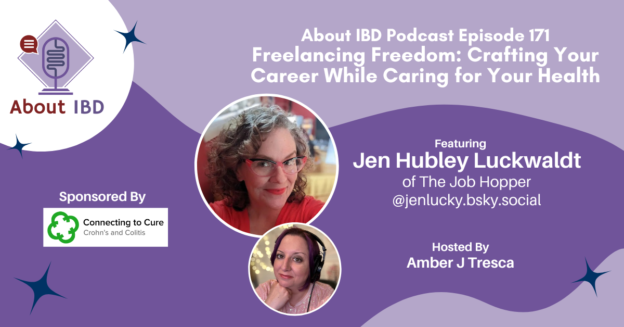
It’s not easy to manage both a career and chronic illness like inflammatory bowel disease (IBD, Crohn’s disease, or ulcerative colitis). We need tools and tips in order to keep everything moving and succeed at work while caring for ourselves. I talk with Jen Hubley Luckwaldt about how freelancing can be a valid way of meeting both goals. Jen shares her journey from traditional employment to freelancing, including how it offers her flexibility in balancing work, health, and family. We talk about the importance of setting boundaries with clients, how to identify your marketable skills, and building a supportive community. Jen emphasizes the value of an abundance mindset in freelancing and offers practical tips for finding work and managing time effectively. If you’ve ever wondered how you can manage to work while still making it to infusions and appointments: we have a roadmap for you.
Find Jen Hubley Luckwaldt and The Job Hopper at:
- The Job Hopper: https://thejobhopper.substack.com
- Bluesky: @jenlucky.bsky.social
- Old Mom Things: https://oldmomthings.substack.com/
- LinkedIn: @jen-hubley-luckwaldt
Find Amber J Tresca at:
- AboutIBD.com: About IBD
- Verywell: Verywell Health
- Facebook: @aboutIBD
- Twitter: @aboutIBD
- Pinterest: @aboutibd
- Instagram: @about_IBD
- YouTube: @AboutIBD
- Threads: @about_IBD
Find Mac Cooney (mix, sound design, and theme music) at:
- Facebook: @maccooneycomposer
- Instagram: @maccooneycomposer
- Web: Cooney Studio
- YouTube: @MacCooneyComposer
- Theme music, IBD Dance Party, is from ©Cooney Studio.
These show notes may contain affiliate links. If you choose to purchase after clicking a link, Mal and Tal Enterprises, LLC may receive a commission at no extra cost to you.
Listen and Subscribe to About IBD: Apple Podcasts | Spotify | Overcast | Castbox | Amazon Music | All Other Podcast Apps
Transcript
Amber Tresca 0:04
I’m Amber Tresca, and this is about IBD. I’m a medical writer and patient educator who lives with a J pouch due to ulcerative colitis. It’s my mission to educate people living with Crohn’s disease or ulcerative colitis about their disease and to bring awareness to the patient journey.
Amber Tresca 0:20
Welcome to Episode 171
Amber Tresca 0:22
Are you struggling to manage your career and your health? Having a full time job while living with an IBD is not easy. I worked in an office for many years before my health and the needs of my family prompted me to take the leap into working freelance.
Amber Tresca 0:37
I’m thrilled to welcome Jen Hubley Luckwaldt. Along with her partner, Alison Doyle, Jen, created The Job Hopper, which is a sub stack community offering job searching tips and career advice. Jen shares her journey from traditional employment to freelancing, with an emphasis on how the shift has allowed her to better balance work health and family. We explore the flexibility a freelance career can offer, why setting boundaries with clients is so important, and how to identify the skills you already have that can help you start your business. Jen also provides valuable insights on building a supportive community and networking, especially for those navigating the challenges of a chronic illness you
Amber Tresca 1:24
Jen, welcome to about IBD.
Jen Hubley Luckwaldt 1:28
Amber, thank you so much for having me on.
Amber Tresca 1:31
I’m so glad to know you for so many, many reasons. But when I started developing episodes around things that are like getting outside the gut a little bit, I don’t know, I still haven’t come up with a name. Maybe we can workshop that a little bit, but about how to live a better life with people with chronic illness. And then immediately you came to mind, because you are perfect for this. So I would love for everyone else, though, to get to know you a little bit better. So would you get started with an introduction and let us know a little bit more about yourself.
Jen Hubley Luckwaldt 2:05
Happy to. My name is Jen Hudley luck Walt. I’m a freelance writer and editor, and have been for over 14 years, and I have a job search and career advice newsletter on sub stack called The Job Hopper, which I run with Allison Doyle. She’s another one of our former about.com folks. She’s my co founder and CO editor.
Amber Tresca 2:28
I do love to see people from the way back days. Do you remember what year you started with about.com
Speaker 1 2:36
- 20 years ago?
Amber Tresca 2:40
Okay, yeah. And then the, I don’t remember what, I don’t remember what they were called inside, but the silos at the time, what silo were you in?
Jen Hubley Luckwaldt 2:48
They were channels, and channels I did parenting, which was funny, because I wouldn’t have a kid for another 13 years, and style and money and, oh my goodness, I think I did everything at least once. Oh, hobbies. But I worked all the time, and I didn’t have time for hobbies. I mean, these are, this is the olden days of the internet. So really, anything went
Amber Tresca 3:14
It’s funny, because I couldn’t really place her. I was thinking about it. I’m like, gosh, I feel like I’ve known her forever, but then I couldn’t really remember exactly, and that explains a lot, because you were all over the network.
Jen Hubley Luckwaldt 3:25
And here’s a careers tip for anyone. The way you describe that to people is you say that you’re a generalist, and it sounds better than I was an expert at nothing, and I did a lot of different stuff. You’re a generalist.
Amber Tresca 3:39
Yes, perfect. Perfect, already dropping the knowledge. I was always in health, so never veered from that. So like, we didn’t, we didn’t work in the same channel at all, but we were under the same umbrella network, and so that’s how we knew of one another. But yeah, going back, I mean, I go back to 2000 so like going back all these years, it’s like the memories of those days are fuzzy for a lot of different reasons, and none of them are drug related.
Jen Hubley Luckwaldt 4:09
So unfortunately, it’s too bad, but it’s true.
Amber Tresca 4:13
It’s too bad, but it’s true. All right, so great segue though into you telling us more about your journey and our focus here today is freelancing and how that is a good opportunity. Well, I think, and you’ll tell me, but that it’s a good way for people with chronic illness or rare disease to still be in the workforce. So can you tell us how you got started as a freelancer? Sure
Jen Hubley Luckwaldt 4:40
You know, if I could have started off as a freelancer, I absolutely would have. I just had to wait for the Internet to catch up to me. Yeah, because I always wanted to work at home, to work for myself, to manage my own time, to have a lot more choice about the projects I worked on.
Jen Hubley Luckwaldt 4:59
Because you know, even if you love your job, if you work for someone else, they get to tell you what the deadlines are, where the company’s going, which is not always where you want it to be going in the long term. So I wanted that independence, and I didn’t really get it till 2011 and the thing that changed was that I got laid off. So I think I was the only person in the layoff meeting who was excited, and I really liked my job. It wasn’t like, Yeah, I’m out of here. I was just like, Okay, I you know, I thinking about it, but I couldn’t bring myself to make that leap, because I liked my job.
Jen Hubley Luckwaldt 5:38
And then when they were like, you don’t have this job anymore. I was like, problem solved. Yeah, yeah. I started freelancing full time in 2011 used my severance to buy me a couple months to transition and make all my mistakes without totally ruining myself financially, which is always nice. Mm, hmm, and I never looked back. It’s been a learning experience, certainly, but it’s definitely the best professional thing I ever did, short of going to work for about because that’s where I met a lot of my friends and colleagues, yeah.
Amber Tresca 6:10
And I think also having that network my journey was that I was doing the work for about.com which is very well health now. And that was, that was kind of a side gig because, you know, high type A personality, I guess I don’t know if we I don’t know if we like use that phrase anymore, but
Jen Hubley Luckwaldt 6:27
I still, I do all the time. Oh, okay, all right, so there’s two of us, at least
Amber Tresca 6:33
I would, I always say in regards to myself, so I don’t apply to anyone else. I don’t want to be insulting…
Jen Hubley Luckwaldt 6:37
But it’s a compliment.
Amber Tresca 6:39
I mean, I don’t know it, because it can also go sometimes with like people thinking that maybe you are uptight or inflexible. I’m not saying I’m not those things, but I shouldn’t say…
Jen Hubley Luckwaldt 6:50
Are we not those things? Maybe I am those things.
Amber Tresca 6:55
But yes, I see what you’re saying. Yeah. So, but for myself, you know, being the type like I was doing about.com in addition to my full time job, I was, you know, working at a regular nine to five, and I didn’t get laid off. I left after I had a baby, because it was too much and not knowing how it would all work out. And but what happened was, is that as people left the job that I was at and went into, went to, like other places, they then would reach out to me, to hire me. So, like, it would be great to start out as a freelancer, but I actually don’t really know what that path would look like, because I was in a space where I had made connections, and then it was those connections that paid dividends. And then, of course, all of the people that I met through about.com which is just a wide swath, you know, not all in health at all, just a wide swath of people, which, of course, is, you know, how I know you and why I immediately tapped you to come on my show.
Jen Hubley Luckwaldt 7:55
I mean, that’s the one of the best things we really did luck out, because it was, you know, such a diverse site in terms of topics. So now you know, if I need a health person, I’ve got, you know, 100 health people I can contact. If I need a parenting expert. I know all those folks. It’s really just been very helpful from a networking perspective. So
Amber Tresca 8:17
interesting how it’s worked out like that. And so what types of of freelance work do you think that people who live with chronic illness, who live with rare disease, what might be flexible, what might be accommodating when you’re when you’re living with a health condition?
Jen Hubley Luckwaldt 8:33
So there are all different kinds of jobs that you can adapt to. Freelance work. Obviously, like you, I come from the writing and editing, journalism side of things, but designers, project managers, anyone who works online from their office currently can certainly do it. But there are also for people who maybe are making a bigger translate transition. You could look at things like being a virtual assistant or doing customer service, those jobs still exist. I would just say it’s always easier if you can transition more directly for what you’re doing right now, especially when you start out, because your freelance career will grow and develop with the market.
Jen Hubley Luckwaldt 9:18
The big thing I wanted to say, as somebody who deals with chronic illness myself, because I collect autoimmune disorders as if they were Pokemon, is that whatever area you focus in, you really want to look for something that is flexible, and that means for me, at least, I have found it’s better if I don’t have a daily deadline every single day. It’s better if I’m working for as on a contract basis for companies that will allow me to work either by the project or do hourly but say like this is due every Friday, or here are deadlines throughout the month, because then I can kind of get ahead. Yes, a. Little bit.
Jen Hubley Luckwaldt 10:01
And you know, sometimes you wake up and you just don’t have the spoons, and it’s not a work day, I would say, as you’re figuring out what you want to do as a freelancer, really keep in mind what your needs are, and be honest with yourself and know that that’s okay. It’s all right to need time off to take care of yourself. Hopefully people know that. But just in case, I think it’s important to keep in mind and
Amber Tresca 10:24
something else, that if you if you’re really good at your freelancing, like you may be approached to do more, yeah.
Jen Hubley Luckwaldt 10:32
And don’t be afraid to push back. It’s really okay. It’s a negotiation. One of the great things about being a freelancer is you do not have a boss. These are clients. You can tell them what your availability is, and that is just fine. Yeah,
Amber Tresca 10:47
I’m going to have to, like, bleep myself, but I always after, after, after. I said to you at the beginning of our conversation that I that I try, not I try to keep the swears off of this podcast, because you and I both are do love the swears, but I always say that my boss is a real bitch, and my boss is me.
Jen Hubley Luckwaldt 11:09
I say something similar, yeah,
Amber Tresca 11:18
Coming up: how to find out what your strengths are.
Amber Tresca 11:28
Okay, so how does somebody figure out, like, what are my strengths? What are my marketable skills that I can take out into the into the workplace as a freelancer.
Jen Hubley Luckwaldt 11:38
The first thing Iwould recommend that people do is talk to their friends and their favorite co workers and ask them, what, what are my strengths? Because, again, I find, and this may be because I’m a type A person, but I find we are all much harder on ourselves than the people who love, like and respect us are, yes, so they’re more likely to say, you know, you’re amazing at sticking to a deadline. You are a creative thinker.
Jen Hubley Luckwaldt 12:08
And you think, Well, I don’t think I’m anything special in this regard, but you’re not looking at it maybe the way that your coworkers and friends would. The other thing I would say is take a look at your current or your former jobs at the Bureau of Labor Statistics, Occupational Outlook Handbook. I know that is a long tail for for this thing, but yeah, take a look at that, because you’ll see the skills that are required for it, even soft skills, like, you know, people skills and conflict resolution, creativity, critical thinking, things that you might take for granted, and if it’s okay with you, I’d love to give the URL for that Absolutely hard to Google. Yeah.
Jen Hubley Luckwaldt 12:54
So it’s www.bls.gov/o.O, H, and include the w, w, w, because this is a government site and it will not work. I was testing it out before the podcast, and I was like, wow. I’m glad I did that. Otherwise I would have sent people to a dead link that would be no help.
Amber Tresca 13:19
Oh, boy, and heaven forbid that it redirect or something.
Jen Hubley Luckwaldt 13:22
I know what if it did. Can you imagine? Could go anywhere much better? Yeah, be a lot more entertaining. But would it be useful?
Amber Tresca 13:34
That’s so interesting, ask people around you again. You know, makes so much sense. I never would have thought of that. Also, I’m a little afraid
Jen Hubley Luckwaldt 13:43
that’s okay too. You don’t have to tell anyone about that. Yeah, yeah. You can just file that away and be like, don’t ask that person for a recommendation.
Amber Tresca 13:50
This is true. But what about that, though? What about asking more formally, for instance, a LinkedIn recommendation? Does that work?
Jen Hubley Luckwaldt 13:54
Yes, the big thing to do. I usually offer people recommendations before I ask for them, or sometimes, like, you know, if you’re really after a job and time is of the essence, and you’re like, Man, I don’t have time to write 15 recommendations and hope that people will be willing to reciprocate. Yeah, it’s totally okay to reach out and say, Hey, do you think that you could speak to this or that quality or experience if you do that, be as specific as possible.
Jen Hubley Luckwaldt 14:30
Look at the job listing and see what are they looking for, and say, like, do you think you can tell this person that I have you know, managed a team of writers or and people usually are pretty honest about whether they’ll feel comfortable or you just won’t hear back, and then there’s your answer. But usually I found that people are actually very, very willing to help.
Amber Tresca 14:52
Yeah, I think that’s true.
Jen Hubley Luckwaldt 14:53
Yeah.
Amber Tresca 14:54
Jen, we have to talk about boundaries here. It’s been a little bit of. A personal struggle for for me, so same, maybe I’m just asking for you to give me advice on this. To I mean to your point about asking someone for a LinkedIn recommendation, I have been asked to give them. For the first time, I had someone ask me for a recommendation, and if and this person could totally be listening, and you know, I adore you and I love you, but I’m going to relate this experience that, could you write me a recommendation?
Amber Tresca 15:30
I wrote the recommendation, and then I was given edits, and it never even occurred to me to approach it in that way, and I was totally fine in in that process, but it just because I am such a binary thinker at times that I was just like not thinking of it that way, but it totally made sense. And obviously that’s somebody that knew what they needed in order to get their LinkedIn profile to where they wanted it to be.
Jen Hubley Luckwaldt 16:00
Okay. That never occurred to me. I’ll be honest with you, really that that you could even ask for edits so like, I wish you could see. Can I tell you I wish that your audience could see my face right now, because my eyes popped open, but now that we’re talking about it, like, sorry, I’m cutting off your question. Sorry, I just got amazed by this. Now. Okay?
Amber Tresca 16:21
Because I thought it was, like, commonplace. I mean, I was like…
Jen Hubley Luckwaldt 16:24
Okay, but that, that just means I haven’t run into it yet. You never know. It’s a good, wide world out there. Um, I think that’s probably okay, as long as was this person, I’m assuming, you know, was kind and respectful in their approach. Yeah, that’s the main thing with all of this, really.
Amber Tresca 16:42
Yeah, and there and there, you know, there’s reciprocity there as well, and all of that. So I say in collaboration. And as a writer, a lot, at least the writing that I do, there is a lot of collaboration. I’m used to getting edits and notes. I have no problem with it anymore. I don’t have, I don’t have a lot of ownership, except for what I write for my blog that’s my own. Don’t ever give me edits. I don’t want to hear it.
Jen Hubley Luckwaldt 17:06
That’s important to say, because that has happened to me. People will pop out of nowhere and be like, I think you should cover this. It’s like, get your own blog.
Amber Tresca 17:14
Absolutely, absolutely. I mean, I love what’s the word I’m looking for, content analysis. Oh, yeah, like, like, you know, I have a whole internet full of content managers and and sometimes I really enjoy getting this the suggestions, because it will be something that I never would have thought of, especially if I can be given an expert to go with it.
Jen Hubley Luckwaldt 17:33
Along with a suggestion and not a reply guy, as long as it’s not somebody being like, let me explain your disease to you. And also the thing that you’ve been doing for 25 years.
Amber Tresca 17:44
But you know what I mean this, this does feed into my question around boundaries, though, because I want to know about setting boundaries in regards to clients and prioritizing your health, but also something that I see in you that I find so admirable is that I have seen people give you notes or edits on something you’ve written and but you are always so good about replying, not only in a constructive and kind way, but also usually come back with something with some humor,
Jen Hubley Luckwaldt 18:27
That’s my defense mechanism. You got me.
Amber Tresca 18:29
It’s, I mean, I recognize it because I try to do the same, except when I get really mad, and I don’t usually do it on my own behalf. I will 100% do it on someone else’s behalf. But I find, I have found that so admirable in you. So how can people think about setting boundaries in this way?
Jen Hubley Luckwaldt 18:50
Well the first thing I would say is I have learned the hard way that if somebody, if it’s a somebody, commenting on something you’ve done, not a client and and you’re really mad. Never respond when you’re really mad, even if you think you’re reining it in. This is where I’m kind of a hippie. I think your intention comes through. I feel like the vibe comes through in what you write, and you’re not in control of it.
Jen Hubley Luckwaldt 19:15
And one of the advantages of working at home for yourself is you control what people see of you. You never have to worry about losing, you know, the cheese falling off your cracker in front of other people. So take advantage of that and walk away until you’re feeling better. But with clients, first of all, obviously, build in that time wherever you can, set the boundaries right up front. Give yourself the time to do it and be honest with yourself about what you can do, not in a perfect world, but in this one.
Jen Hubley Luckwaldt 19:45
Yeah, then I would say also there’s a mindset issue, which is, I try to remind myself that it’s not necessarily a conflict, it’s a collaboration. We have the same goal, which is to, you know, get this piece of content out into. World, or whatever we’re working on, and people have their own stuff going on, so they’re not always thinking of me. For example, I don’t work Wednesdays. Wednesday is my day off in the middle of the week. I find it really helps me not to be flat out for a whole, you know, five day work week and all my regular long term clients know that, but I still get a ton of requests to do stuff on Wednesdays. It’s not because they are trying to push me, and it’s not that they don’t care. It’s that they have their own priorities.
Jen Hubley Luckwaldt 20:34
And so I just sort of gently say, Oh, I’m not available Wednesday hopefully they tell me with time and I can offer them something very soon. Or, you know, sometimes you have to go back and say, here are the things that I’ve got on my prior list for you, what’s the most important? What do you need first? But the mindset, I think, is the most important thing. Like most people, really want to work with you, not against you. Assume the best and worst case scenario. You’ll find out maybe that’s someone that you don’t want to work with forever, and then you replace them eventually with a client who’s more flexible.
Amber Tresca 21:07
Yeah, that’s such great advice. Like, I’m really taking, really taking it in for myself as well, you know, and then also the idea that there’s always another client…
Jen Hubley Luckwaldt 21:17
Let me put it there is, and it’s, it is another thing. Again, I feel like I’m, you know, getting ready to sell people my MLM or something. But it comes from an abundance mindset, the idea that there are other clients, there’s more work, that’s important to remember, because the other thing you’ll run into as a freelancer is sometimes you are like, shoeing clients away to protect your time and your health. And other times it’s like they’ve totally disappeared. Where is everybody? There’s nothing. It’s coming back. Especially if you remain flexible and willing to learn new things and adapt, the work will be there. It’s just an up and a down cycle. That’s the way it goes.
Amber Tresca 21:58
100% agree with that, 100% and sometimes when I was like, Oh, that client is not gonna come back at me again. Like, I’ve actually never had that happen starting a boundary…
Jen Hubley Luckwaldt 22:10
Yeah, no, never from a boundary. Oh, usually from a you know, the marketplace shifted. That’s usually why you lose people. In my experience.
Amber Tresca 22:24
After the break: How to think about and incorporate feedback.
Amber Tresca 22:39
All right. So we talked a little bit about LinkedIn and sort of, you know, engaging people. And you said, Ask friends and co workers, hopefully ones that are kind I mean, you want a certain little, you know, you may want a little salt in there too, just so that you get a dose of reality. And it’s not all completely positive, but what more role might community plan. I’m thinking specifically of like networks or mentors as you start a freelance career,
Jen Hubley Luckwaldt 23:07
I think community is everything. I get most of my gigs through friends and colleagues and especially referrals. I at this point, because I’ve been doing this for a while, I have a lot of friends where, if I can’t take on a job or it’s not quite right for me, I’ll refer to them, they’ll do the same for me. And I think people will be amazed at how quickly that happens. But the big thing is, and we say this a lot on The Job Hopper, kindness really is the best approach to building your freelance career.
Jen Hubley Luckwaldt 23:41
If you come at it from a perspective of, how can I help other people, they will remember that I found that 100% of the time, and I’d say to in terms of social media, you will probably already have networks that you like and you’re active on new ones roll out all the time. Sometimes you have to make a switch, like, I’m not on X slash Twitter anymore for political and other reasons, but it’s okay to like the networks you’re on and to maximize that, you don’t need to jump on every new trend. Usually, what I do is I try it, just so I know how it works, and then I know pretty quickly if it’s for me or not. Like, I love blue sky. I think blue sky is great.
Amber Tresca 24:23
I’m sort of figuring out blue sky. I haven’t quite got there yet. My husband is now, like, very quickly, got to be, like, a blue sky expert.
Jen Hubley Luckwaldt 24:29
Really?
Amber Tresca 24:30
Yeah.
Jen Hubley Luckwaldt 24:30
Yeah, that’s cool, because it’s brand new. So he’s, like, on the ground floor. I love that, seriously.
Amber Tresca 24:36
So he’s developed a network in there for his gaming writing, which, you know, he does as a side hustle, and he’s coming at me with, you can do this and you can do that, and here’s what I did there and that. And I’m like, like, what…
Jen Hubley Luckwaldt 24:50
I bet you 85% of this would be news to me, because I’m just not that person. But you know what? Allison would know it all already. She absolutely would. She’s. So good at social media?
Amber Tresca 25:01
Yes. Alison, who ran, what was it called? Any about.com days job search, job search? Okay, great. I was gonna say careers with job search. Yeah, fantastic. And your partner at The Job Hopper…
Jennifer 25:13
And like, the nicest, kindest person completely, definitely exemplifies this idea of like, you help people in order to get help. Well, not in order to but help people, and they will help you.
Amber Tresca 25:27
Right, which I have also found to be true. And I’m asked fairly often about is that, do you know anybody who and I’ve kind of, I didn’t set out to be like a connector, but it’s kind of worked out that way.
Jen Hubley Luckwaldt 25:40
Let me ask you, too, are you an introvert or an extrovert?
Amber Tresca 25:43
Oh I’m 100% an introvert. My husband would argue,
Jennifer 25:46
Gut so I am an introvert. Yeah? Absolutely loves people. So no one believes same, yeah, no one believes me. Yeah.
Amber Tresca 25:56
No,I I love people. I love a one on one conversation. But if you ask me to walk into a room of a bunch of people that I don’t know, that will give me anxiety for days.
Jennifer 26:08
I’m sweating as we’re talking about this. Yeah, it’s not just a hot flash, although it’s also a hot flash. Could be a hot flash…
Amber Tresca 26:15
Sometimes they come together, but writers are mostly introverts. That’s been my experience. But, uh, podcasters sometimes are introverts, and it’s kind of a weird thing, yeah, to say, okay, but then your job is kind of like talking to me when I was like, Yeah, I love people. I’m not an introvert that doesn’t like people.
Amber Tresca 26:37
And for instance, some of the feedback that I’ve gotten in my life. And, you know, Jen, this is now a therapy session for me.
Jen Hubley Luckwaldt 26:44
I love it. I’m so excited.
Amber Tresca 26:45
Um, so some of the feedback that I’ve gotten in my working career was that I don’t speak up enough, yeah, in meetings and so forth.
Jen Hubley Luckwaldt 26:53
Can I say something about that? Oh, sorry, go ahead.
Amber Tresca 26:55
Yeah, yeah, no. It was just, it was just gonna say that. It was just, it was delivered to me by somebody that I trust, and it was because we had a trusting relationship that I took it to heart, and he and we were able to have that conversation, and then I was able to change my behavior. So when it was delivered in that way, it was okay, and we worked through it.
Jen Hubley Luckwaldt 27:14
The first thing is, you absolutely need friends like that, because if people won’t give you advice when you need it, then you’re not going to continue to grow. But also, I love that you were able to, like get that feedback in the spirit it was given. And then the next thing I want to say is that women get that feedback all the time, and I think it’s partly because we don’t speak up as much, because we don’t like to interrupt unless we’re adding on. Yes, we don’t want to interrupt because we have a thing to say and we think it’s more important. We’re just not socialized to be that way. But the other thing is, I wonder if sometimes people think we’re not speaking up because they’re not listening to us. I think all of that is at play.
Amber Tresca 28:00
I was younger then, so like I wasn’t, I wasn’t cognizant of all of these aspects of that feedback and thinking back on it now, because it is a person that I respect and trust and who respected and trusted me and who said nice things about me when I wasn’t in the room.
Jen Hubley Luckwaldt 28:19
Yes, and I love that, so we stan a supportive King, yeah.
Amber Tresca 28:26
But also, there have been other times when I have been accused of taking over a meeting, so I do wonder about people’s perception of it versus what it actually is because of my gender or other. And now that I’m a podcast host, I absolutely talk more in every single space in in my life.
Jen Hubley Luckwaldt 28:53
I love that journey for you, and I want to see it continue. I think it’s great.
Amber Tresca 28:57
Yeah. I mean, if you would have told me that, like, you know, I would go and, like, give talks at medical meetings and stuff, no. Like, no. The answer to that would be no, you know, but that’s, that’s part of my work life now.
Jennifer 29:08
Isn’t that crazy? Do you ever kind of want to get in a time machine and go back and tell like yourself 20 years ago, like, Hey, this is what you’re going to do for a living?
Amber Tresca 29:17
It is really wild, because it’s like, I didn’t set out to be a writer. I was told again, here’s feedback that I didn’t listen to Jen. I was told in my college career that I should probably get out of science and get into English. And I was like, yeah, no, I want to do the science and and then it turned out that, you know, I’m a medical writer, so this, you know, my background in science…
Speaker 1 29:42
I just, I wonder what possibly could have been going on with that advice. What are the factors? What could the factors possibly be?
Amber Tresca 29:52
Yeah, exactly, exactly, yeah, you know. And I think in freelancing in general, and you kind of talked about this a little bit, but I. Wonder if you could get a little more specific for me, because I think my own mindset, I kind of come from that scarcity mindset in almost everything, and I have to remind myself not to do that. And but you talked a little bit about that abundance mindset, and I think that you have it like, do, do you have any thoughts about how somebody can sort of make that shift?
Jennifer 30:24
I had to work really hard at it, because I definitely, like, by nature, sort of assume disaster like that is, I’m like, my mother claims that this is genetic and that it’s from the Irish side of our family. Like, Oh, cheers. It’s terrible, and it’s only getting worse. Disagree, yeah, you know, with a big smile on their face as they say that, but yeah, yes, I do think that there is enough. There is enough in every area of our lives, but specifically in freelance. There is a ton of work out there, even independent of what the economy in general is doing, like I got started as a freelancer, really, during their session, or at the tail end, when things were about as bad as they were going to be, yeah, and there was plenty of work, in part because people companies were being very careful to, you know, determine whether they needed to hire someone full time or whether this was a project that they could outsource to someone like me. The other thing is, I will tell you that keeping that mindset, that there is enough work and that there will always be more work, will help you avoid getting trapped in low paying gigs or situations where people just aren’t very nice. Like, I have a policy I only work with nice people. Yeah, if I find out that someone and that doesn’t mean, like, you know, I want the criticism. Obviously. I want constructive criticism. I want to do the best I can do. Sometimes projects don’t work, and we need to do them over. And I’m I’m used to that. I’m happy to do it. It just means I don’t work with people who are bullies in any way. I don’t work with people who don’t respect my time or other people’s time. And yeah, I would just say it’s something that you have to practice. So another thing is, don’t feel bad if it’s not you know, second nature to you to assume that things are okay, but there’s a lot of work out there. And people need listeners. People need your unique voice. They need your skills. I would say, especially if you are chronically ill, you have a skill set that other people don’t have, in terms of patience and ingenuity that are really valuable to employers. You know how to get stuff done with no resources when it seems like it’s impossible just by virtue of dealing with day to day life, and that’s a soft skill that, honestly, no one teaches and can’t be learned other than through experience. 100%
Amber Tresca 32:56
Wow, that was a great sound bite.
Jen Hubley Luckwaldt 33:00
Thank you for that. Anything I can do, I’m here to
Amber Tresca 33:05
help. All right, so let’s track a little more specific. You gave one resource already. Is there anything else that you like, some tools or platforms that you recommend for people as they’re starting out?
Jennifer 33:15
Yes, all kinds of stuff. So if you’re tracking your time, I like toggle. I love Trello. I love Google Calendar and Google Docs. There’s also an app called tomato timer that actually is owned by the company top till now, but you can just search for tomato timer, and it uses the Pomodoro method, which, if you’re familiar with it, you can set it up so that you work for, you know, I haven’t used it for a while, because now I’m on different types of projects, but I think it’s like, you’re you work for 20 minutes, and then you have five minutes off, and then every three pomodoros, which is the cycle, you get, like, 10 minutes. Oh, and I find it really useful for times when my motivation is low and I’m just feeling very distractible. I have a lot of friends with ADHD who say it’s like the way that they get things done. But the big thing, I would say, is, especially when you’re just starting out, there are so many free tools for everything that you want to do. Do not pay for anything it is perhaps other people don’t suffer from this problem, but this is a problem that I have. I tend to think, like a good little capitalist, that if I throw money at this problem, I can, I can get rid of it. This absolutely, you know this, this app will solve all my productivity woes, and like, there’s a free version that will help you do that. So don’t waste your money.
Amber Tresca 34:39
Agree with that 100% although I use Trello to produce this podcast,
Speaker 1 34:47
and I do pay for it. Well, yeah, I mean, you will find free. I mean,
Amber Tresca 34:51
it’s fine to use the free, but I needed more so, and you
Jennifer 34:54
totally can upgrade once you get to the point where by the time you need the paid version of things. Like Trello, you are fingers crossed for you earning enough money that that’s okay. It’s fine to invest in things, just don’t let anybody fool you into thinking you have to spend money you don’t have yet. That’s the main thing.
Amber Tresca 35:11
Agree, Agree and use that, that free trial. I’ve done that, although if they ask for a credit card before a free trial, I that’s out. I’m not doing that. I’ve done that
Jennifer 35:21
a couple times, and I have, first of all, yeah, your advice is the best advice. Just don’t. But if you do, put a note in your calendar to cancel it, although even then, sometimes they make it like next door to impossible to cancel. So, you know, be sparing with your paid trials. They
Amber Tresca 35:39
do, yeah, and be prepared that you might need to, I don’t know better be a really good tool, yeah, that you really, really want to kick the tires on. But, yeah, I do have a few paid things. I don’t know. Maybe I don’t want to go through what I use, but maybe I’ll put them in the show notes, and I’ll put links to everything that you have
Jennifer 35:54
already talked about in the show notes. I want to hear what you use. I want to know if there’s something I’m missing.
Amber Tresca 36:00
Yeah, I mean, can’t think of anything that would probably be a revelation to you, although I do use Evernote yes for my writing, so yeah, and have 1000s and 1000s of notes. And then, of course, it also becomes something useful that you use, just for, like, tracking, like I have a kid that’s applying to college, so just like everything involved with that I can, I can keep track of
Jennifer 36:24
that way, if there was ever an application for Evernote, that’s the one, yes,
Amber Tresca 36:29
yeah. Like, totally, totally. And so that’s that was a great addition. And again, most of the things that I use, truthfully, they were usually given to me by somebody else who is already a friend, a fellow freelancer, whoever that was already using it and having success. And that’s, that’s how I felt, well.
Jennifer 36:47
And the other thing too, like, going back to Trello, like, mostly when I use that, it’s a client, they’ve already paid for the paid version, so I don’t have to, that’s the other thing. Like, don’t, don’t volunteer to buy stuff that the people who are paying you should buy no totally, hopefully it won’t come up. But a good thing to keep in mind, good reminders
Amber Tresca 37:05
there
Amber Tresca 37:12
up next, how The Job Hopper can help you. You Oh,
Amber Tresca 37:28
Jen, we’ve known each other for forever. This is the first time we’re, like, really collaborating, no on this, on this level. Like I said, I there’s so many things that I admire about you, and I do love to be following your social media, because I enjoy your family dynamics so much. And I just want to ask you about your daughter. She just seems like, just, like, she just seems like magic, and I love it. Can you tell us a little bit more about about Katie? Yes, okay,
Jennifer 38:09
first of all, you’re gonna be sorry you asked. I love to talk about Katie, and I could do it all day long. Katie is my daughter, and she is six, and I had her when I was almost 42 so, you know, I’d had this whole life before. And then I was like, Wow. I remember being pregnant and thinking, I sure hope this works out, because it was going to be this big change. And then Katie arrived, and she is the most awesome, delightfully weird person on the face of the earth, and very wise in that way that extremely smart kids can be wise. The other day, I was trying to figure out, like I was we had a huge snowstorm, and I was doing work stuff and house stuff, and then it occurred to me, I hadn’t heard anything from Katie for a while, and I’m like, that never means good things. So I went looking for her, and she had made herself a fort in her bedroom, and she was just quietly reading, and I was like, Oh my God, we’ve achieved the next level. I just kind of backed out of the room like Homer Simpson my way into a hedge like peace and quiet. It’s here at last. Here we go. But she’s been great, and freelancing has also allowed me to be there for her in ways that, again, like the culture could change, to allow people to have a full time job and a life and a family and take care of themselves, but that’s not within any of our individual control. Freelancing kind of lets you do all of that without waiting for society to get a clue, because it might be a while. I have a feeling it might be a minute while.
Amber Tresca 39:46
It might be a while. Going freelance when my son was a baby has allowed me to be there for all of the things that that they need me there for. Yeah. Yeah, and with my whole body and soul, yeah, but to bring my whole self and not be worried that, oh my gosh, I have to get right back to my desk for whatever reason. Now, there are times when I miss things because if there’s a conference or I have a speaking opportunity, like I was gone one time on my daughter’s birthday, but also I had a room full of people saying, happy birthday, and that was, yeah, she may have found it a little
Jennifer 40:29
amber, you know, I think that’s really important too, because we want to be there for our kids and like, they’re they’re the boat, they’re the center of our hearts. But also one of the things that we can give them is a demonstration of how their mother and other women deserve to work on things that they love, that it’s okay to have passions outside of your home. And another thing that I really love about freelancing is it makes me possible to do that part time, whereas, if I had to find a part time job, it might be harder to find something that I loved as much as the work that I do. There
Amber Tresca 41:08
was some great advice in Michelle Obama’s book. I think it was becoming, I think that’s the title. I have to look it up in LinkedIn show notes. And she said she worked part time for a while when her kids were little, and she said, you might as well just work full time. Oh yeah, yeah.
Jennifer 41:26
Well, because you just get paid part time, and then work full time it takes,
Amber Tresca 41:29
Yes, it just takes over your life. Anyway. All right, we have gone through a lot of resources. I will link everything in the show notes. But Jen, let’s go through where folks can find you and find The Job Hopper and find Alison and so that they could take advantage of the great information that you’re putting out.
Jen Hubley Luckwaldt 41:45
So the best place to find us is at our sub stack. That is The Job Hopper. Dot sub stack.com, and that is not a government site, so you can just type that in and you will find it. You can subscribe for free. Our job search content, all of our our main advice content, is free, and it will be free forever. We have some bonus content, like an advice column that is for paid subscribers, but if you submit a question to that and we answer it, obviously we send you that answer for free. We’re not going to shake you down for five…
Amber Tresca 42:24
Oh, that’s so funny.
Jen Hubley Luckwaldt 42:27
But we would love to see you. And our chat is open and free, and you can email us through the site. And we really did create this site primarily to give back, because we both received so much help over the years and as the Internet has changed, not necessarily in positive ways, it’s become a lot harder to access advice for free that will really help. So we’re hoping to do a little bit to change that.
Amber Tresca 42:55
I love it. I can’t recommend it enough. People need to go right now and subscribe to The Job Hopper, because not only great information, but as you’ve just heard, Jen is one of the most generous and hilarious people that I have ever known. So I just can’t, I just can’t recommend it enough. And then thank you so much. When I reached out to you, you were an emphatic yes, and I was just overjoyed.
Jen Hubley Luckwaldt 43:23
I was so excited, and I’m so excited to be here, um, I actually whooped in my office. I was like, Yeah, go on that podcast. What are you doing this afternoon?
Amber Tresca 43:39
Oh my gosh. Well, you should do more podcasts. We should. We’ll talk offline. But thank you so much for being here. And I really appreciate all you know, all of the ways that you’ve helped me over the years that you don’t even know when I’m reading something that you’ve written and I’m laughing to myself, and then in all of the ways that you you are helping the freelance community, I really appreciate it. And
Jen Hubley Luckwaldt 43:58
Thank you for everything that you do. I’ve been listening to your podcast, and I’m really enjoying it, and like I have different chronic disease, but so much of what you say is applicable to anyone who is, you know, struggling in that particular way. So thank you.
Amber Tresca 44:14
Oh, that’s so nice.
Amber Tresca 44:19
Hey, super listener. Thanks to Jen Hubley Luckwaldt for sharing all the tips and tricks about how people with chronic illness can think about pivoting to freelancing. For Jen and for me, it has been the solution to keep doing the work that we love while also being able to take care of ourselves. I wholeheartedly recommend The Job Hopper, which you can find on sub stack, and Jen’s personal sub stack, which is called old mom things, you won’t find a more helpful, honest yet optimistic voice as you navigate a career with chronic illness, you can visit The Job hopper.substack.com, for tools, resources and information.
Amber Tresca 45:00
Also thanks to connecting to cure for sponsoring this episode. Connecting to cure is a nonprofit whose mission is to accelerate research, amplify awareness of Crohn’s disease and ulcerative colitis and connect and support the inflammatory bowel disease community. You can find them connectingtocure.org and I am so grateful for their support.
Amber Tresca 45:22
As always. Links to a written transcript everyone’s social media handles, and more information on the topics we discussed is in the show notes and on my episode. 171 page on about ibd.com
Amber Tresca 45:36
Thanks for listening, and remember until next time, I want you to know more about IBD.
About IBD is a production of Mal and Tal Enterprises.
It is written, produced, and directed by me, Amber Tresca.
Mix and sound design is by Mac Cooney.
Theme music is from Cooney Studio.
Amber Tresca 45:58
You uh, well, I would hope you listen to my show if you’re going to be on it.
Jen Hubley Luckwaldt 46:06
Well, yeah.
Amber Tresca 46:07
Sometimes people don’t, and then I’m like, come on.