
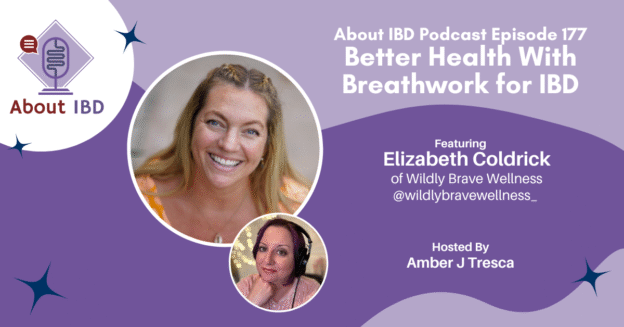
Elizabeth Coldrick, a nutritional therapist and breathwork facilitator living with IBD and a permanent ostomy shares her experiences living in Bali, the challenges and benefits of managing IBD abroad, and the importance of nutrition and breathwork for mental and physical health. She explains how breathwork can reduce stress and inflammation, offers a simple breathing exercise, and discusses her new nutrition e-book for people with ostomies. The episode highlights self-care, community, and practical strategies for living well with IBD.
Listen and Subscribe to About IBD: Apple Podcasts | Spotify | Overcast | Castbox | Amazon Music | All Other Podcast Apps
Episode highlights
- The connection between breathwork and mental health, particularly for individuals with inflammatory bowel disease (IBD).
- The significance of breathwork in managing stress and promoting overall well-being.
- Personal experiences of living with IBD and an ostomy, including challenges faced while living abroad.
- The impact of lifestyle changes, such as diet and exercise, on health while living in a different country.
- The physiological effects of breathwork, including its ability to lower cortisol levels and reduce inflammation.
- Different types of breathwork practices and their emotional and physical effects.
- The importance of finding qualified breathwork practitioners and creating a safe environment for participants.
- The role of nutrition in managing IBD and the development of resources tailored for individuals with ostomies.
- The benefits of community support for individuals living with chronic health conditions.
- A simple breathing exercise to encourage listeners to incorporate breathwork into their daily routines.
Find Elizabeth Coldrick and Wildly Brave Wellness at:
- Web: https://wildlybravewellness.com/
- Instagram: @wildlybravewellness_
- Free Happy Gut Guide: https://go.wildlybravewellness.com/happy-gut-guide
- Stoma Recipe eBook: https://wildlybravewellness.com/delicious-stoma-ibd-recipe-nutrition-ebook
- Sound Healing Videos: https://www.youtube.com/watch?v=62yWpuNrSgI
Find Amber J Tresca at:
- AboutIBD.com: About IBD
- Verywell: Verywell Health
- Facebook: @aboutIBD
- Twitter: @aboutIBD
- Pinterest: @aboutibd
- Instagram: @about_IBD
- YouTube: @AboutIBD
- Threads: @about_IBD
Find Mac Cooney (mix, sound design, and theme music) at:
- Facebook: @maccooneycomposer
- Instagram: @maccooneycomposer
- Web: Cooney Studio
- YouTube: @MacCooneyComposer
- Theme music, IBD Dance Party, is from ©Cooney Studio.
These show notes may contain affiliate links. If you choose to purchase after clicking a link, Mal and Tal Enterprises, LLC may receive a commission at no extra cost to you.
Transcription
[Music: IBD Dance Party]
Amber Tresca 00:00:05 I’m Amber Tresca and this is about IBD, the podcast that knows mental health and IBD are related. I’m a medical writer and patient educator who lives with a J pouch due to ulcerative colitis.
Welcome to episode 177.
How much attention do you pay to your breathing? Probably not very much. We kind of take it for granted, which makes sense, but our breath can be a powerful tool when we’re stressed or upset. We might stop for a moment to breathe and recenter ourselves. Breathwork is the practice of using breathing techniques to reduce stress. It’s been in use for thousands of years to promote a healthy mind and body. Even short breathing practices like box breathing or alternate nostril breathing can help with stress reduction.
My guest is Elizabeth Coldrick of Wildly Brave Wellness. Elizabeth lives with IBD and a permanent ostomy. She moved from the UK to Bali in order to heal from everything she’d been through with her health. While in Bali, She discovered breathwork and studied to become a breathwork facilitator. Elizabeth tells us how she managed her ostomy and her IBD while living abroad, how she came to be involved in breathwork and her interest in nutrition for people with an ostomy. Plus, she takes me through a simple box breathing exercise that you can do right along with us. Elizabeth Wooldridge is a certified nutritional therapist, breathwork facilitator and founder of Wildly Brave Wellness. Diagnosed with IBD in 2009, she underwent multiple surgeries and now lives with a permanent stoma. Her focus includes anti-inflammatory nutrition, hormone balance, and nervous system regulation.
Elizabeth, welcome to about IBD.
Elizabeth Coldrick 00:01:48 Thank you very much for having me, Amber. It’s lovely to be here.
Amber Tresca 00:01:52 Oh, it’s my pleasure. And I am excited to hear so many things from you today because our topic is breathwork. But we have to start with your recent relocation relocations. Plural? Because when we first connected, you were living in Bali. But you are now back in the UK, in Dorset. can you talk about living in Bali with IBD and how you dealt with your ostomy there?
Elizabeth Coldrick 00:02:23 Yeah, absolutely. Because I think it’s really great to hear and see other people living with IBD and stomas in another country, because I think not a lot of us do it because it’s obviously scary.
Elizabeth Coldrick 00:02:35 You know, living with a health condition. But yes, I turned 40 last May and I’m well, I went to Bali last February with the idea of going for my 40th, just going for a few months. I wanted to have a bit of a reset because I literally hit burnout. Obviously, after years of living with IBD and all the surgeries and running businesses. And I did the whole eat, pray, love thing. You know, I went over there to heal and to calm. And. Yeah, whilst I was over there. I mean, like, well, if I start quickly before I moved over there. I obviously did a lot of research. Because even though Bali, it sounds like a third world country, it’s not anymore. You know, it’s very commercialized and there’s hospitals, beautiful big hospitals. But I just wanted to make sure that there were stoma surgeons. There were definitely IBD specialists. Just in case something went wrong. So I did a lot of research before, obviously spoke to my stoma supplies.
Elizabeth Coldrick 00:03:35 My GP’s got all the right supplies, enough medication. I spoke to the airlines so there’s a lot of prep work. If somebody is listening to this and they want to move to a different country, I would always say, do your prep work and make sure that you’re completely organized and prepared to have everything for as long as possible. But yeah, I moved over there and honestly, I was I’ve been there 15 months and it was the best thing I ever did. I completely, I don’t know, found myself again without sounding cringe or cliche. No, no.
Amber Tresca 00:04:07 No, I get.
Elizabeth Coldrick 00:04:08 It. That’s it. Came back to myself. I dropped a load of steroid weight. My aches and pains went. I fell in love with Reformer Pilates. I started surfing again. Of course. The food is delicious over there. It’s all very fresh food and lots of beautiful, like sushi and salads and rice dishes. And yeah, I just honestly had a fantastic time up until February. Which classic, isn’t it? Literally a year later, after being there and I’d had Bali Belly a few times, which is horrendous, but it’s only 24 hours.
Elizabeth Coldrick 00:04:45 But basically my Bali belly turned into gastroenteritis. That turned into a parasite. My hernia got worse. Everything just went wrong with my gut and unfortunately it resulted on April 1st, me rushing myself into hospital with a bowel twist and I had major surgery and hernia repair. So that is actually the reason I’ve come home. I was planning on coming back to the UK, but but kind of like later in the year. but the universe obviously had different plans and it wanted me to come home sooner. But before that situation, living in Bali was fine. Like the swimming, the sweating, my stoma bag, like the heat I drank, of course, loads of electrolytes, loads of coconut water for hydration. And yeah, it was amazing. It was great. So now I’m back in the UK and I’m actually happy about it.
Amber Tresca 00:05:42 Yeah, good. It sounds like it was. It became the right time. You weren’t. You may have been. Yeah I don’t want to say forced. You know, it was the type of thing where you kind of had to make that decision, but you sound like you are totally okay with it.
Elizabeth Coldrick 00:05:58 Yeah, like my friend said, it was like I was divinely guided, you know, like light universe stuff, because it was like I put it out to the universe that, oh, I think I want to move back to England, maybe move to Portugal or Spain, I’m not sure. And then it was like, bam! Yeah, you are. You’re moving back to the you. So I’m fine, I think. Yeah, I’m all good. I think if I hadn’t had my surgery I yeah wouldn’t have moved. Well definitely wouldn’t have moved back because that’s the thing I, you know, couldn’t do any surfing or Pilates or anything. So. But yeah I’m just going with it.
Amber Tresca 00:06:35 Elizabeth can you describe you said you had belly belly a couple of times. What what does that mean.
Elizabeth Coldrick 00:06:41 Oh my gosh. Of course I didn’t even think to explain it. So barley belly is basically DMV. So diarrhea and vomiting. so yeah that’s what barley belly is. So, so it’s very, very common.
Elizabeth Coldrick 00:06:55 And, you know, it’s very common in India as well for like Westerners to to get it.
Amber Tresca 00:06:59 Yeah.
Elizabeth Coldrick 00:06:59 It does only last 24 hours, but it’s horrendous 24 hours. But the weird thing is, is most of us that live with IBD or, you know, have had awful flares, kind of it sounds awful, but are used to it. but when you have it, when you have a stoma or an ostomy, it is so much more exhausting because of course, hydration is our biggest thing. And when you get barley belly, your stoma bag literally just fills up with water. I was literally having to empty it every half an hour. So of course you can’t sleep because you don’t want to lie on it and then it explode. So I was losing so much water. And you know what it’s like when you feel sick. You try and drink, but you don’t feel like it. So I was having. I mean, I drink electrolytes all day, every day. I have one sachet and two liters of water.
Elizabeth Coldrick 00:07:49 But yeah. So the that was horrendous. But then the throwing up again when you’ve lost Homer because you have to hold your stoma so you don’t get your hernia or whatever, worse. And then you’re trying to throw up and oh, it was horrendous. But it is 24 hours. And then and then it goes. But the biggest piece of advice I hope that everyone will take if they are going away is and I’d never heard of it before, which I don’t know why. Charcoal. So when you’re either yeah, take charcoal tablets or you can obviously buy them wherever you go. So I bought a packet of just charcoal powder and oh my gosh, I can’t tell you how incredible that stuff is. Like when you have a Bali belly or a tummy upset or even a hangover if people drink. So yeah, that’s my biggest piece of advice and electrolytes. But yeah, that’s what Bali Belly is.
Amber Tresca 00:08:43 Yes. And so in terms of your ostomy. So the products that you were using Thing where everything was okay.
Amber Tresca 00:08:54 You weren’t having to change every day, and you weren’t having to go to any special lengths, ordering all kinds of things. It just. It worked out.
Elizabeth Coldrick 00:09:03 Yeah, absolutely. So yeah, like I said, I completely organized and planned it all so that I had way more because I knew I was going to go home probably six, maybe eight months later. It was just going home for a month, which is what I did last October. I came home for a month. So I just I counted out everything and I think I actually did count out if I had to change my stoma bag every day because like most of us, I change mine every other day. But of course, in a hot, humid climate, you know, the stickiness and being in the water and everything, I just thought, oh, maybe I’ll have to change every day. But no, unless I was out surfing or, you know, in a swimming pool for a long period of time. I changed my bag every other day, took everything over.
Elizabeth Coldrick 00:09:50 I didn’t run out of anything. I actually brought a load back. and then medication wise, I’m not on any medication for my IBD, but I take thyroxine for my thyroid. and I have naproxen as well, just in case my back goes. So I took all of that. And of course in Bali they’ve got pharmacies and doctors and everything. But stoma wise I would always say yeah, because I have salt’s healthcare bags, the little black ones with Hollister gel things and they are just the best like I’ve tried others in the past and these just work. So yeah, if you’re using a bag that you really love, take lots with you. Just like on a holiday.
Amber Tresca 00:10:30 Yeah, which sometimes people get caught though I’ve seen it happen where people are looking for supplies and they’re in an unfamiliar place. So. Yeah, yeah. Which is nobody wants to be in that situation. And I haven’t looked it up at all. But, like, I have a rough idea of how many people live with a stoma in the UK and in the United States? What about Bali? What is it like there?
Elizabeth Coldrick 00:10:55 Do you know? That’s a really good question.
Elizabeth Coldrick 00:10:57 And I did look it up over a year ago. But I don’t have the years. But it’s it’s not a lot, of course, because Bali is really small. It’s literally five hours north and south and it’s a really small island. But I did speak to my surgeon and I spoke to the nurses about it, and they said, oh no, we we have quite a few people living in Bali with stoma, and obviously the surgeons are there. So when I originally went to see a surgeon last year about hernia surgery, I kind of said to him I was like, so do you do paracetamol hernias? Like a lot. And he said, yeah, yeah, I did four last week and I was like, whoa, whoa, okay. So I think, yeah, it’s kind of like everywhere. It’s becoming a lot more common fortunately. Unfortunately. But yeah, numbers wise I’m not sure. But I didn’t see anybody there while I was there with her. And I was the first one in the breathwork class ever, which we’ll talk about that’s had a stoma.
Elizabeth Coldrick 00:11:52 And yeah, everywhere I went I was the only one with a stoma.
Amber Tresca 00:11:56 Yeah, that’s kind of what I would. I mean, it’s kind of the same in, you know, the United States and the UK. I’ve never met anybody like me sort of in the wild, you know, that’s just, you know, only through patient groups and through my work. So yeah, not so uncommon in Bali, though, that you were going to be at risk, I guess is, you know, the way to put it.
Elizabeth Coldrick 00:12:20 So that’s it. Because I think I was talking to a friend the other day about, you know, like she was like, oh, where are you going to go next? And do you want to live somewhere else? And that’s the that is the sad thing and the reality, like I would say, oh, I’d love to live in the Philippines maybe, but I wouldn’t, I just wouldn’t like, I wouldn’t have moved to Bali unless I knew they had proper hospitals, proper stoma surgeons, you know.
Elizabeth Coldrick 00:12:42 Yeah, it’d be lovely to go and live in a on a remote island where it’s really small. But even in Bali, like I wanted to live further up the coast, but I didn’t because even where I was living, I was still just over an hour away from the hospital. So if I’d moved further, yeah, it’s just not worth it. So yeah, that’s all good.
Amber Tresca 00:13:01 Yeah, yeah. You went about it in a very smart and organised way. So yeah. That’s so you’re a good example to other people. Not only that they can do that. But then also how.
Elizabeth Coldrick 00:13:12 So you put together a survival kit like a guide of what to do and a checklist. Do a little freebie.
Amber Tresca 00:13:19 I was going to ask you, yeah. If you had done something like that, because I think it would be, you know, even for somebody who wants to be there for a month just to take a nice long break. I, you know, there’s definitely things that you need to plan for.
[MUSIC: About IBD Transition]
Amber Tresca 00:13:38 Up next, Elizabeth tells us how to get started with breathwork.
Amber Tresca All right, Elizabeth, let’s get started on the breathwork and how you got into it. Can you tell me how what? You know. Where did your interest in breathwork come from, and how did you get started?
Elizabeth Coldrick 00:14:03 Yeah, absolutely. So breathwork is still quite new to me. it’s of course been around for thousands and thousands of years. but it’s become a lot more popular over the last kind of decade, I suppose. A couple of decades. I was very naive. I got into it last year, so probably. Yeah. Last May, June time. I’d had a friend of a friend tell me about it. And I looked into it and, you know, back then, I was very naive. I thought breathwork was just breathing. I thought, what is this? Breathwork people are like going into studios and groups and what breathing like, who’s going to pay for that? I don’t understand. And then, of course, it wasn’t until I did my first breathwork session that, you know, guided breathwork session in with a group of people that I went, oh, okay.
Elizabeth Coldrick 00:14:54 So this is really different to breathing. So yeah, I got into it last year because like I said, going to Bali, I was like, right, I’m going to try all these different modalities, you know, cold plunges, breathwork, kundalini, water temples. Like I was just like, okay, hit me with everything to try and help my nervous system to get back to normal. so yeah. So that’s it. So I came across breathwork last year and yeah, dabbled in it a bit. I’m now a qualified facilitator, but yeah, I did it like that to start with and then just fell in love with it and the power of it. And then obviously research more about the connection with how it can completely calm the gut and lowers inflammation and calves the nervous system, which of course, when we’re living with IBD and or a stoma Ostomy is kind of like the number one thing to do besides anti-inflammatory nutrition. So yeah, I fell in love with it then.
Amber Tresca 00:15:53 Yeah for sure.
Amber Tresca 00:15:55 So all right, I myself am. Well, I’m always learning. We all are. But learning a little bit more about breathing. I just had a physical therapist the other day. Yeah. Tell me how wrongly I was breathing. So. So obviously.
Elizabeth Coldrick 00:16:11 Not perfect.
Amber Tresca 00:16:14 It was very funny. but so breathwork, as you said, is not just breathing. Can you talk a little bit more about that difference?
Elizabeth Coldrick 00:16:25 Yeah, absolutely. So like I was last year, I was like okay so breathing you know, we’re all told aren’t we. If we’re overexcited or stressed or upset, you know, everyone would just say breathe. And as we all know, it just instantly calms us and relaxes us because it’s just a just a deep breath. It is super, super relaxing. And that of course works wonders. So if anybody’s at home and they’re having a stressful time, I always recommend just to take a second or a minute and just breathe. Yes. That’s incredible. But what’s the difference? What the difference is with breathwork is breathwork is, I suppose, well, it’s guided and it’s more transformational.
Elizabeth Coldrick 00:17:11 And it I think it activates the parasympathetic nervous system a lot deeper because there’s different forms of breathing. So like I said just now we obviously breathe, you know, as we’re talking and then calm breathing. But with breathwork and how I’ve been taught, it’s called conscious collective breathing. So it’s literally in through the nose, out through the mouth, in through the nose, out through the mouth. And it doesn’t stop. So when you do it, it’s actually really intense. And you will have heard if, you know, you’ve obviously researched and people listening who probably know it sets off emotions and it releases emotions, it releases. It can release really deep trauma from the body. And again, bringing it back, like we said to IBD and stoma, like, we’ve all gone through a hell of a lot with our health. And even though most of us go through life or positive and we’re like, yeah, we’re fine, we have got this.
Amber Tresca 00:18:07 We’re not fine.
Elizabeth Coldrick 00:18:08 We’re never we’re not fine.
Elizabeth Coldrick 00:18:11 That’s the thing that we always say, yeah, we’re fine, we’re fine, but we’re not fine. And we can only say that to each other because we actually get it. But that’s it. It’s. That’s what I want to do now, moving forward is really help other people like me. And I’m still on my journey. Oh my gosh. Like I said, I’m far from perfect to help them breathe better I suppose, and also breathe so that they can almost like access those deep emotions and hurt and trauma. I know it sounds a bit woowoo, but that’s what breath. Yeah that’s what breathwork is. And obviously there’s loads of more sciency bits that you can go in. But that’s kind of the simple difference.
Amber Tresca 00:18:50 Yeah. So let’s contrast the science versus the woo for a minute here because I think it’s okay to be woo. especially because I think breathwork is something that I can’t really think of a lot of downsides. So, you know, if there even are. Yeah. I mean, unless maybe you hyperventilate and, you know, but if you’re being guided, that won’t happen.
Amber Tresca 00:19:20 but that it is something that you can try and there’s not going to be a lot of risk involved with this. It is it is just something that you can try. And if it’s not working out for you, then you can just leave it behind, and try something else. But I know that there’s science behind it. I know you know that there’s science behind it. So I would love for you to tell us a little bit more about that and what happens to the body when we’re engaging in breathwork, and how does that affect our nervous system? And then, of course, our gut, which is tied into everything.
Elizabeth Coldrick 00:19:56 Yeah, absolutely. So if people aren’t aware, we’ve got the parasympathetic nervous system and the sympathetic nervous system and basically those access are fight or flight. So of course, you know when people are very stressed and they’re in high cortisol, you go into what’s called fight or flight. You know, you’ve probably heard it. It’s back from prehistoric times. You know, when we’re being chased by a tiger or a lion.
Elizabeth Coldrick 00:20:20 Of course we’re not now, but our body still kind of lives in that situation a lot of the time. So a lot of us, you know, especially parents, working commitments, family health, biggest thing, our body just kind of tenses. And we go into this fight or flight, which is the sympathetic Nervous system. Whereas when we access the parasympathetic nervous system, that goes deeper, I suppose, and helps to calm all of our nervous system. When we breathe, everything comes in the body. So the parasympathetic nervous system, which runs all through our body, which is of course connected to our gut and connected to our breath and our brain and everything, and it just lowers all of the stress and cortisol. So it just completely calms everything. And like we were saying earlier, though, like with with breathwork, there isn’t I wouldn’t say yeah, there’s a downside, but I will say now I’m a facilitator that it it must be done, especially the first few times with a facilitator.
Elizabeth Coldrick 00:21:25 Because if you do, you know, people do do it on their own and they can pass out, which of course they come around. But it is, I’ve seen quite a few and heard quite a few stories about situations even in guided. So it’s. It’s really powerful because if you think about it, you know, especially with conscious connective breathing, we’re bringing in a lot of oxygen into the, into the body straight away and then releasing carbon dioxide and like it’s in and out in and out. So it can make you lightheaded as well and dizzy. But yeah, I think the, the nutshell of it is that it just completely activates, like I said, the parasympathetic nervous system and reduces stress, lowers cortisol, reduces inflammation. And the science has been proven, apparently, that five minutes of breath work is the equivalent to 30 minutes of meditation. So you don’t need to be like sitting there for a long time.
Amber Tresca 00:22:24 That leads me into my next question, which is about the time commitment that it takes.
Amber Tresca 00:22:30 It does sound like you probably want to start working with a practitioner. So how often should you be practicing If you go to a class, is it once a week, that type of thing. And then either either, as you saw on your own, in your own body, or as you were working with other people. When do people start to feel the effects?
Elizabeth Coldrick 00:22:52 Oh yeah. So fairly instantly. so if I yeah, if I answer your question first about how often to do it. So I would say start off by like trying it maybe. Well try it first of all to see if you even like it. And then I would probably wait at least three weeks, 3 or 4 weeks to do your next session. Because what it does is when you do the breathwork as well. Yes. The sessions, you know, they’re normally 90 minutes long because you do a bit of somatics first and then meditation afterwards. But once you actually leave the studio or the place you’re doing it, the effects then carry on.
Elizabeth Coldrick 00:23:29 And I can’t tell you like how many times I’ve done breathwork sessions, you know, guided with facilitators, had amazing experiences. Yes, it was wonderful. It was amazing. But then the next day I just completely hit a wall and I either was crying or I was super tired, or I had a headache and I was thinking, why the hell? Like, why do I feel so rubbish? And then I have to remind myself, oh my gosh, because breathwork activates, like I said, all the emotions in your body. So yeah, I would say start off with once, then maybe 3 or 4 weeks later and then, you know, you can build up to doing it once every two weeks. I wouldn’t say do it like a proper session every week. I think especially for us, I think that’s way too much. But then once you kind of learn like I have now, and even like if you’re not trained, if you’ve done a few breathwork sessions, you’ll learn the techniques that you’ll then be able to do at home.
Elizabeth Coldrick 00:24:24 So like if I do a session at home, it’s literally like five minutes and I will just do five minutes of deep breathing. There’s of course loads of different types of breath which we can talk about as well, and breathing techniques, but I would say a commitment. Yeah. Like literally you could do five minutes a day and and that will make a huge difference. Huge difference. Yeah.
Amber Tresca 00:24:46 Okay. Yeah. That’s so interesting because I was thinking of it in a very different way. And that’s a super important thing to know. That that first off that it’s not something that you’re going to be doing. It’s not like a weekly thing necessarily.
Elizabeth Coldrick 00:25:04 It’s not like yeah, but three times a week.
Amber Tresca 00:25:07 Right. Right. I think that’s how I was thinking about it.
Amber Tresca 00:25:11 or even meditation, which, you know, could be a daily or even, you know, several times a day, depending on how you’re engaging with it, but that it is more of an intense emotional healing process. And so you are going to also need to build in that downtime after because it releases some of those Emotions.
Amber Tresca 00:25:36 Have you found or do people find in general that the more they do it, the more that they go to breathwork classes or engage with breathwork, that the emotional release after changes, does it become less intense?
Elizabeth Coldrick 00:25:53 Yeah, just I think I think for me personally, it’s kind of got more intense, but in a good way. Like, not in a scary way, I know that. I mean, of course, when I did my training, it was three weeks, like 11 hours a day, not of breathing, but of doing the course and doing breathwork every day. And it was a lot. And I think what we were saying earlier as well, like when do you see the effects? Most people see effects in the first session. I would say like most people do, because if you’re doing if you’re being taught correctly and you’re being present and you’re doing the breathing, you will notice, you know, this is what we all know. We all talk about and explain in any one session.
Elizabeth Coldrick 00:26:34 But, you know, you get tingling in your hands so your fingers can go tingly. You can go numb. You know, my my hands actually come up so my hands will come up. And I’m not like, I’m not making them go up. you can feel like, almost like a bruise in your ear as well. My leg’s gone numb, like all these weird. But they they go literally instantly after you’ve come around. So it’s just it’s a really weird thing to explain because. Have you done it before?
Amber Tresca 00:27:01 No, no, no, like I said, I’ve been told I’m breathing all wrong, so.
Elizabeth Coldrick 00:27:05 Yeah, right. Okay, we’re gonna get you to do one.
Amber Tresca 00:27:07 Yeah.
Elizabeth Coldrick 00:27:08 And you’re like, yeah, once you’ve experienced it, because it’s really hard to explain. Like when my parents explained it to me before I did it, I was. Like, what do you mean? Like, your body moves and what? And, you know, some people scream as well.
Elizabeth Coldrick 00:27:20 You know, crying is very normal because your body’s just releasing. Yeah, all of this emotion. So yeah, I would say easing. But then, you know, professionals I mean not like me yet I’m. Yes, I’m trained, but I’m learning. But a lot of people I know do breathwork every day, even if it’s five ten minutes. But like you said, you’ve got to be aware that it will open up stuff. So I always say to people as well, if they’re going to come to my class, just make sure the next day you’re not at work, you’re not doing anything too stressful because you might feel a little bit wobbly.
Amber Tresca 00:27:57 Yeah, Yyou know better out than in, right? So I want it to all come out.
Elizabeth Coldrick 00:28:03 Yes. That’s it. It’s holding. And that’s what we’re saying about like the woo woo I suppose it’s not woo but it is. We are holding trauma in our cells. Yeah. And that’s something we learnt a lot about as well.
Elizabeth Coldrick 00:28:16 Which again like everybody that’s living with IBD, we hold on to a lot of pain. And I’ve had constant neck pain, constant back pain. And it’s come back a little bit now. But that is literally trauma and emotions in the tissues. So scientifically, that’s where kind of the breath comes in to release that. And that’s what like all the somatics is like shaking and probably seen all over Instagram. So yeah it’s amazing.
Amber Tresca 00:28:44 So there are different types. Can you give. I imagine there are as many types as there are practitioners. Maybe as people bring their own their own personality and their own creativity to it. But what are some of the main types of breathwork.
Elizabeth Coldrick 00:29:02 Yeah. So the main types of breathwork I would say, or I’ve been taught and kind of know of is there’s the conscious connective breathing, which is what I spoke about earlier, which is that in through your nose, out through the mouth, in through nose out through your mouth, like continuously, which activates the parasympathetic nervous system.
Elizabeth Coldrick 00:29:20 And then there’s hollow tropic breathing, which I’m not trained in. But that is like conscious connected, but it’s even deeper. And it actually, you can kind of have out-of-body experiences. Hallucinations. You. If it’s it’s it’s big. So those are the two main types of breathwork that I’m aware of. And then you’ve got kind of like the yoga breathwork, which of course can be like box breathing and all of the different, like, hot breath holds. I suppose, you know, there’s Pilates breathing as well, which is opposite to yoga. but yeah, I would say those are the two kind of main ones.
Amber Tresca 00:30:00 So when you’re looking for a practitioner, because I’m getting the sense from you that this is something where you want to have trust in safety with the people that are around you. Do you have any thoughts about how people can look for a practitioner, what they should be looking for, and if there’s anything that when they leave a session, they might say, this not necessarily that breathwork isn’t for me, but maybe the person that was facilitating isn’t the right one for me.
Elizabeth Coldrick 00:30:34 Yeah, that’s a good question. So answer your first question with regards to the practitioners. The facilitators, funnily enough. So my teacher, who is Alex in Bali, who was kind of like one of the originals, he’s trained hundreds and hundreds of people from all over the world, literally all over the world. He’s putting together a directory that will be just like a website link, which as soon as I get, I will share, because then, you know, if you’re in America or France or Spain, you can go and have a look. I mean, that’s just with Alex. Of course, there are thousands of other people that have trained, but I would just say, of course, look at their certificates and their training. You know, ask where they’ve actually trained. But then when you’re actually in the class, I think you’ll know straight away if they’re holding the space, because funnily enough, one of my friends was saying this the other day, just because you’re trained as a yoga instructor or a breathwork facilitator doesn’t mean you can hold the space.
Elizabeth Coldrick 00:31:34 Well, because that’s I think that’s what you want to look for. So I would just say to people to make sure and we’ll see afterwards. If you feel safe, you feel seen. You know, you don’t want to be like lying there with your eyes closed, thinking, oh my gosh, if something happens, is is she going to come over? Is he going to come over? Yeah. And the communication, because also we do a lot of therapeutic touch. So kind of like holding the shoulders. We might lift the, the mouth up. So of course any breathwork facilitator should be getting that permission from, from the participants before we close. You know, they close their eyes and then like you know, after care also explaining before the session what they’re going to be doing and then the aftercare explaining, like we said earlier, like, you know, if you’re going to drive, drive really slowly. Don’t worry if you’re going to be like really low or crying, you know, this might happen just.
Elizabeth Coldrick 00:32:26 Yeah. To make sure that they feel. Yeah. How old? I guess that’s the best way. Because otherwise, you know, you’re not going to want to go back, are you.
Amber Tresca 00:32:36 Know for sure?
Elizabeth Coldrick 00:32:37 Yeah. I want it to be a positive experience.
Amber Tresca 00:32:40 Yeah. And with touch it is especially important to obtain that consent. You know, a lot of people might think of it as well. Do I really need to, you know, ask somebody before I touch them just on the shoulder or something like that. But you really do. When you’re working with people who have lived through trauma, and there’s a whole spectrum of IBD and everyone’s journey is different, severity is different, etc. but I would say that almost everyone living with IBD and then other digestive conditions, that’s trauma right there. It doesn’t matter what your journey has been. There’s trauma And a breathwork practice may bring it out. And you do need that safety and that consent, you know. But but it sounds wonderful. Yeah, honestly.
Elizabeth Coldrick 00:33:41 It is wonderful. And just on that note, actually, I want to say because of course, you know, most people listening to this will have an ostomy. That was something I was almost quite nervous about to start with, because of course, all these classes and no one else had an ostomy. And of course he’d be like, okay, you know, if anyone wants to come over and see me before we start. Da da da. And of course, I always went over and just had to explain, like, you know, you can touch me. That’s fine. But please don’t touch here because I have my, my stoma bag. and like you said, if someone’s in a flare, you don’t want to be going and pressing hard on their on their guts or their diaphragm. So I think, yeah, always, always feel confident and comfortable to speak up. and that again, that’s another reason why I’m so happy to be home because I’m going to start doing online breathwork. But the power and the special side of it is in person.
Elizabeth Coldrick 00:34:34 But I want to be I’m going to do it for like normal people, but I want to specialize eventually for just people with IBD or stomas, because we all know what it’s like, don’t we? You know, like going into a room and especially a quiet room. Oh. So.
Amber Tresca 00:34:50 Yeah, exactly. And your stove.
Elizabeth Coldrick 00:34:53 I might go, you know, I’m making up, you know, IBD, you might have wind, but I thought doing it in a space with people that have IBD in a stoma that get it, no one else is doing that. So that’s what I really want to do, because then you feel even more comfortable and. Yeah and held so yeah.
Amber Tresca 00:35:15 Yeah.
Amber Tresca 00:35:16 Yeah I you know I have a J pouch and. Yes. But sometimes man my stomach can be loud. It does make some noise. It’s a little cringe.
Elizabeth Coldrick 00:35:28 Touchwood. Mine hasn’t made a noise in public yet, but I swear it’s going to at some point.
Amber Tresca 00:35:33 Because.
Elizabeth Coldrick 00:35:34 It’s so much louder.
Amber Tresca 00:35:37 It’s, you know, it’s just one of those things that we learned to deal with.
[MUSIC: About IBD Transition]
Coming up. Elizabeth takes us through a breathing exercise.
Amber Tresca So why don’t you start with me? Let’s let’s start together. Let’s do a simple breathwork practice that you can take me through and that people can follow along if they. If they like
Elizabeth Coldrick 00:36:17 Perfect. Yeah. So I think I think for, for this today would be lovely would be to do the box breathing which I will talk you through which honestly is so calming. And it also helped with breath as well because like I said, I’m still improving. But my whole life I’ve gone. Talk talk talk talk talk talk talk talk talk talk. And this is the thing. So with the breathing it helps. So box breathing what we do. And I’ll explain it first and then we’ll go through it is we take her in breath through the nose for four counts. Hold for four counts. Exhale out the mouth for four counts, hold for four counts and then go again.
Elizabeth Coldrick 00:36:56 So does that make sense?
Amber Tresca 00:36:58 It does.
[MUSIC: About IBD Chill]
Elizabeth Coldrick 00:36:58 Yeah. Perfect. So if everybody wants to relax sitting lying, sitting is probably better. When we’re ready. When we’re ready, we’re going to take a nice deep breath through the nose. So 1234 hold 234 out. Two, 234. Hold. Two. Three. Four. In. Two. Three four. Hold. Two. Three. Four. Out! 234. Hold 234. Do you feel excellent?
Amber Tresca 00:37:56 I do, actually. There may be something to this. I may have to stop resisting and actually learn how to breathe properly. I think this is also great. The box breathing. for kids. For younger people. Pretty simple. And you can do it at any time just to try to calm yourself down a little bit.
Elizabeth Coldrick 00:38:18 Absolutely. And just on that note as well, actually. So which is something, you know, people can work towards. So the more you breathe out, so the longer time you breathe out, that calms your nervous system more.
Elizabeth Coldrick 00:38:30 So eventually, you know you can work into breathing four and then breathing out seven or breathing out eight. And that even so, the exhale is just.
Amber Tresca 00:38:41 Yeah I think naturally for myself like the exhale is longer than a four. You know. So yeah. Okay. That’s good to know because I also Elizabeth I’m very like a like a rule follower, believe it or not. So when you tell me to count to four and breathe, I will count to four and breathe, you know. So being given that permission to say no okay. For exhales a little bit longer like that. Just do it that way. Okay. Thank you. Good.
Elizabeth Coldrick 00:39:09 I’m the opposite. By the way I’m a bit of a rule breaker. I’m always like I’m not going to do that. I’m going to do it.
Elizabeth Coldrick 00:39:17 You can see how we were at school.
Elizabeth Coldrick 00:39:19 The two of.
Elizabeth Coldrick 00:39:20 Us.
Amber Tresca 00:39:21 Yeah. Yeah, probably. I was the pleasure to have in class. So, you know.
Elizabeth Coldrick 00:39:26 Stop talking. Honestly.
Elizabeth Coldrick 00:39:28 Stop talking.
Amber Tresca 00:39:31 Well, that’s what makes you a great podcast guest. Elizabeth. so I want to ask you, okay, so I did not move countries, but I did move from where I grew up in Michigan to where I live now in Connecticut. They’re pretty far apart. For anyone that doesn’t know the geography.
Elizabeth Coldrick 00:39:48 Of the United States.
Amber Tresca 00:39:50 but I know when I go home to Michigan, there are certain foods that I eat, certain things that I do when I’m there that I can’t do here in Connecticut. What? What is that for you? So you came home, you were in Bali, you went back to the UK. What are or what were the first few things that you were doing, you know, from being home?
Elizabeth Coldrick 00:40:12 This is such a good question. And any English people listening are going to just be shouting at the phone or anything right now because they’re going to totally get this. So it’s hilarious. So when I first came back the first time, which was last October, it was of course, our winter.
Elizabeth Coldrick 00:40:29 I’d been in Bali for like 7 or 8 months eating all this beautiful, fresh food, and it was gorgeous. I came home and all I wanted was baked beans on toast.
Elizabeth Coldrick 00:40:40 Yes, yes.
Elizabeth Coldrick 00:40:41 Bacon sandwiches?
Elizabeth Coldrick 00:40:43 Yep.
Elizabeth Coldrick 00:40:44 Bowls of.
Elizabeth Coldrick 00:40:45 Cereal.
Elizabeth Coldrick 00:40:46 And toast with jam.
Elizabeth Coldrick 00:40:48 Nice.
Elizabeth Coldrick 00:40:49 So, basically a cut. Oh, no. Actually, what was the other thing? Oh, spaghetti bolognese. And I think lasagna.
Elizabeth Coldrick 00:40:54 Oh. Oh.
Amber Tresca 00:40:56 Yeah. I mean, I’m not British, but I get that.
Elizabeth Coldrick 00:40:59 You get that?
Elizabeth Coldrick 00:40:59 There you go. Like all the comfort foods. Oh, my God, 100%. So, yeah, they were the foods that 100% I wanted. Yeah. When I came back and actually, since I’ve been back, of course, it was pretty much summer now. So I’m eating fairly normally, but I think the difference as well, that I’ve got to be really careful is yeah, in Bali Barley. I pretty much didn’t eat any processed food because it was so expensive.
Elizabeth Coldrick 00:41:26 Like to.
Elizabeth Coldrick 00:41:26 Buy.
Elizabeth Coldrick 00:41:27 Rice cereal in pounds was like £6 a box and to buy biscuits was like £3 a packet. So we like I didn’t really anything processed. Whereas of course coming back now I’m already like digestive biscuits. You know, and I live with my parents now so they’ve always got a few little I mean they’re super healthy but so I’m, I’m trying to be really mindful to not go back into that situation because even in Bali like I had cookies all the time. I had gelato every week. But I don’t know whether because it was just freshly made and like the chocolate over the chocolate every two weeks, but it was literally I watched it being made. So I think, I think that’s something I’m weaving in a lot into my nutrition coaching as well, that, you know, I’m not saying cut all of those yummy things out, but let’s maybe adapt the way we’re eating them. So, you know, if you want, like, you know, a Reese’s peanut butter cup. Let’s let’s make our own right and have the one with all the extra sugar and emulsifiers and stuff in so but yeah.
Amber Tresca 00:42:30 Yeah, I read something once that said, okay, you know, have your dessert. Right? Yes. But make but make it yourself. Exactly. And and I think.
Elizabeth Coldrick 00:42:40 It’s.
Amber Tresca 00:42:41 All right. Makes sense. You’re making something from scratch with hopefully you can find fresh ingredients and then also the time to make it so that there’s the component of making it a little bit better for you. And then it also puts in a little bit of a barrier because you’re making it yourself and it takes the time. But I’ll tell you, that is never a barrier for me because I.
Elizabeth Coldrick 00:43:05 I.
Amber Tresca 00:43:07 I am always with the baking. So I’m like, well, I made it myself. So.
Elizabeth Coldrick 00:43:11 So surely it’s half the calories?
Elizabeth Coldrick 00:43:14 Definitely fine. It’s totally fine. I made it with wheat flour. It’s practically health food. It’s totally fine.
Elizabeth Coldrick 00:43:23 So that makes me laugh as well. The whole sugar thing, because people are like, oh, but it’s with honey and coconut sugar. I’m like.
Elizabeth Coldrick 00:43:28 That’s no sugar.
Elizabeth Coldrick 00:43:29 Oh my people, that still sugar?
Elizabeth Coldrick 00:43:31 Yes.
Amber Tresca 00:43:32 100%.
Elizabeth Coldrick 00:43:33 Yeah, although I.
Amber Tresca 00:43:35 Did it was funny because I, I ran out of regular like cane sugar and I was making banana bread, as I do like, all of the time. but all I had was honey. I said, oh, let me try it with the honey to give it that little bit of sweetness. And you know what worked out really well? So I may have I may adapt my recipe. And I think I needed less honey than sugar.
Elizabeth Coldrick 00:44:04 Brilliant.
Elizabeth Coldrick 00:44:05 And if you use.
Elizabeth Coldrick 00:44:07 Honey, then you’re getting in a few extra vitamins, so it makes it.
Elizabeth Coldrick 00:44:11 Even better. Right. Yeah. That’s amazing. Yeah.
Amber Tresca 00:44:15 Yeah. My banana bread, man. It is health food.
Elizabeth Coldrick 00:44:17 Okay.
Amber Tresca 00:44:20 All right. Elizabeth, thank you so much for speaking with me today. I want to make sure everybody can find you. We are going to put a lot of resources about you and about your work in the show notes.
Amber Tresca 00:44:31 But please tell us also where people can find you on the interwebs and on social media.
Elizabeth Coldrick 00:44:36 Absolutely. So my Instagram handle is wildly brave wellness underscore. It’s a bit of a mouthful. Sorry. and then that’s the same with my website. My website is Wildly Brave Wellness. And what I’ll do is as well, I can send you links like I’ve got a really great freebie, which is the Happy Gut Guide, which is, I think it’s about 12 pages. It’s just literally me outlining how to look after your gut with IBD and a stoma. And then it’s got some recipes in there as well. But, I mostly you can basically find me. I live on Instagram and for those of you that don’t know as well, I’ve just recently launched my first ever E-book, which is like a nutrition and recipe e-book, but it’s just for people or mostly for people with IBD and stomas, because there’s so many lovely recipe books out there. But how many times do we have to amend them? It’s so annoying.
Elizabeth Coldrick 00:45:30 So I’ve created a 75 page like Ultimate Guide. It’s got a few chapters, first of all, about how to manage your stoma, whether it’s a colostomy or an ileostomy, how to manage the foods to thicken out the output. Loosen the output. I’ve got like a shopping list with all my safety foods on and then it’s got 40 recipes. So there’s breakfast lunches, dinners, sides, snacks, desserts and drinks. And that’s only 19.99. It just goes straight to your to your email as well. So I can send you the link for that if you want.
Amber Tresca 00:46:04 Perfect. Absolutely. We will make sure that everyone knows where to find you and where to get these resources. I’m also going to remind people to sign up for your newsletter when they go to your website and they’ll appreciate it.
Elizabeth Coldrick 00:46:18 Absolutely.
Amber Tresca 00:46:19 Thank you. Yes. And then also get your lovely little notes in email, which I do and I appreciate. Of course. Oh my gosh, I’m such a fan. So totally. I love to see you pop up in my mailbox.
Elizabeth Coldrick 00:46:35 Oh, that makes.Me so happy because I put a lot of work into those emails as well. So I’m very grateful.
[Music: IBD Dance Party]
Amber Tresca 00:46:40 Yeah, I know how much work it takes. So I always want to support. Yes, because it’s a lot of it’s a lot of work. So thank you for all of that that you’re doing for the community and all that you’re going to do in the future. I can’t wait to see where you go with this next. So thank you so much.
Elizabeth Coldrick 00:46:59 Thank you so much for having me. Pleasure.
Amber Tresca 00:47:07 Hey super listener. Thanks to Elizabeth Coldrick of Wildly Brave Wellness for taking the time to put together this episode with me. Find her on Instagram as. Wildly Brave wellness and her website. Also wildly Brave wellness.com. Be sure to sign up for her newsletter so you can keep up with everything that’s going on with her. As always, links to a written transcript, everyone’s social media handles, and more information on the topics we discussed is in the show notes and on my episode 177 page on about ibd.com.
Amber Tresca 00:47:39 Thanks for listening. And remember, until next time. I want you to know more about IBD.
About IBD is a production of Mal and Tal Enterprises.
It is written, produced, and directed by me, Amber Tresca.
Mix and sound design is by Mac Cooney.
Theme music is from Cooney Studio.
Elizabeth Coldrick 00:48:01 What is wrong with my brain today? It’s like my hormones just gone.