
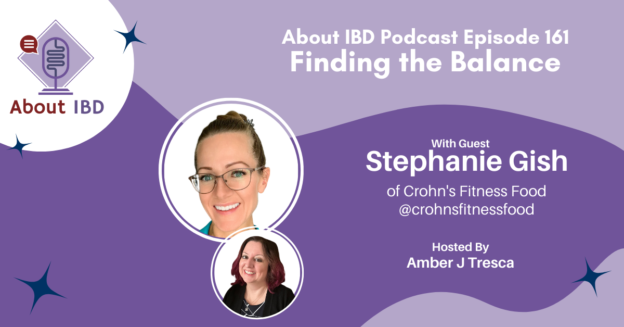
Stephanie Gish, host of the Crohn’s Fitness Food podcast, gives the details of her journey with Crohn’s disease and IGA nephropathy. Stephanie’s Crohn’s symptoms began in 2003, but she was initially misdiagnosed with an anal fissure. After being discharged from the Army for medical reasons unrelated to IBD, she went through years of fragmented care, and finally received a Crohn’s diagnosis in 2009. Stephanie brought her knowledge of health and fitness to bear in managing Crohn’s, but the diagnosis of IGA nephropathy had her changing course and rethinking her approach.
Buy “Crohn’s, Fitness, Food and My Rocky Road to Health” at Amazon:
Find Stephanie Gish at:
- Web: Crohn’s Fitness Food
- Facebook: @crohnsfitnessfood
- Podcast: Crohn’s Fitness Food
- LinkedIn: @stephlivsey
- Instagram: @crohnsfitnessfood
Veterans Resources:
- The American Legion, a US Veterans Organization
- VA Disability Calculator, via Veterans Guide
- 100% VA Disability Benefits List, via Veterans Guide
- Veterans Crisis Line, via the US Department of Veterans Affairs
- Veterans and IBD with Dr. Anish Patel
Find Amber J Tresca at:
- AboutIBD.com: About IBD
- Verywell: Verywell Health
- Facebook: @aboutIBD
- Twitter: @aboutIBD
- Pinterest: @aboutibd
- Instagram: @about_IBD
- YouTube: @AboutIBD
- Threads: @about_IBD
Find Mac Cooney (mix, sound design, and theme music) at:
- Facebook: @maccooneycomposer
- Instagram: @maccooneycomposer
- Web: Cooney Studio
- YouTube: @MacCooneyComposer
- Theme music, IBD Dance Party, is from ©Cooney Studio.
These show notes may contain affiliate links. If you choose to purchase after clicking a link, Mal and Tal Enterprises, LLC may receive a commission at no extra cost to you.
Listen and Subscribe to About IBD: Apple Podcasts | Spotify | Overcast | Castbox | All Other Podcast Apps
Transcript
[Music: IBD Dance Party]
Amber Tresca 0:05
I’m Amber Tresca, and this is about IBD. I’m a medical writer and patient educator who lives with a J pouch due to ulcerative colitis. It’s my mission to educate people living with Crohn’s disease or ulcerative colitis about their disease and to bring awareness to the patient journey.
Amber Tresca 0:19
Welcome to Episode 161.
Amber Tresca 0:21
IB D affects us for a lifetime, which means that we need continuous medical care. This puts us at risk for poor continuity of care, or fragmented care. A study from the Veterans Health Administration of 20,000 veterans with IB D showed that poor continuity of care was associated with worse outcomes. The researchers write and I quote, patients with IBD require care by primary care providers, gastroenterologists and surgeons, but the delineation of responsibility by physician is often unclear. My guest is Stephanie Gish, the host of the Crohn’s fitness food podcast and author of Crohn’s fitness food and my rocky road to health. Stephanie’s journey to getting a diagnosis and care for Crohn’s disease was interrupted repeatedly in the early days of her symptoms, she was serving in the army, she had to advocate to get the medical care she needed, all while trying to go through her life as if nothing were happening. She learned many lessons along the way about managing Crohn’s disease, both with and without medications, as well as how mindset and acceptance are important parts of living with a chronic illness.
Amber Tresca 1:25
Stephanie, welcome to about IBD.
Stephanie Gish 1:27
thank you. It’s a pleasure to be here. Thank you for having me.
Amber Tresca 1:30
Oh, it is my pleasure. All right, Stephanie, let’s get started first of all by having you introduce yourself to our audience.
Stephanie Gish 1:38
I am Stephanie Gish. I have both Crohn’s disease and IGA nephropathy, which is a type of kidney disease. I’m a voice actor slash audiobook narrator, and I host the Crohn’s, Fitness, Food Podcast.
Amber Tresca 1:49
Amazing. Thank you so much. You know, Stephanie, I’ve been listening to your show for a while, been, you know, watching your Instagram, but I think that probably there’s parts also, when I read your book, I don’t want to forget that part. You don’t want to forget about your book. So okay, we’ll get into that. But all that to say is that you have had quite a journey with your Crohn’s disease in a lot of different ways. So I wonder if you would first start and just, we’re going to get a level set here and let us know how you were diagnosed, like, what were your symptoms like, and what that whole process was for you?
Speaker 1 2:24
Love to. So my symptoms actually started about 20 years ago. I was in college. I think I was 22 at the time, back around 2003 and I noticed blood in my bowel movements. So immediately I knew something wasn’t right, and had assumed my colon was bleeding, which, in hindsight, was a correct assumption, but but at 22 I was living away from my parents, I was both embarrassed and I was also in denial about what was happening, so I waited a few weeks before I decided to do something about it, and after a few weeks, I finally went into the college health clinic to go see a doctor, and she did a very, very brief visual exam and simply told me that I had an anal fissure, and I was fine.
Stephanie Gish 3:15
So I took that information with me, and I held on to that. But not long after, that’s when I started having like, the intense cramping and abdominal bloating that so many of us are very familiar with. And my symptoms continued like that for the next three years, because in the back of my head, I just thought it’s an anal fissure. Time can go by and I’m okay. And so that happened for about three years.
Stephanie Gish 3:44
Finally, the symptoms got really bad. It was probably around September of 2006 that I had my first really severe, debilitating flare up and bad enough that I couldn’t leave the house for about three months. And so after three months, I finally went to the hospital. I waited that long because I didn’t think I could go. I couldn’t be in the car for 15 minutes without having an accident, so I’d wait till I could go 45 minutes so I could make it to the hospital.
Stephanie Gish 4:14
And that was that was in December of 2006 when I went to the ER because I didn’t know where else to go, and I was pretty much dismissed. They gave me antibiotics and told me to follow up with my primary care doctor, which I did, my primary care doctor then referred me to a gastroenterologist, and the GI doctor ordered a colonoscopy, but that wasn’t scheduled for until two months later.
Stephanie Gish 4:42
So by the time I got the colonoscopy, it had been six months since the very beginning of like the severe stay at home for three months flare up. So after we did the fun colonoscopy, the doctor, he was hesitant, so there was still some. Some ulcerations, but he was hesitant to give me a lifelong diagnosis of a chronic condition, even though he suspected IBD.
Stephanie Gish 5:08
So the plan was to do nothing take Imodium when it diarrhea got bad, and Tylenol when the pain was bad, and to basically watch and wait and see what happened, and to see how so I was just waiting for the next bad flare up, which because they said, if it’s IBD, it will flare up again. So it was watching, wait, wait for a flare up. And that process took another three years until I finally got a diagnosis in 2009
Amber Tresca 5:40
I have so many questions. I mean, it’s like, Okay, so first off, she diagnoses you with an anal fissure. Like, do you think you actually had one?
Speaker 1 5:51
I don’t know. I have thought about that so many times, and it’s like, was there or was it just like, I mean, it was clearly blood from my colon, like, maybe, maybe I had a bleeding colon and anal fissure to this day, I just, I don’t know.
Amber Tresca 6:08
Yeah, because it’s, well, they can be very painful, but it’s kind of painful in a very particular spot.
Stephanie Gish 6:14
Yeah, and, and it wasn’t, I mean, it was just, I think that’s why I could ignore it for so long, because there was just blood in the toilet. But, and other than the like, the intense cramping pain and the bloating pain like that, was a different pain. It wasn’t an anal fissure type pain, so I don’t think…I don’t think there was one.
Amber Tresca 6:14
Because also, um, like, they can be troublesome and take a long time to heal and stuff like that. But like, they heal up, you know, if it’s an acute thing sometimes, so it’s like, I don’t know that’s really, that’s really wild. And then the idea of not wanting to give you a diagnosis, do you have any insight as to why that would be, because I really don’t, I really don’t get it.
Stephanie Gish 7:06
I don’t either. I…it was, you know, that was back in 2000 and what did I say, 2007 when I seven? Yeah, 06-07, when I had the colonoscopy. And I don’t know if it was just, you know, almost 20 years ago, if it was just more of a hesitation, I don’t, I don’t know. I know from talking with a lot of people like nowadays, it’s like even the treatment is often like, let’s start right off with biologics, or let’s start off with the big guns, because the faster we can get this under control and get this taken care of, the better that long term healing and process is going to be, as opposed to just, well, if it’s IBD, it’ll be back. So it’s like, but knowing what I know now, it’s like if my second flare would have been worse and landed me in the hospital or for surgery or an obstruction like it could have been so much worse for this. Let’s wait. Take some Imodium, but…
Stephanie Gish 8:11
I can see watching and waiting for certain things, I guess, but maybe not for progressive disease that really has the potential to, like, change everything. I mean, you named a bunch of the potential intestinal complications, also fistulas…
Stephanie Gish 8:28
Yeah…
Amber Tresca 8:28
…which are miserable and so, yeah, it was that’s really wild to me. And in that time, we had some biologics. I don’t have, like, an encyclopedic knowledge of them. I know the first was approved in 1998 so they were there, yeah, you know, they were in use, that they could have been, you know, pulled out in your case, or at least something, I don’t know, at least something, oh my gosh. It’sjust why. It’s just wild that, that it all went down that way. Um, but had, did you know anything about IBD prior to…any…you had to have been on the Google machine, right?
Speaker 1 9:05
I was, I was on the Google machine for sure, prior to my bleeding colon. I had never heard of Crohn’s / ulcerative colitis. IBD was not in my vocabulary.
Stephanie Gish 9:14
But when I was dismissed and I knew my colon was bleeding, I definitely turned to the Google machine, which was difficult when you’re at the school library computer, but then you just got to get bold and and Google. So I definitely learned a lot doing that and but by the time I got my diagnosis, I was pretty, pretty certain that that was going to be the diagnosis, because it was a six year wait from the first symptoms to finally getting a diagnosis, so I had a lot of time to research and guess as to what was happening.
Amber Tresca 9:52
Okay, I have to back up for a minute, though, because part of your journey here is that you were in. Military service. And again, I forget everything, so I don’t have an encyclopedic knowledge, but that was before your diagnosis, right?
Stephanie Gish 10:08
Yes
Amber Tresca 10:08
Okay, and you originally had an injury that you think maybe kind of started you on the path to all of this that happened later with the intestinal problems. So could you describe what happened there? I read it in your book, so…
Stephanie Gish 10:26
Yeah, so I broke my foot in the Army. And it was actually I broke a bone in my foot. It’s a sesamoid bone. It’s on the bottom of your foot, and it’s, it’s a tiny little bone, and I broke it, and no one knew it was broken.
Stephanie Gish 10:45
So so at that time, my my mantra kind of became, “Put your head down and drive on,” and and that was my life raft. Not a good one, but it was for the early years in the Army trying to get through that broken foot injury, and then I carried that mantra into my IBD journey.
Stephanie Gish 11:06
So the sesamoid bone, in some people, it can be a naturally bipartite sesamoid, a natural two piece bone. So for a long time, the doctors just kind of assumed that maybe I just had a natural two piece bone. Mine was not it was broken, and it took them two years.
Stephanie Gish 11:27
So mind you, I was walking around with this broken bone that felt like every time I took a step, it felt like someone was hitting my foot with a sledgehammer, and it was incredibly painful, and it took two years. Finally, an orthopedic surgeon did a bone scan, and that thing lit up like a Christmas tree. So clearly something was happening. So they removed the bone, they did surgery, took the bone out, and then at that point, I couldn’t run, I couldn’t wear the military boots, and so they did a medical board.
Stephanie Gish 11:56
And all this time I was still having I had started to have that bleeding from my colon. I was having my Crohn’s symptoms, but that was kind of on the back burner because it was embarrassing, and because the foot pain was so intense that that was like my focus. And so they finally did after the surgery, they did a medical board, which is when the Army discharges you for medical reasons.
Stephanie Gish 12:26
So they did the medical board, and I was discharged from the army. And so that kind of, that whole process of learning to just grit my teeth and bear it, is that mindset of “Put your head down and drive on.” And I took that into my IBD journey. So during my time in the Army, I was, you know, as a female, as a woman in the Army, I did not want to fit into any stereotypes. I did not want to, especially the bad stereotypes that women shouldn’t be there, or that women couldn’t hold their own.
Stephanie Gish 12:26
And so it was really hard to have both the Crohn’s symptoms that I was embarrassed to talk about and the foot issues that people were just not even believing was an issue. And I didn’t even want to go to sick call. Like sick call is just like going to the medical clinic, because I didn’t want to be the one made fun of. I didn’t want to be the one that couldn’t hold my own. And I did actually have one lieutenant, which is like the first officer rank in the Army, so it’s like the lowest on the totem pole, did actually publicly mock me one time when I asked to go to sick call.
Stephanie Gish 13:40
And so, you know, when you’ve got all that kind of on your shoulders in the back of your head, I’ve been made fun of when I asked to go to sick call. I didn’t want to be a weak female in the military. I didn’t want to fit any mold of not being able to hack it. So I just put my head down and drove on. And I learned to smile through the pain.
Stephanie Gish 14:03
And the mantra actually came because I picked up that mantra when we were doing a I think it was in ROTC time so early on, and we were doing a 12 mile ruck march, and it was rainy, and it was dreary, and so everyone was wet and miserable, and everybody else was complaining. I was in so much pain, I couldn’t complain. Like I was just in so much pain, all I could do was literally put my head down. And one of the cadre, one of the instructors, had said, “Put your head down and drive on.” That’s how we do in the Army.
Stephanie Gish 14:40
Like, stop complaining, everybody, it’s raining and we’re marching, and that’s what we’re doing. So put your head down and drive on. And that just was burned into my memory. That’s kind of how I carried that with me for all those years of put your head down, drive on.
Stephanie Gish 14:54
So through the pain, I learned to smile, and because I smiled, people didn’t believe that my foot was broken because I walked into the clinic and I smiled and said hello, and because I smiled when I walked into the gastroenterologist office, and I smiled and I said, Hello…people didn’t believe me. So all the time, all the time, went on, and I learned to, like many of us, I learned to smile through the pain and hold it in even more.
Amber Tresca 15:24
I understand what you’re saying. And it brings up a lot of ideas. And you went into it about not wanting, wanting to present yourself in such a way that you are, that you are taken seriously, which we feel like we have to then put our own needs by the wayside.
Amber Tresca 15:44
And quite frankly, it sounds as though you were pretty much toldthat, you know, you can’t be sick, you can’t have a problem here. And then on top of that, that you had a very, I don’t know how typical it is to break that bone or to have that bone already be in two pieces that they wouldn’t have recognized it, but then you had, like, I mean, honestly, that’s really a weird thing. It is like that they couldn’t, I mean, normally you break your foot. You go, I mean, I’ve broken my foot many times. You go…
Stephanie Gish 16:12
Yeah.
Amber Tresca 16:13
…the fact that they’re like, Well, you might have this, um, benign anatomical anomaly…
Stephanie Gish 16:18
Yeah.
Amber Tresca 16:19
Or it could be broken, or we don’t. We don’t, know, but in the meantime, just go about your business.
Stephanie Gish 16:25
Take some take some Tylenol,
Amber Tresca 16:27
…and just move it along. Move it along. Just wild. I mean, I hate that for you. I really, you know, and to go so long without a diagnosis as well, even though you had a colonoscopy is really pretty bonkers, like it just should not have gone down that way. So, I mean, honestly, I’m really glad that you didn’t have some kind of really serious thing happen to you during that time.
Stephanie Gish 16:52
I am too other than, other than staying at home for three months of intense bloody diarrhea every 15 minutes.
Amber Tresca 17:03
Do you think of that now and think, How did I ever like? How did that become my normal? How did that happen?
Stephanie Gish 17:10
I do think that. And as I listen to other people’s stories, it’s it fascinates me how much we can think is normal, like, how much we can internalize and convince ourselves that this is okay, I’m not that bad. It’s bad, but it’s not that bad. And it didn’t happen slowly. I mean, that flare up came on, like, I remember the second it started, because I was working at home. I had just been, literally just been discharged from the army that September, and it was mid September that the flare hit. So I was in my home office. I was going to start my new graphic design career, slash web design career, working in my home office. And the urgency hit, and I bolted from my bedroom to the bathroom, which was like 15 feet away, and I barely made it. There was and and that surprised me, like I probably would have thought, how could you not control your own bowels as an adult there? There was no controlling us. If I wasn’t going to make it to the bathroom, it was still coming out, but luckily, I made it, because it was only 15 feet away. But had I been like in an office setting, or still in the military, I would have craft my pants like not even a question about it, and and then I just laid on the bathroom floor for the next 24 hours, because it hit just every 15 minutes and and I don’t know why, at that moment, it didn’t seem more severe to me, or if it was honestly, I think I was just I was alone. So my ex husband, I was married at the time, he was on a rotation away, so he was gone for like four weeks. So I was home alone. I was living in Texas, my parents, my family, were all back in Utah, so I just kind of had no support system, like a support system that I would have felt close enough talking to about my horrible bloody diarrhea and bathroom issues. So I was just alone. And I think when you’re alone and you feel like you don’t have anywhere to turn to you just and then that mantra of put your head down and drive on it was this, this mantra, this, I can do this. I am determined. I can fight through it. I will get through this, that kind of mindset. And I think at that time, I didn’t expect it to go on for the next three months, the next 20 years. And so you just kind of, you deal with that in the moment, and then that moment becomes 345, months, and then all of a sudden it’s. Just your new normal. And it’s like, looking back, it’s like, none of that was normal,
Amber Tresca 20:06
none of that. No, it becomes your life. And then I get what you’re saying about not having somebody right there who looks, looks at you and says, No, we’re not doing that. We’re going to the hospital. We’re doing what I’m doing. So you’re just kind of coping with it until, or I know I do this too. You wait until it’s convenient to cope with and then guess what? That convenient time never comes. Yes. Yes.
[MUSIC: About IBD Interlude]
Amber Tresca
Up next, how a specialist gaslit Stephanie into questioning her diagnosis.
Amber Tresca 20:57
Okay, so Stephanie, you finally get a diagnosis, very delayed, okay? And you kind of, you kind of took a very particular approach, I think, to managing your Crohn’s disease, especially in those first years after you were diagnosed. How did you go about making those decisions about your medical care, about your diet, about your exercise, just right after you were you were diagnosed, and trying to figure
Stephanie Gish 21:27
it all out. Honestly, I think because I was in denial for those first three years of my journey, and then basically told to just wait and see what bad things would happen. And then by the time I did go in and was told to wait another three years, so six years had passed, and I feel like at that point I didn’t have a lot of trust in the medical system, and I’d been in denial for so long. So when I first got the diagnosis, like the official, it’s 2009 the six years had gone by. At that point, I wanted medications like I was ready to like, let’s great. We know what this is, fix it, fix me. And we started on, I think this is another downfall of it. We started on the, I guess, the weaker, you know, medications. So we started on the mesalamine tablets, 12 to 24 day, whatever it was. Then we did the classical enemas, and those weren’t helping. And then finally, we started Imuran, and that wasn’t enough. So then we did a combination of Iran and Humira, and I think because I had spent so much time trying to figure things out on my own, and then when I got the medications, the medication didn’t fix me immediately. There wasn’t like this, boom, take the pill and you’re better. And so that added to my frustration. So here I was accepting the medication, but I naively wanted to be fixed overnight, so a little bit of history. In college, I did two figure slash body building competitions, so I had learned a lot about diet, the metabolism, fitness, supplementation, and with that knowledge, or what you know in hindsight, maybe lack of knowledge, who knows? But because I wasn’t getting that instantaneous relief, I thought, you know, what I can I can maybe do this on my own. Maybe I can do it better and but that, that decision took a while. So I had actually been on the HUMIRA and Iran for about four and a half to five years, and I did get into remission, but it was as probably many people have experienced. It was remission, but I still had a lot of bloating, a lot of pain. I was still passing mucus, so it wasn’t like where I thought I should have been. So after about four and a half five years, I thought, You know what, I can do this on my own. And I knew it was a controversial decision. Then it still is. But I think because I’d had those first six years of just being left on my own, and I didn’t really have that clear education, like the path of how this disease goes, or what the medications can or can’t do, you know, it was just kind of like, you know what? I’ll go back to figuring it out on my own, because I did for six years. So let’s do that again. So looking back, I would not say that it worked. In short, I did learn a lot about through my path. I learned a lot about gratitude, stress management, meditation. Medication, intermittent fasting, nutrition, processed foods, every diet under the sun that is advertised for IB D, learned about it. I tried it. So I think in total, I was off medication for about eight years and then and then, in the span of about 18 months, I had two moderate to severe flare ups. So I had one in late 2022 but because we were in the middle of a move, literally in the middle of a move across, you know, the country, I didn’t really get the help I needed then and then again. Earlier this year, in 2024 I had another flare up, where I finally realized at that point earlier this year that I can’t control IBD any more than someone can control, say, kidney disease or cancer, like there are just certain things now I can do a lot to Improve my overall health and my state of being, but I finally accepted that I can’t do this IBD journey without the biologic medication. And so that took me. It was about eight years to get to that point and and so here we are today. I am happily back on had Lima, which is now a new eight years. You know, after an eight year span, there’s been a lot of drugs that came out that I’m now re learning about, but had Lima is a biosimilar for Humira, and HUMIRA is what I was on before. So I am now on that back in remission, very grateful, and I’ve promised my doctor that I will not be stopping it.
Amber Tresca 26:47
Did you go through all of this whole journey with your with your current physician? Is that? Why is that what prompted the please don’t stop your medication.
Stephanie Gish 26:57
You know it wasn’t my current physician. And okay, honestly, I’ve had multiple, multiple physicians, and that’s probably another reason why I felt, I guess, let down by the medical system I had when I got out of when I first got the diagnosis. I was my husband was military too, so I was at the army, the active Army Hospital. And so I saw that doctor for probably three, three years or so, but then, then I got divorced, and so then I was on my own, and I transferred into the the VA medical system. And so then I got a new doctor. But I had that doctor for maybe four years or so, and he was the one that I had when I went off medications, and I was honest and talked with him about it, and he, you know, he’s like, Well, let’s do a colonoscopy make sure you’re in remission when you stop medications. Let’s try and do this as right of a way as possible that we can. So he was very respectful of my choices, and I did trust him and and felt good with him as a doctor, but then then I got off the medications, and not long after, he’s like, Oh, we now have an IBD specialist here at the VA hospital, so I’m going to transfer you to him. And I’d actually had really liked the GI I had, but then he transferred me away, and then this new IBD doctor that I had for about a year, year and a half, I never actually met I had one phone call with and then he transferred and went to a different hospital. So then I got assigned a different doctor, and I had that doctor for a few years, and I was starting to really like her. But then, then I got transferred again to different doctor and then, and then we moved so it’s like, once I was off medications, then I was just kind of like, now I’m off and I’ve got nowhere to turn to because every new doctor I saw it was like, Well, you probably don’t really have Crohn’s because now you’re off medication and and you’re fine. You’re fine. You’re not. I don’t have to admit you right now, so you must be fine. So I think, in hindsight, I think that experience then kind of compounded everything else I’d had before, to where it was just like, I’ll see what happens. And but this new, oh, and I didn’t even tell you the worst of the doctors,
Amber Tresca 29:19
the worst of the worst of the doctors.
Stephanie Gish 29:23
So then we moved here to Florida, which is where I’m at now. I’m in the VA system, and I tell my primary care doctor, I’m like, I need to be seen by a GI. I had a GI, and they’re like, Well, I have to refer you to one first. So then I have to wait for a new referral to be seen by the GI. I finally get the appointment couple months later. And mind you, this is when I had that first of the two moderate, severe flare ups. So I had been bleeding. I’d had intestinal bleeding all summer long, and it, luckily, it stopped. So by the time I got to see this new gastroenterologist, the VA. Here in Florida, my colon had stopped bleeding about three to four weeks prior. And I go in, and I see this new doctor, and I sit down with him, and he looks at me, and he says, okay, so you’re not on medication, and completely ignore the fact that I had bleeding for my colon for the past three months. And he looks at me and he says, Well, assuming you even had it, assuming you even had it, 20 years into my journey. And he says, assuming you even had it. He’s like, I don’t need to see you. You don’t need to be seen by me. Follow up with your primary care doctor, assuming you even had it. There’s the door. Goodbye. It was like a five minute, five minute meeting. I was so dumbfounded, like I couldn’t even think of a of a retort, or like a defensive argument, like I had nothing. So I walked out the door and I left, and I am really grateful for the primary care physician that I had at that time, because I went back and told her what happened, and she’s like, this is ridiculous. You need to be seen by a gastroenterologist. You need to be followed. I’m not qualified to follow your IB D. You need to be seen by gastroenterologist. So she put me into what’s called the Community Care Network, which is a group of private physicians that work with the VA when they need, when someone needs to be referred out, when the VA doesn’t have care that you need, they can send you to like a private physician. And so that’s how I got the doctor that I have now, who I love and believes me, and I will hopefully stay with him for a long time.
Amber Tresca 31:49
Well, you know, is he Young? Because
Amber Tresca 31:54
you’ve been shown on the road so many times,
Stephanie Gish 31:57
he’s probably, I don’t know, middle aged, but I guess I am too. So I’m like, okay, somebody
Amber Tresca 32:02
who’s, I’m just saying, like, not going to retire. Maybe I don’t under 20 years. I
Stephanie Gish 32:06
don’t think he’s retiring soon, so I’m hoping that he’s, I feel like he’s got 20 years in him.
Amber Tresca 32:11
Okay, good. Because I can’t, I can’t with this, how many times that you were shuttled from one gastro to the next, because that’s super fragmented care, and I don’t see how anyone could ever get the full picture or treat you properly after only just a short amount of time. And meanwhile, they are on their, you know, on their way to somewhere else. So, you know, they know that it’s not going to be a long term situation. So it’s just, I don’t know that’s really, that’s really wild, what happened to you.
Stephanie Gish 32:47
And I think, you know, I’ve thought about it, and I there’s been so many times in my journey where I’ve almost wanted to just throw in the towel and be like, Screw it. Like, you know what, I am not going to go back to the hospital. Like you get so frustrated. And this is coming from a place where, like, I’ve now spoken to so many people who have IB D, and so many people who have faced that frustration of, like, I don’t want to deal with it. They don’t believe me anyways. And on the other side, I’m like, you gotta fight for it. You gotta get the care you need. You have to fight for it and but when it happens to you, it’s so just, what’s the word disheartening? Where it’s just like, Yeah, it’s like, do I have the energy to go meet this, another new doctor and try to explain that I’m doing fine right now, but this is a disease, as you should know, remission and relapse, and because I’m not relapsing at the moment doesn’t mean I don’t have it like trying to work up that motivation to advocate for yourself each time is so hard, and that’s even As someone who knows the value of advocating for yourself, and would, without question, tell someone else. You know, if the roles were reversed and someone were telling me my story, I’d be like, go to the freaking Doctor, tell them you need that. So I just I think about all of the people who get stuck in a saga, even somewhat similar, and they just reach a point where it’s like, I can’t even bother with it. The doctors just they’re not helping, or it’s so hard to get that care because it, it still happens. I mean, this was 2022 when I had a gastroenterologist tell me after me having the disease for 20 years, assuming you even had it, and then I leave the office questioning, do I? Did I not have Crohn’s disease? Is the whole 20 years a lie? And I spent the next two weeks like scouring through 1000s of pages of medical records. It’s like, right here, ulcerated transverse colon, like, ulcerated colon, like antibodies, ulcers, like terms, I’m like, clearly it’s there.
Amber Tresca 35:11
That’s what I was gonna say. I’m like, you had, like, there was objective proof that you were and then there would have been, I hope biopsies,
Stephanie Gish 35:20
and lots of biopsies,
Amber Tresca 35:24
like all of that, that said, yes, yeah, this woman has Crohn’s disease. And then, not only that, but the idea that, okay, you might not know exactly what something is, but then if you treat it and it gets better, that kind of gives you a clue. So like the fact that you were on humera for a while and then you your symptoms did improve during that time kind of probably means you have processes like I don’t understand. So
Stephanie Gish 35:53
for anyone listening, advocate for yourself, it can never go understated
Amber Tresca 36:02
100% 100%
[MUSIC: About IBD Interlude]
Amber Tresca 36:08
Coming up Stephanie gets another serious diagnosis and a wake up call.
Amber Tresca 36:20
Oh, Stephanie, you’re an overachiever. You know, I feel comfortable in saying as one over achiever to another, you have another you have another diagnosis that you did not need. As you mentioned, it is a kidney disorder that is called IGA nephropathy, and this means, and I’m going to explain it in very, you know, just a couple of sentences here, and you could tell me, if I’ve got it wrong, and that this means that there’s a protein called immunoglobulin A IgA, and this builds up in your kidneys, leads to inflammation and A loss of kidney function over time, which is terrifying. Okay, so tell me more about this diagnosis and how this has also affected
Stephanie Gish 37:06
your life. Yeah. So, so you nailed it. So as as you mentioned, I gene nephropathy. I Gan, for short, if you want to be in the know, or at least I call it, I get an IGA n, but it is an autoimmune disease, or, I think more specifically, it’s an immune complex mediated disorder, which I think there’s also like some conversation for IB D, as to whether IB D is autoimmune, or is it immune mediated?
Amber Tresca 37:35
It is immune
Stephanie Gish 37:40
Yes, so So is Eigen so I was diagnosed with IGA nephropathy in 2021 and a little bit of history on that. So for years, I had microscopic blood in my urine. Every time you do the urinalysis, microscopic blood, you can’t see it. But in 2018 2019 I had what’s called gross blood, and it was gross, but it’s just gross because it’s visible. You can actually see the blood. So my urine turned like dark brown, and so shortly after, I started being followed by a nephrologist, which I had to fight to get to the nephrology clinic. So talk about advocating yours for yourself, the journey wasn’t just with Crohn’s, but finally, I got in to see a nephrologist, and he followed me for my journey, had a cystoscopy, which was also fun colonoscopy, but for your bladder.
Stephanie Gish 38:34
For those who don’t know,
Amber Tresca 38:35
I’m just gonna say, I’ve had a couple of cystoscopies as well, and like, I’m telling you I’d rather have another baby. That test is really, really something else. I mean, talk about head down and drive on, oh boy.
Stephanie Gish 38:52
And I feel bad for the men out there that are bad to have them. But, well…
Amber Tresca 39:00
That’s true. That is true. Yeah, yeah. So anyway…
Stephanie Gish 39:03
So I was being followed by a nephrologist, and in late 2020 my creatinine levels started to rise, and I was passing protein in my urine. And those are, like, the two big, like warning flags for IG nephropathy progressing. So in 2021 we did a kidney biopsy, and that’s the only way to confirm whether it’s igan or not. So got the biopsy in 2021 it was IGA nephropathy. And I think, honestly, I think the diagnosis of I gene nephropathy is really what helped me to accept and really understand how little control I have over autoimmune, immune mediated diseases, because things simply cannot be controlled by eating kale and turmeric and doing yogurt.
Amber Tresca 40:01
Just not how it works, because you were doing those things.
Stephanie Gish 40:06
I was literally doing all the things. I mean, I was, I was drinking raw milk, I was making homemade sauerkraut. I was I did the carnivore diet, I was journaling, I did yoga, yada yada yada, like I did all the things, and my reward was IGA nephropathy, like, oh, boy, you can’t outsmart the immune system. Yeah, yeah. And, but I think, I think because of that, like, it was just like this, I don’t know the universe hitting me on the head. Like, like, how smart slash dumb Do you think you are? Like you cannot control these things. So I think, because I had grappled with with IB D for so many years, and being medication free, I studied all these principles of like meditation and mindset and and Buddhist philosophy. And I think finally, when I got that Eigen diagnosis, it was kind of like I have to accept that there are things I cannot control. And that was like one of the big things through, like meditation and philosophies, where it’s like, there’s just, there’s some things you can’t control, and learning to accept that is going to serve you long term, instead of dwelling on how awful it may be. So I think because of that, I was able to accept the I Gan diagnosis, which is, it’s not a great diagnosis. I mean, for a lot of people, it’s, it’s like this earth shattering diagnosis, like you have this chronic kidney disease, that 5050, chance that might lead to renal failure. Just have to wait and see. And so I think having that, accepting that, also helped me to accept that, you know what? IBD is not any different. I also cannot control it, and it has its own it may not lead to kidney failure, but it could lead to colon failure, and, you know, a whole slew of other things. So I think it helped me to, I guess that’s the good part of my medication free journey, is having learned some deeper insights into my emotional and, you know, mental health and learning to accept things. So that’s a nice thing that I may not have otherwise discovered or ventured into, but it helped me to accept the IGA nephropathy diagnosis, which in turn, then allowed me, 20 years later, to finally accept my Crohn’s disease diagnosis. So my journey continues, and I continue to hopefully evolve with it in whatever direction it may go. The universe
Amber Tresca 42:50
is wild man, you know, I’m just gonna say I think you probably could have learned the lesson in a different way, probably, probably without getting the without getting the IGA diagnosis. I mean, gosh, geez, and accepting it, that’s a whole other situation about because you could say, well, you need to accept it, because then you can move through it, and then you’re not struggling against something that you can’t control. But then there’s also the idea that, but if you accept it, are you then allowing it into your life and to control you? And I can sort of see both sides of this, and we should probably end up somewhere in the middle, but I really don’t.
Stephanie Gish 43:36
Yeah, there’s and there’s a there’s a lot to the mindset of just like accepting it, not accepting it. Is it controlling you? Are you controlling it? But right the body is gonna do what it does. Raw milk. Be damned, because I was found it.
Stephanie Gish 43:57
I went to the farm.
Amber Tresca 43:59
Yeah, yes, you detail that. But alright, so when, yeah, you did go through all of this in your book. Your book is called Crohn’s fitness food and my rocky road to health. You go through everything that we have discussed. You go through the raw milk and how that became, like untenable? Is that a good word to use…?
Stephanie Gish 44:24
Just hard to acquire. It’s, it’s a process. It’s a process. But let me tell you, if you do get it from a reputable farm, it is so delicious and there are some incredible nutrients in it. But it’s, it’s a it’s a whole raw food, full of nutrition, which, which is good, but it’s it’s not going to make Crohn’s go away, or stop, or stop IGA nephropathy from happening.
Amber Tresca 44:52
Yeah, because otherwise, then you would never have developed that condition. Let’s, um, close out your journey a little bit. Because you It took way too long for you to get diagnosed. It took way too long for your health to be taken seriously, and it should have been. And then you got to a point where you were frustrated and you were hoping to manage everything yourself. The universe came along and bunked you on the head and said, maybe you need to accept a couple of hard truths about the way your your body is behaving right now and your immune system is behaving right now. So could you tell me more about how you’ve come back around to now I’m going to be on medication, and how you are doing now that you are back on medication.
Stephanie Gish 45:49
So I think there’s, there’s a couple of things that I realized in this, this latest part of my journey, my story, that keeps going. But, um, yeah, as I was just mentioning, I think the kidney disease and that diagnosis of finally being able to accept that while I can do things to improve my overall health, and there’s a lot of things that I learned in that time of off medication that I’ll continue like I’ll still reach for the most nutritious foods that I can and and focus on fitness.
Stephanie Gish 46:18
And there’s, there’s a benefit to doing that and trying to achieve the most optimal health I can, but that’s also going to be in conjunction with medication, because there are certain physiological processes that just in immune mediated diseases, but just cannot be stopped without the help of modern biological medications. So accepting that, but then also in that process.
Stephanie Gish 46:49
So I have a blog as well, Crohn’s Fitness, Food. I’ve been blogging part of my journey on that so to be truthful and transparent in my journey, I wanted to go back through my old blog posts and and I do want to, you know, kind of point out that I’ve never tried to say, like, like, this is the way, or, like, food, is it like? So in the blog post, I never said, like, this is gonna, like, fix everything, but, but it was, but it was journaling. Like my it was journaling my process of all right, I’m off medications. I’m trying this method. Let’s see how, how it helps.
Stephanie Gish 47:26
So it was real eye opening to go back through those blog posts and realize basically every blog post was me trying to overcome some minor, minor symptoms. And luckily, they were minor. They were minor symptoms, minor flare ups, but they were just minor enough where it kept me going like minor enough that I didn’t feel like I needed to jump back on medication. But I wasn’t. I wasn’t where I needed to be.
Stephanie Gish 47:52
So going back through those old, old blog posts to make the update that now I’m back on medications, it really just made me accept that all those years, I wasn’t doing as good as I thought I was. I did have some good times in there. I mean, it was eight years I wasn’t in complete, you know, horror for eight years, but, but a lot of that times I was trying to figure out how to overcome a minor flare up. And so right? It allowed me to, you know, finally realize that I wasn’t doing as good as I should have been, and I probably should have stayed on medication, but I didn’t, and that wasn’t my journey.
Stephanie Gish 48:33
But luckily, looking back, I did not have a severe flare up those complications we mentioned earlier, luckily, thankfully, I did not end up hospitalized or with or with a obstruction or fistula or anything that would have been horrible to go through as well. Instead, I got to moderate to severe flare ups and a wake up call that this is where we’re at. It’s time to accept it, and medication is what is going to help me long term now and in the long term. So I’m happy to, happy to be back on my hadlima. And it is, it is helping. I’m feeling good. It’s helping. So I’m happy to have it. And it’s been a long circuitous circular, long and winding road.
Amber Tresca 49:27
Long and winding road to get here.
Stephanie Gish 49:28
A rocky road. It’s a it’s a play on Rocky Road, ice cream, the rocky, bumpy road that where life takes us.
Amber Tresca 49:39
Well, it’s been such a journey. Thank you for sharing all of it with me. There’s so many learnings and so many takeaways, and I do want to encourage people to go back to your blog and to your book Crohn’s, Fitness, Food and my rocky road to health. But before I let you go, tell everybody where they can follow you all over the interwebs. I want to ask you about your newest iteration in your working life, where you’re doing voiceover work and all of that like, what is that like? And what has that journey been like? And what do you enjoy about that the work that you’re doing now.
Stephanie Gish 50:18
It is fun and it is hard. So in short, it is hard.
Amber Tresca 50:24
I know people think it’s not so hard.
Stephanie Gish 50:26
In short, it’s called voice acting. And so kind of, I got on the path, because my background is, is broadcast journalism. So I’d had like that training of like television and journalism and and radio and being behind the mic and and then I started my podcast in 2018 and love the sound of my voice, but I don’t, but, you know, that’s what they all say, but, but I really enjoy like that audio aspect. And so then I started realizing, when we moved out here, I was ready to obviously end my career in Texas, because now I’m in Florida and trying to put together my passions and my skill set and what I enjoyed, and it was this voice acting arena. And I thought I could just jump into it, but it’s voice acting. It’s kind of like trying to break into Hollywood. Apparently, it’s like, acting in Hollywood. I’m like, man, there’s like, it’s hard to get going in this but, but I’m going, I am. I think I’ve got about nine audiobooks under my belt, working on couple of corporate narration type things. So it is a lot of fun. It is a lot of work, but I’m really grateful that it’s something I can do at home, because, as many of us with IB D and chronic conditions know, going into an office is not the thing that many of us want to do. Like, there’s so many days that like fatigue. I know a lot of us struggle with fatigue. Fatigue has been like my thing for the past. I feel like six years, and it’s just, I can’t imagine having to wake up at five, 6am go put in, like, the eight hours at the office, like when you have to, like, put on your A game and and you got to play the part and do the role. It’s exhausting. So thankfully I don’t have to do that right now. Hopefully I’ll get more audio books and voiceover work and continue to grow this thing, but it’s a whole lot of fun and keeps me at home, buying the microphone and and pursuing some things that I really enjoy. Yeah,
Amber Tresca 52:33
I think about this a lot. I have been a freelancer since my son was a year old, and I was like, breaking down every day over like dropping him off at daycare, and just decided to take to take that plunge, and it’s worked out really well. And now I think there’s no way. And then I wonder, how did I do it? And how did I do it with an infant? I don’t even know. I have no idea, I guess, because I was 20 years younger at the time. But like, Yeah, but the fatigue is probably and if you ask my husband what the worst symptom is about the IB DS, he would say that it’s, it’s the fatigue. He says it’s like, like if watching an energizer bunny just down when the fatigue takes over. Um, yeah. Voice acting is hard, and narrating books is hard. I don’t have any problem listening to my own voice anymore. What is your relationship to listening back to your own voice?
Stephanie Gish 53:30
It took a while. It took a while. I jokingly said, I love the sound of my voice, which I do now. I like, I accept it now, like, it’s very weird to hear yourself when, yeah, for the first time to, like, really hear yourself on audio, through a microphone, and it’s like this that I always sound but it’s weird, and after a while, then you just kind of get used to it. It’s like, okay, that’s that’s my that’s my voice. So and then you can get to know it. You can get to love it. You can appreciate it for, for what it is. And so I think I appreciate it for, for what it is now. But it took a while to to not think, Wow, is that what people hear? Sounds so different in my show.
Amber Tresca 54:21
Yeah, that’s very funny, but I completely relate to that. So okay, Stephanie, let’s go through all of the places that people can find you which there there’s more than one. So I don’t know if you have a particular way that you normally go through it, so we don’t miss anything. So maybe I’ll just let you loose and let you tell the people where to follow you.
Stephanie Gish 54:47
I think the easiest way people can find me and links to my book and podcast and all that jazz is to simply go to my website, which is Crohn’s Fitness, food.com there’s a link to the podcast right at the top. And if you scroll to the bottom, my social media links are down there at the bottom, and your social media is is also usually Crohn’s, Fitness, Food, yep. So I do a Facebook, which I don’t post very often, on an Instagram, Which, admittedly, I’ve been a little bit absent on there recently, but I do tend to get back, I think I have a little bit of work. PTSD, my last job, my last job in Texas was marketing communications for private school. So it was like, you have to do the social media. You have to do, like, all the promotions. And so now it’s just like, Oh, I’m so tired of social media, but, but I still try to force myself to to get on there.
Amber Tresca 55:43
Well, maybe we can find a way to make it fun again. You know, maybe there’s a way for you to break through that and make it more fun and and creative. Again, I think that’s what I like. Yeah, about that is that, because most of my job is kind of like technical writing, so doing the podcast, and things that are associated with that are more creative, and so it just it feels good to kind of flex that muscle a little bit. I think
Stephanie Gish 56:10
I just need to keep reminding myself, like this isn’t work anymore. This is your own stuff. Like you can do your own stuff now,
Amber Tresca 56:21
Right? But and you can have some fun with it exactly
Stephanie Gish 56:24
and connect Exactly. And I do love connecting with the community on there that is like, it’s huge. I mean, it’s so amazing, just especially the IB D community that’s out there on social media, just how quickly people are willing to connect and happy to share and support each other. So I definitely love seeing that and being a part of it.
[Music: IBD Dance Party]
Amber Tresca 56:47
Agree wholeheartedly and with that great segue into saying, Thank you so much for speaking with me today, and thank you for your voice and for all of the stories that you have brought to Crohn’s Fitness, Food, the podcast and your book, which I enjoyed immensely, and for going through your journey with me and bringing these learnings forth for other people, especially for those that are newly diagnosed, and I hope also for healthcare providers who may be listening, who can also have some takeaways from your journey as to maybe how we can do better by people who are going going through that first process of getting diagnosed. So all that to say, thank you so much Stephanie.
Stephanie Gish 57:35
Well, and thank you so much for having me. And thank a big thank you to all of the work that you’re doing in our community. I’ve listened to your podcast for a long time, and just I love the stories that you share, and the information and the research and the experts that you bring on. You have so much to share, and it’s so valuable. So thank you for for doing that, for doing the work you do, and thank you for having me on to share a little piece of my story.
Amber Tresca 58:06
Hey, super listener.
Amber Tresca 58:07
Thanks to Stephanie Gish for connecting with me and for creating this episode together. I highly recommend her book, Crohn’s fitness food and my rocky road to health. Stephanie is an experienced voice actor, so she has also made an audio book version available. Her podcast, Crohn’s fitness food can be found in all the podcast apps, including wherever you’re listening to this right now. There’s so much more to her story than we could include here, so I encourage you to follow her in all the places across the interwebs. I know I could listen to her voice all day.
Amber Tresca 58:37
As always, links to her and transcript everyone’s social media handles and more information on the topics we discussed is in the show notes and on my episode. 161 page on aboutIBD.com.
Amber Tresca 58:49
Thanks for listening, and remember until next time, I want you to know more about IBD.
Amber Tresca 58:57
About IBD is a production of Mal and Tal Enterprises.
It is written, produced, and directed by me, Amber Tresca.
Mix and sound design is by Mac Cooney.
Theme music is from Cooney Studio.