
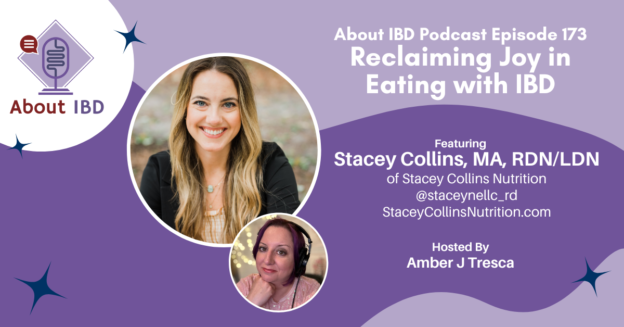
People with Crohn’s disease or ulcerative colitis (forms of inflammatory bowel disease, or IBD) were told for many decades that diet didn’t affect the disease. Even today, some patients are still told this, even though there is now significant evidence that diet absolutely matters in IBD. Stacey Collins, MA, RDN/LDN describes how her journey with ulcerative colitis led to j-pouch surgery. Her philosophy as a registered dietitian is one of “nutrition by addition” rather than by dietary restriction. Stacey also focuses on the emotional aspects of eating with IBD, including the understandable fear and anxiety around food.
Listen and Subscribe to About IBD:
 Apple Podcasts
 Spotify
 Overcast
 CastBox
 Amazon Music
 All Other Podcast Apps
Topics discussed:
- The role of diet in managing inflammatory bowel disease (IBD).
- Personal experiences with ulcerative colitis and dietary management.
- The misconception that diet does not impact IBD management.
- The philosophy of “nutrition by addition” versus dietary restrictions.
- The importance of individualized dietary approaches for IBD patients.
- The impact of food on gut health and bacterial diversity.
- Emotional aspects of eating with IBD, including fear and anxiety around food.
- The significance of finding joy in cooking and eating.
- Practical dietary recommendations for IBD patients, including the Mediterranean diet.
- The importance of community support and connection in managing IBD.
Find Stacey Collins, MA, RDN/LDN at:
- Stacey Collins Nutrition: https://www.staceycollinsnutrition.com/
- Twitter: @staceynellc_rd
- Instagram: @staceynellc_rd
- LinkedIn: @stacey-cutler-collins
Publications from Stacey Collins, MA, RDN/LDN:
- Scarlata K, Zickgraf HF, Satherley RM, et al. A Call to Action: Unraveling the Nuance of Adapted Eating Behaviors in Individuals with GI Conditions. Clin Gastroenterol Hepatol. Published online December 14, 2024. doi:10.1016/j.cgh.2024.11.010
- Collins S, DIGID Inflammatory Bowel Diseases Workgroup. Iron in GI conditions. Patient.Gastro.org. 2024. https://patient.gastro.org/iron-in-gi-conditions/
- Collins S, Castelan VC, Wernick R, et al. Effects of nutrition status and perioperative nutrition supplement completion on postoperative outcomes in patients with inflammatory bowel disease undergoing surgery. Gastroenterology. 2024;166(3):S22-S23. doi:10.1053/j.gastro.2023.11.081
- Collins S. Surgery and Nutrition. Crohn’s & Colitis Foundation. 2024. https://www.crohnscolitisfoundation.org/patientsandcaregivers/diet-and-nutrition/surgery-and-nutrition.
- Nishioka H, Hasegawa Y. Addressing sarcopenia in people with disabilities: definition, assessment, and nutritional care. Medical Nutrition Matters. Reviewed by Collins S. October 1, 2024. https://www.eatrightstore.org/dpg-and-mig-products/dmnt/addressing-sarcopenia-in-people-with-disabilities-definition-assessment-and-nutritional-care.
Find Amber J Tresca at:
- AboutIBD.com: About IBD
- Verywell: Verywell Health
- Facebook: @aboutIBD
- Twitter: @aboutIBD
- Pinterest: @aboutibd
- Instagram: @about_IBD
- YouTube: @AboutIBD
- Threads: @about_IBD
Find Mac Cooney (mix, sound design, and theme music) at:
- Facebook: @maccooneycomposer
- Instagram: @maccooneycomposer
- Web: Cooney Studio
- YouTube: @MacCooneyComposer
- Theme music, IBD Dance Party, is from ©Cooney Studio.
These show notes may contain affiliate links. If you choose to purchase after clicking a link, Mal and Tal Enterprises, LLC may receive a commission at no extra cost to you.
Transcript
Amber Tresca 00:00:05 I’m Amber Tresca and this is about IBD, the podcast that knows that diet does matter. I’m a medical writer and patient educator who lives with a J pouch due to ulcerative colitis. It’s my mission to educate people living with Crohn’s disease or ulcerative colitis about their disease, and to bring awareness to the patient journey.
Welcome to episode 173!
Years ago, bowel rest, which means not eating any food, might be recommended for managing IBD. When not in a flare up, you might have been recommended a low fiber diet. Today, we know that these things are not always appropriate for everyone. Even today, people are sometimes still told that diet doesn’t matter. Although we have so much evidence to the contrary, I feel confident in saying that diet does matter. What is very much an active area of study, however, is which diet is right for any individual patient.
My guest is Stacey Collins. Stacey is a dietitian who specializes in supporting people with IBD as they manage nutrition. Her philosophy includes the idea that we should think about nourishment in terms of addition and not restriction.
Amber Tresca 00:01:11 She explains why diet is important, how food is also about joy and connection, as well as nourishment, and how the Mediterranean diet is more of an idea than it is a blueprint.
Amber Tresca Stacey, welcome to About IBD.
Stacey Collins 00:01:30 Thank you. It’s so great to be here.
Amber Tresca 00:01:32 I’m so excited to talk to you for a bajillion and a half reasons that the listeners will understand as we get into this episode. But first, I would love Stacey for you to introduce yourself and let the listeners know a little bit more about you.
Stacey Collins 00:01:46 Well, I’m Stacey and I was diagnosed in 2012 with moderate to severe ulcerative colitis when I was just a wee baby junior at the University of Texas at Austin, and I thought I was dying. And good news. Still alive. Still alive. So ultimately ended up needing a J pouch. I guess this journey really began whenever I asked my doctor what I could eat because it felt like even water hurt to digest at the time, and he was like, oh, good news, diet doesn’t matter.
Stacey Collins 00:02:20 Oh boy, I know.
Amber Tresca 00:02:21 I know.
Stacey Collins 00:02:22 So that’s what brings me here.
Amber Tresca 00:02:25 Oh, gosh. So first of all, Stacy, do you often have to tell people you’re from Texas?
Amber Tresca 00:02:36 Or do they pick that up?
Stacey Collins 00:02:39 You know, it’s interesting. Sometimes, the accent will come out to play, and other times, people are like, well, I had no idea. You could have told me you were from California, but I wouldn’t know. And I’m like, you are lying. But, yeah, sometimes it’s very obvious that I’m from Texas. Sorry.
Amber Tresca 00:02:56 No, that’s so funny. I’m a Michigan native, transplanted to Connecticut, married to a Long Islander, so sometimes my accent is all over the place, depending, a Long Islander who is the son of, people from Brooklyn. So. So it depends on who I’m talking to as to what what I sound like. So it is a lot of accents. Yeah, yeah, a little bit, a little, a little bit. My poor kids. No, I think, I think I think they’re firmly New Englanders.
Amber Tresca 00:03:27 But anyway, All right, so, Stacey, as you alluded to a little bit, you were diagnosed in 2012. It sounds like you had a really severe case that even water hurt. I don’t know that I even got to that point, but I’ve heard that frequently from guests on this show. And you live with a J pouch. So tell me a little bit about what led to your having surgery.
Stacey Collins 00:03:52 It was quite an adventure. I did not realize that my disease was severe because I thought it was terminal. So when the doctor was like, you’re not dying of colon cancer, I was like, let’s party. Let’s roll. And so I did not realize that this was a lifelong thing. I didn’t realize that. You know, if you stop taking your Remicade, you end up in the hospital, and you feel so well, Stacy, because of that Remicade infusion. Amazing how that works. But I really just didn’t receive any education when I was diagnosed. And also, I had never had really any interaction with the health care system at large.
Stacey Collins 00:04:32 I grew up with no flu, no like headaches, no nausea, no ear infections. So, I had no idea how to be a patient. So that in itself for me was a learning curve. And then pretty soon thereafter, my hospitalization or my diagnosis was my first hospitalization. And during that hospitalization, I learned from a really sweet doctor who became my doctor for many years that this was a chronic thing and that I needed access to my Remicade, and without getting my Remicade, I probably would end up with something terminal like colorectal cancer because of the severity of my disease. And it was really prudent that I continue to get the prescribed medication in order to live a very good quality of life. So Remicade worked for me very well for several years, and when I say very well, I still was probably sick about four times a day. I still had about two hours in the morning that were relatively unpredictable. But I just got to where I was learning to live my life that way and normalizing that.
Stacey Collins 00:05:33 This was just the quality of life that I needed to accept. I was still running all these half marathons because, bless her sweetheart, she’s in her 20s, and she’s gonna she’s gonna burn the candle at both ends. I was learning how to be a person in the workforce with these symptoms. Learning how to, you know, communicate why I was tardy every day. learning how to just be a person. I feel like I really grew up with this disease. And so eventually, moved to Oklahoma after I got married. And that was the biggest disaster that could have happened with my disease, because my doctor did not seem to understand that I had a moderate to severe flavor of the disease because I was in six months of remission whenever he received me. So he just didn’t seem to have a sense of urgency around writing the prescription for my Remicade. And I ended up about 16 weeks late receiving my Remicade, which was actually a biosimilar. Whenever I finally did receive it, no one briefed me on that.
Stacey Collins 00:06:43 So I remember just like completely panicking at the infusion center when I looked up and saw that it didn’t say, Remicade, infliximab, it said That Inflectra and security had to come in and it was a whole big ordeal. Oh my gosh. Yes. So they were like, oh, I grew up. They were like, this is a combative patient. There were people on walkie-talkies. It was.
Amber Tresca 00:07:05 Oh, you got some spice in you, don’t you?
Stacey Collins 00:07:07 I do. I do. And then yeah, the doctor basically was like, oh, she’s one for the theatrics. And I was like.
Stacey Collins 00:07:15 Oh, I, just didn’t know. I thought I was being given the wrong medication. Yeah. Because this was also let me think this was in 2017. So I wasn’t quite aware of the biosimilar sphere anyway. So that was super fun. And needless to say, because of that 16-week tardiness in receiving my medication, my disease reared its ugly head and I ended up in the hospital several, several, several times, not responding to any of the medications, just kind of marched through them.
Stacey Collins 00:07:47 Eventually made my way back to Texas. Had a phenomenal nominal doctor here, and I was told that I had exhausted all my options and would need a total connectome, which in my mind was a death sentence. I thought that meant my life was over, which is funny. It’s almost like, you know, dancing with the devil you know is better than the devil you don’t know. I probably got that wrong because I’m very bad at idioms, but it’s something like I would have just rather continue marching through the medicines because I had kind of grown into adulthood doing that. And then whenever I got my total connectome, I remember being like, wow, do people just live with this level of energy?
Amber Tresca 00:08:32 Yeah, I understand that.
Stacey Collins 00:08:33 Yeah, yeah.
Stacey Collins 00:08:34 That’s kind of what led me to JP land.
Amber Tresca 00:08:36 Yeah. So it was really the or was it? Am I, am I contextualizing this properly that it was really the lack of another medication option, like nothing was working for you anyway, and there was nowhere else to go.
Stacey Collins 00:08:54 It was. And also, there were so much in my personal life that was going on at that time that I assure you, like, you could not have tranquilized me. There was just so much that I was healing from with very, honestly intense things that I kind of planned to write, like ghostwrite a book about one day, maybe.
Amber Tresca 00:09:15 Yeah.
Stacey Collins 00:09:15 But yeah, it was just like, there’s no way that I would have responded to medicine, given all that my body was enduring from a very, in-depth sort of traumatic response to the world around me. So I think it was kind of a both and.
Amber Tresca 00:09:32 Yeah, I understand that. So, prior to having the surgery, had you done any research into it? What like what did you know about it before they presented it with you? You said you thought it was going to be like a, like a death sentence that like, you know, your life was over before it began. Like what? What led you to that thought?
Stacey Collins 00:09:52 I was kind of told at the dawn of my diagnosis the day that I was diagnosed.
Stacey Collins 00:09:58 You can either have your whole colon removed today, or you can start Remicade. And so in my mind.
Amber Tresca 00:10:04 Just that’s a wild choice. That’s a wild choice.
Stacey Collins 00:10:07 Yes, it’s a wild choice. And I remember thinking it felt like an amputation. And I think that in itself for me was just mentally I didn’t want to read about it. I didn’t want to consider it a possibility. And when I tried to, it was a lot of Reddit forums on people talking about how bad their lives are.
Amber Tresca 00:10:27 Yeah.
Stacey Collins 00:10:28 And I was like, no, thank you. Not interested at all. And I found that a lot of people who maybe had a really good experience with the J pouch almost, like, romanticized it. I felt I felt like it was really hard to find a middle ground. Like, just tell me what a life. A day in the life is like. Can we not put this on a pedestal? And can we not act like life is the worst thing ever? And because I couldn’t find that middle ground, I just opted not to read about it.
Stacey Collins 00:10:54 And I think it was just the fear of the unknown for me.
Amber Tresca 00:10:58 Yeah, that’s so interesting. I understand what you’re saying, and I often say that there’s kind of a skewed perspective online of J pouch and maybe even ostomy because people who are doing well are often living their lives, and you’re hearing from people who are not doing as well after their surgeries. But to think about it in a way that it could be romanticized and that, you know, the polar opposite of it being that people with less than happy experiences with it. And now I’m wondering where I fall in that spectrum, because I think I think I may romanticize that a little bit,
Stacey, because after ten years of disease and then waking up — ridiculously — waking up in recovery, feeling better than when I went into the surgery is like, that was my experience.
Stacey Collins 00:11:58 And so no, I kind of agree with you. I think that’s kind of where I am now. I think I tend to romanticize it. Like this morning I had this breakfast full of seeds and I was like, this is f awesome.
Stacey Collins 00:12:10 I’m sorry, I’m sorry.
Amber Tresca 00:12:12 Yeah. No, you’re good, you’re fine. It’s it’s the sentiment is well taken. I also have seeds in my breakfast. Because you know why, Stacey? Because I saw a dietician and she was like, hey, don’t be afraid of putting some hemp seeds in that oatmeal in the morning. Amber. Just see how it goes. So, Well, what were you studying in school to begin with? You’re a dietitian now, was that what you you began?
Stacey Collins 00:12:44 No. Oh, bless my sweet heart. So I started out, you know, very idealistic. I was like, I’m gonna be a surgeon. so I was pre-med, pre-nursing. And then I realized that you have to be pretty good at organic chemistry for that. CS, in fact, do not make medical degrees. So I changed my major to sociology. I was like, what on earth am I going to do stuff?
Amber Tresca 00:13:14 Science. Great, great.
Stacey Collins 00:13:15 So we’re gonna pivot. But then I realized that I really missed healthcare.
Stacey Collins 00:13:22 And so I ended up getting accepted in nursing school. My first job out of college was working on a bone marrow transplant unit as a unit administrative assistant. And in that moment I was like, oh my God, there’s a dietician here. And she gets to treat people with nutrition. That’s wild. Which she let me follow her around on the unit, and I realized that she was helping people, going through some of the most intense times of their lives, like still find safety in their body with food. And she would spend so much time at the bedside with these patients. I felt like nurses were constantly running around from patient to patient and having to chart excessively. And it just kind of gave me an up-close look at kind of the life that I actually wanted when it came to health care, and I instantly became angry because I was like, why did a doctor tell me with a digestive inflammatory disease, that diet doesn’t matter. And this little wind chime of a unit in this hospital has a dietician, and everyone knows her, and she knows all her patients and their families and really gets to caregiver in a way that feels like it would be really gratifying.
Stacey Collins 00:14:32 So I instantly changed my mind, declined my acceptance to nursing school, started taking more chemistry because, spoiler alert, you have to take a lot of chemistry to become a dietician. So I had to retake organic chemistry one and two. And the labs biochemistry did one prerequisite at a time because that’s all that I could afford. as I continued to work in hospitals. And then eventually that led me to, kind of in my late 20s, getting accepted to a graduate program at OU Health Science Center in Oklahoma City. And that’s where I did my training to become a dietitian. So it was a long time coming for me, but I’m glad it worked out.
Amber Tresca 00:15:16 Yeah. Me too. Where was the J pouch surgery in the midst of this?
Stacey Collins 00:15:22 Oh. Great question. So, gosh. Surgery. During my grad school, I was in the hospital every semester because it was just like steroid taper with Entyvio. Then you get off steroids and you’re dying. And then steroid taper with, you know, Inflectra or Stelara or whatever.
Stacey Collins 00:15:41 And then you get off steroids and you’re dying. So that was just kind of the roller coaster that I was on while in grad school. And then immediately after grad school, while I graduated during the pandemic. And then I thought that would be a great time to get JPP out surgery. So I thought, yeah, I got J pouch surgery pretty much immediately when I graduated from grad school in the pandemic, also working as an ICU dietitian for people on life support with Covid. So great times were had all around.
Amber Tresca 00:16:15 Oh, boy. Yeah. I want to ask you something that I think about sometimes, and you and I are a little similar in this being post-surgical and seeing all of the new therapies come online for ulcerative colitis the past few years, does that give you any feelings? Do you have any thoughts around that?
Stacey Collins 00:16:39 I almost want to hear your thoughts.
Amber Tresca 00:16:41 Oh, yeah. Okay. I was going to say you could pass on answering this question if you want to, but, I feel like I should have more feelings about it.
Amber Tresca 00:16:51 You know, because I, I’m like, it’s great. It’s wonderful. It presents kind of good problems to have and how to understand which therapy to use. And are you, you know, switching things all the time while you’re trying to find the right one. That works. Because we don’t really have like, personalized medicine and IBD yet. I don’t have any feelings like I thought I might have had, for instance, like, why wasn’t this around before my disease got so bad and then I needed surgery myself? My life could have been different. Like, I don’t really have those thought, like I’m good with it, you know? So I just I just wonder how other people feel.
Stacey Collins 00:17:38 No, I don’t think I agree because like I said, I truly think you could have tried to tranquilize me and my body still would have been like, we’re here. I really do believe that. Like, my body takes on a lot and I love her for that. But also, like, I don’t think there’s any sort of medicine in the world that my old sort of colitis would have been like, this is the one.
Stacey Collins 00:18:00 Like, I’m pretty sure four weeks later, like clockwork, should have been like, I’m not impressed. I’m really grateful that I had IBD when I did. It’s so weird to even say that. Like it like it’s past tense because it’s really, truly not. I mean, I’m still I’m on currently, I’m on Rinvoq and I’m really grateful for that medication, so I don’t know. I’m grateful because talking to people who had J pouches, you know, decades and decades and decades before I did, they were some of this like I met someone on Instagram who was like, I was the first person to have one in Europe. I was like, what?
Amber Tresca 00:18:38 Stop it. Really? Yeah. Oh my gosh.
Stacey Collins 00:18:41 And they were like, I’ve never felt so alone in my whole life. And it’s so nice to see this new generation of people thriving with their J pouch. And I love my J pouch and I’m so grateful. And yeah, so I don’t know, I, I, I think I’m thankful for the way that things have shaped out.
Stacey Collins 00:18:56 I mean, overall, I’m also pissed.
Amber Tresca 00:19:01 I also identify with that deeply.
Amber: Up next, Stacey tells us about nutrition by addition.
Amber: Stacey, I want to talk for a few minutes about or maybe a lot of minutes about advice regarding diet. I so often see us telling people, and I include myself in this, telling people what not to do. And I think we need to turn the tables and tell people maybe what they should do, what they can include, what they can’t eat. Much like my dietician telling me, hey, put some seeds in that friggin boring oatmeal that you eat every morning. so how do you approach this idea with the patients that you work with?
Stacey Collins 00:19:59 I love nutrition by addition, and I think that your dietitian is doing, as we would say in Texas, the Lord’s work.
Amber Tresca 00:20:07 oh, yes. Because she’s also like a bonus therapist for me, whether she wants to be or not. So yes, we all are.
Stacey Collins 00:20:13 Everyone comes thinking we’re just going to talk about food.
Stacey Collins 00:20:16 And then every now and then someone will be like, so my mom was on the Atkins diet and I’m like, yep, we’re going there today.
Amber Tresca 00:20:24 Well, she told me people sometimes cry, so I never did that. But yeah.
Stacey Collins 00:20:28 Yeah. Oh all the time people. Yeah. Food is deeply personal. Yes, food is deeply personal. And it’s lazy advice to just say restrict this, restrict this, restrict this. I did not get a hard earned master’s degree and take copious amounts of chemistry to prescribe blanket restriction. So the way that I approach this with patients is first, I want to know what you are eating. I want to get eyes on your meals if I can. If that feels like it’s not scary to you. I always tell the moms, I want pictures of your floorboard crackers. I want to know what your life looks like through food because it tells me so much. Are you rushed? Are you a nurse? And you can’t sit down and eat? Are you having to, like, shove snacks into your pockets? What does your life look like through food? And based on that, it’s important to be really realistic about what we can start to add into a person’s diet.
Stacey Collins 00:21:26 So we’re starting to see a really cool tide shift in nutrition where we’re focusing more on inclusion. And I think it’s going to take a while for this to catch fire on social media. At least it seems like people are still really obsessed with less is more.
Amber Tresca 00:21:42 What not to eat.
Stacey Collins 00:21:44 What not to eat. but I think it’s important to acknowledge that IBD gives us a very profound and valid reason to fear food. Like we have a digestive disease and food hurts. I just told you that water hurt me to digest, so you can imagine how anything else felt in my body to digest it. And I tend to have patients who have a pretty colorful history with IBD. That just seems to be who I attract.
Amber Tresca 00:22:12 For better or worse.
Stacey Collins 00:22:14 I don’t know why. Yeah. And so I want to first, like, validate. Like, that’s a fear. That’s been a survival instinct. And it’s protected you. And also, we know that this disease thrives on a lack of bacterial diversity.
Stacey Collins 00:22:28 In fact, that’s one of the cornerstones of how this disease even comes to be. So how can we move past that fear in a way that allows you to feel more safe than not in your body? I kind of see that as a continuum, and start to add something in your diet that’s going to promote that gut bacterial diversity, because as I learned from a dietician friend and mentor, Laura Manning from Mount Sinai, who’s doing fantastic work on J. Pouch Nutrition, by the way, we owe her a great deal of thanks. I feel like, she says that food is fertilizer. And if we can start to think of how we can populate our little gut bugs with foods that feel more safe in our body than not, that’s all we need to kind of build on. And it just it just takes a little bit of experiencing new food with a sense of safety so that you can explore with curiosity rather than judgment and fear. And that’s truly all it takes. But it’s way easier said than done.
Amber Tresca 00:23:35 Yeah, because I feel like this is not only about what are you making for your meals. It actually goes back to a mindset. Yes. And perhaps unlearning things that people may have told you, or that you have just learned by living in your own body. So yeah, it’s so interesting. Well, I mean, I’m so glad to see the shift. You know, I was diagnosed in the long, long ago and I’ve been in this space for a while, so I was in the diet doesn’t matter. See this? This is wild, Stacey. Diet doesn’t matter, but also eat low fiber. Like, that’s what I was told. Like, so, you know, and when I was a teenager and young adult that hypocrisy didn’t really become clear to me until, honestly, until I had J pouch surgery because that was the that was actually the first time that I ever saw a dietitian, so I’d had disease for a long time before that that ever even took place.
Amber Tresca 00:24:38 And then she was all about flax.
Stacey Collins 00:24:40 Oh, gosh. Dear Jesus. Wow. Oh my God. was that a was that a dietician like that came to see you when you were recovering? Yes, yes.
Amber Tresca 00:24:52 Rounded on me. Yep.
Stacey Collins 00:24:54 She didn’t know anything about J pouch, so she.
Amber Tresca 00:24:56 No. Definitely not. And basically she was like, well, you know, horse is kind of out of the barn here. But let’s go through, you know, the steps that I normally go through with, with patients with digestive disease. And I just remember her telling me about flaxseed oil, and I don’t really remember much beyond that, because I had to learn how to live in my new body, and there was nobody to help me do that. I just had to figure it out even today. Yeah. so add to that even today. Yeah.
Stacey Collins 00:25:28 Really.
Amber Tresca 00:25:32 But these. But the old ways of doing things. And you’re a perfect example of it. You were diagnosed at a time when it should have been different for you.
Amber Tresca 00:25:40 Let me just put that out there. you know, and we know better now. But those old ways of doing things never seem to go away. I was told to eat low fiber. There’s still people that are told to eat low fiber, and then they’re never told no one. You’re doing better. You can actually expand what you’re eating and how to go about doing that. so as far as you’re concerned, what is the biggest thing that the IBD community needs to unlearn in terms of diet and nutrition?
Stacey Collins 00:26:11 I think that more is more is actually what we need to learn. So if we can unlearn that whenever we are in a flare and we feel unsafe in our bodies and we want to control, it’s like that. Control is what we’re chasing because we feel so out of control in our bodies. so a lot of us do that by. I’m just going to go back to basics. That’s what I hear a lot of patients say. I’m going to go back to basics. What do you think that means?
Amber Tresca 00:26:40 White rice. White bread. Jello. Broth.
Stacey Collins 00:26:44 Yes.
Amber Tresca 00:26:45 Correct. That’s what it was for me.
Stacey Collins 00:26:46 You were 100% correct. That has not changed. That is what back to basics mean. And so I want patients to understand that even in the absence of IBD, even if we remove IBD from the table and undernourished body is one that is going to have dysbiosis. So we know that people who have chronic undernutrition are at high risk for developing any sort of GI related disease or disorder, simply because they don’t have that bacterial diversity in their gut. And so whenever we’re experiencing this heightened level of inflammation in our bodies that actually requires more energy, more protein, more vitamins, more nutrients to heal from. We’re actually kind of shooting ourselves in the foot by saying, I’m prepared back to basics, and I’m going to not give my gut the bacterial diversity that it needs to heal, and I’m going to reduce my caloric intake that I need to help fuel my brain in this time of distress. And I’m going, like, we’re doing all these things as a survival mechanism.
Stacey Collins 00:27:52 As you said, maybe it’s something that’s been passed down and told to us. I think it’s a little bit of a healthy mix or unhealthy mix of both. so I want patients to understand that there’s a way to maintain that sense of safety in your body, but you need to keep that color in more really is more. So if you’re able to throw things into a smoothie, if you’re able to throw things into a slow cooker, soup or stew and make sure that you’re still getting lots of herbs, lots of different vegetables that are fork tender against the roof of your mouth if that’s safe for you. Some people will just do better with blender as if they have structuring disease or newly healed from surgery. It’s important to maintain color and it’s important to maintain consistency in getting more nutrition. So that’s kind of the very big overarching theme is not less is more. More is more. But it has to be kind of titrated to each individual.
Amber Tresca 00:28:51 The first time I ever heard that, that when you’re dealing with the inflammation from IBD means that you need more food or more calories.
Amber Tresca 00:29:00 You know, however you want to talk about it, not less was Doctor Peter Higgins who’s at the University of Michigan, said that in a presentation, presentations are legendary. If you ever have the opportunity to see one of his, I highly recommend. They’re also very funny. and he said that I was probably DDW, probably like a decade ago. I mean, you could have knocked me over. Like you could have knocked me over with. Yes, because I was like, I’d never heard that before. And not only that, but. Well, I mean, those days there wasn’t really a nutrition or a dietitian track. But to hear one of the gastroenterologists say that, I was like, okay, that makes sense. I literally have never read that or heard that before. I took that in so that, you know, helped me a lot, not only for my own body, but also to, you know, to inform my writing and to think about the research that I’m looking at and how to contextualize that.
Amber Tresca 00:29:51 And, you know, all of that and thinking back on all the times that I was that I was put on bowel rest and also.
Stacey Collins 00:30:00 Okay. So fun fact DDW did not have a nutrition track until last year, and I don’t even think it’s a full fledged track yet. They just started inviting dietitians last year. Yes.
Amber Tresca 00:30:09 That seems what it has been like. Yeah.
Stacey Collins 00:30:11 So we’re just we have a ways to go when when doctors are like. Diet doesn’t matter. It’s like, well, invite us to your party. We will always bring a good snack and we’ll help you understand how to inform quality nutrition care for your patients. Invite us to your party. We want to hang out.
Amber Tresca 00:30:28 So, Stacey, on the heels of that, you and I have talked about joy, experimentation, creativity when it comes to food. How do you how do you find this for yourself? Your your journey was really traumatic in so many ways. Yeah. You know, and and the way, the way, yeah.
Amber Tresca 00:30:51 The way that you came to be a dietician and to to, you know, have interest in food. and then for us to talk about having seeds in our breakfast after you said that water hurt like. So how are you doing this for yourself?
Stacey Collins 00:31:05 Yeah, well, I have a therapist. I have a dietitian. Like, I have my tools, and I. I learned that, you know, you have to rely on your tools when you need them, but also, like, let them help you live a really large life. so I try really hard to see everything as a continuum rather than, like, all or nothing, black or white. I think that really helps me personally. so sometimes that means, like, how can I try to remind myself that I feel safe in my body? I don’t know about you. I actually have this question for you. I’m promised. I’m going to answer your question, but do you ever notice that you have, like, flare brain, where it feels like your brain is in a flare, but you’re you’re having to remind yourself that your body is safe?
Amber Tresca 00:31:56 Yes.
Amber Tresca 00:31:57 And I think I think that that has a little bit worn off over time. But in the beginning, especially in the first several years after J pouch surgery, I had to remind myself that it was okay. I had to I mean, you know, it gets it gets real weird, but like like, you know, like, I would have dreams about losing body parts and, you know, less than optimal ways. Like, there was, like, just, like a lot. There was just, like, a lot there to work through. And so I had to continually remind myself, and actually, it was my ob gyn who said to me in a way that I hadn’t heard it put before, she I think I was just nattering on about something, which is what I usually do during an exam. I’m like a total motormouth because I’m uncomfortable. Right? So I just, you know, yada yada. And so I’m just like, talk and talk talk talk talk, talk, talk.
Amber Tresca 00:32:57 And her and my surgeon were acquainted. So she knew. And I said to her something about, you know, because we don’t know how long, you know, that J Pouch is going to going to last. And she was like, well, you know, it is your natural tissue. So we don’t really have an expectation that it’s going to like, wear out in any kind of way. And I was like, oh.
Stacey Collins 00:33:21 So. Wow.
Amber Tresca 00:33:23 So I guess also it took kind of like an authority figure who knew me, knew my life, knew my body, delivered my babies, to help me understand that in kind of a different way. Because Stacy, I am I’m kind of black and white. I have trouble with the gray. so, you know, I’m still struggling with that in a lot of different ways. And part of it is the black and white of your sick or you’re not sick. You know, or you, you know, you’re in remission or you’re not, not in remission like how that all works.
Amber Tresca 00:34:06 So I have safety in my body now. But it definitely took time to get there.
Stacey Collins 00:34:13 Right. Okay. Yeah. So interesting. So I also am a very black and white at baseline kind of creature, and a lot of this is just work for me of trying to embrace the gray area, because so much of it all feels like the chronicity of it feels like it has to be in a gray area sometimes for me. so if I can find a way and answer to your question, if I can find a way to experience safety in my body, more often than not, if I can remind myself of ways to feel safe in my body, that’s how I can begin to get curious around the experience of eating without that at baseline. More often than not, I’m not going to be able to have joy and pleasure around eating. It’s just not a sustainable, feasible goal for me. So a lot of it is reminding myself what is true. And by doing that, I can maybe go on a walk.
Stacey Collins 00:35:14 I’ve gotten to where here I am, like I’ve had so many years of just trauma to my body that has required so much capacity for healing that I’ve had to make. Intentional room for and just reminding myself that, like all along my body has been healing. Even though it hasn’t felt like it. And so I’ve just now gotten to the point to where I can throw around some weights in my backyard and like, really move some energy through my body that way and feel really confident in my ability to, like, be strong in my body. But it’s taken so many years of just like, I’m going for a walk and I’m going to look at the plants and I’m going to remind myself that I have two feet underneath me and I’m walking, and then I’m going to go back home and I’m going to give myself a sandwich because I deserve nourishment. And I’m not going to overthink the fact that it’s just a PB and J, because I’m just focusing on giving myself nourishment at this meal time. And so it really has taken time and years and years and years of practice to experience joy.
Stacey Collins 00:36:14 But it’s gotten to the point now to where and I will. This is the part where I’ll get emotional talking about it, but I had a dietician help me understand that. Like I could have a meal with my husband. And so like every Friday night we have Pasta Fridays where we. It’s the most bougie thing you could imagine. We Italian import our pastas, and we try to find like San Marzano tomatoes from Italy. And we like try to source these different things from different areas of the world to make different cuisines. and by doing that, we’re able to just like, have the experience of cooking for three hours together. And during those three hours I might decide to have a glass of wine, but I don’t go to the bathroom like I’m able to participate in a full meal. This is this is. I didn’t expect this. I’m able to stand around the stove and not feel fatigued. I’m able to like, take in all of the scents and the meditative like experience of chopping up vegetables, and it feels the whole thing for me feels very like sacred and new.
Stacey Collins 00:37:38 And it’s not that I’m eating out of survival, it’s that I really do get to eat with someone that I really love, and I get to experience pleasure in my body that has worked really hard on my behalf to heal. And so I guess an answer to your question. It’s been a really long road and it’s been a spectrum. But if I can help patients understand that they have a capacity for healing and that they have every right to deserve that, to know that they deserve to experience pleasure around a meal in their bodies with a digestive disease, then I’ve done my job. Like, even if that’s not an accessible. Goal for them today, I want them to revisit it. Because with this being a remiss, relapsing thing, it will be something that they can revisit at some point. And I just want to be the person to remind them like that. My dietician has been for me, to remind me that you still deserve to experience pleasure in your body, around the experience of eating, and that’s the ultimate middle finger that you can give to IBD.
Amber Tresca 00:38:45 Oh my gosh, I love that so much. I do love a good middle finger, usually both of them at the same time. and yeah, and the idea that we have to give ourselves permission and that’s, you know, often someone else has to help us to learn to give ourselves permission to enjoy a meal. And then what you’re describing is enjoying the food from beginning to end. Also the the creation of it. The the chopping, the you know, all of that, but also the inclusion of someone you love, being there with you and helping reinforce those, those positive feelings around this process and that it’s something that you enjoy together and that we have to allow ourselves the time and the space to do that and that also that we deserve it.
Stacey Collins 00:39:47 Yes.
Amber Tresca 00:39:49 I mean, because the disease is so punishing.
Stacey Collins 00:39:51 Yes, we deserve pleasure and yes, yes, this is a punishing disease. And notice I’m not doing that with every meal. This morning I had seeds, which was excellent, and I had a lovely breakfast, but it’s not like I had all the time in the world to stand around my kitchen and just cry at how happy I am to be in my body.
Stacey Collins 00:40:12 Like, that’s not. it’s not a sustainable, all the time sort of thing. But I think that, you know, it’s it’s a glimmer. It’s something to, to acknowledge. It’s the mundane magic that comes with, life that we romanticize.
Amber Tresca 00:40:31 Yes. Well, yeah, we’re definitely romanticizing it a little bit right now. During the pandemic, my husband and I had this kind of quirky cookbook, and we just cooked a bunch, like we just started in the beginning of it and just started making our way through the recipes.
Stacey Collins 00:40:51 I love it.
Amber Tresca 00:40:53 And it was something. I mean, of course we made content out of it because, you know, that’s that’s who we are. But at the same time, it was like we had never, you know, cooked together like that before. And we just we had a little bit of time and, and I would say that I I am not a very experienced cook, but I try. And so thinking about that has opened it up a little bit to me.
Amber Tresca 00:41:24 You know, so that it’s less about how do I get a meal on the table that ticks all the boxes for everybody? everything from the food allergies to the likes and dislikes to the intolerances to. Are we making sure that we’re following, you know, the my plate that the kids are are taught in school now? as much as we can, but also creating something that’s just fun and also looks interesting. And like all of that. And so, yeah, I guess, you know, the way that you’re describing it is, in terms of permission and finding joy. Sort of a sort of came to it, but in I fell into it. You know what I mean?
Stacey Collins 00:42:11 Yeah. yeah, it’s kind of like it was a fun, creative project.
Amber Tresca 00:42:15 Yeah. Which I mean, and that’s how almost everything happens in my life. I just kind of fall into it. I mean.
Stacey Collins 00:42:21 Honestly, I can, I can relate.
Amber Tresca 00:42:25 Yeah, but it is the honest truth. Coming up, Stacey demystifies the Mediterranean diet.
Amber Tresca 00:42:46 I was just talking to somebody the other day about I was being interviewed and we were talking about nutrition and what a big what a big topic it is. And for all of the different reasons why, which you and I have gone through here. And then I mentioned something about the Mediterranean diet, and it’s put forth usually as the diet plan that we should be trying to follow when we have IBD. I have, I have books, I have cookbooks, I have all sorts of information on this diet. I literally spent some time in the Mediterranean. Amazing. I’m still confused. I’m still not quite there with it. And yesterday, as I was in the grocery store and you’re shopping, you know, as one does in the grocery store, the grocery store. Well, I was avoiding the the the robot that chases me around the store. it we don’t make it easy for people. Like, it’s not easy to eat this way. I think that’s why I’m confused.
Amber Tresca 00:43:52 And is there just any, like, broad, you know, really high level advice that you can help people with when they’re when they’ve heard this and they’re trying to internalize it and trying to do something with it?
Stacey Collins 00:44:06 Yeah. I think if you focus again on inclusion. If you’re naturally including things that are aligned with the quote unquote Mediterranean diet, which I’ll talk a little bit more about, then you’re naturally excluding things that are not part of it. The thing is, you can call it the Amber Tresca diet if you want. You can call it whatever you want because the Mediterranean diet is named the Mediterranean Diet because it’s focused on, well, places around the Mediterranean. But it’s also like pretty white places, if you think about it. Greece? Yes. Italy. It’s not really talking a whole lot about Turkey and Tunisia and Morocco and all of these other countries that are also part of the Mediterranean. And so I’ve worked with people who are Texan, who are Mexican, who are Tex-Mex, who are First Nations, and all of these people are able to eat a mediterranean diet just by checking a few boxes.
Stacey Collins 00:45:06 So it doesn’t matter what you call it. If you’re able to get, you know, three servings of fruit a day, three servings of vegetables a day. and and not all at once. If you’re going from 0 to 3 fruits and three vegetables, you’re going to have tremendous GI distress, and you’re never going to talk to me again. So that’s, that’s, you know, first priority. Second priority. Are you able to get two servings of legumes lentils, beans, peas. Are you able to get two servings of whole grains a day? And they they don’t have to be gluten free. Or they can be gluten free. It doesn’t really matter. Some gluten free, options or oats. Millet. Buckwheat. Teff and corn. flax. And rice. So, there’s no good evidence to suggest that you need a completely gluten free diet. But when we think about that gut bacterial diversity and the lack thereof that often is accompanied by IBD, we want to think again. Food is fertilizer.
Stacey Collins 00:46:09 And so maybe rotating your grains. I don’t know about you, Amber, but my mom had, like, you know, those glass jars full of different pastas. And I was like, oh, are we having macaroni? And she was like, no, that’s decoration.
Amber Tresca 00:46:22 Like, oh, I didn’t realize where you were going with that. No, we did not have that.
Stacey Collins 00:46:29 Okay. So I remember my mom would just like keep pasta in glass jars growing up and but they weren’t like, it was just, you know, look, but don’t touch. It was like, well, no, we’re not having that for we’re going to have like Kraft for dinner. We’re not going to have that pasta. That’s for decoration in the glass jar.
Amber Tresca 00:46:45 Interesting.
Stacey Collins 00:46:46 But I do recommend like keeping things in glass jars and actually using them, rotating those grains out. Like right now I have orzo in a jar. I have buckwheat in a jar, I have oats in a jar.
Stacey Collins 00:46:56 And, you know, in two weeks after I’ve gone through those, I’ll have something else rotate them out. couscous. Semolina pasta. It doesn’t matter. Okay, so, another priority is focusing on lean protein sources. So fish chicken turkey eggs Greek yogurt. If you’re able to get two servings a day, a lot of people are focused really hard on protein. And it is important. But it’s also like the lowest priority of all of our macronutrients because as Americans, we tend to make meat the star of the show on our plate anyway, so we don’t have to, like, obsess over protein or getting enough protein. It’s okay, especially if you also have legumes in your diet. and then two servings of fatty fish a week. Salmon, tuna. If you don’t like those things, it’s okay. You can get your omega three, which are potently anti-inflammatory from other things like chia seeds, flax, walnut. By the way, I don’t fuck with flax. So sorry I cussed again. it’s just like one of those things from IBD that I’m just like, you know what? Some things aren’t worth the fight, and it’s one of those things.
Stacey Collins 00:48:00 So, and then lastly, healthy fats, Avocado. Olive oil is your healthy fats. Yeah. Yeah. Those are kind of the components of the Mediterranean diet that you want to focus on inclusion rather than exclusion.
Amber Tresca 00:48:15 Yeah. I feel like when you lay it out like that, it sounds more doable. And it also sounds like the way I have shifted our family eating. You know, as I’ve understood a little bit more about it now, what everybody does when they’re away from me, I don’t know. so I can only control you do your thing for breakfast and dinner. We do our best. Do our best. Beans are always on the table now, and so is salmon. And I don’t even like salmon, but I make everybody eat it, including myself. but, you know, I was at the Trader Joe’s the other day, and, because that’s where I buy my salmon. Because they have wild caught. And, the cashier was so funny. He was like, well, how do you cook this?
Amber Tresca 00:49:01 And he goes, you know what you should do? I said, yeah, you know, I find different ways, so I don’t really I still haven’t come around to loving it, you know. And he says you should chop it up and, like, fry it in some batter. And I was dying because I was like, okay, it might be good, but I don’t know.
Stacey Collins 00:49:18 You like that wasn’t actually the goal of consuming the thing.
Amber Tresca 00:49:21 That wasn’t the goal. But the goal was, was, increasing the diversity in our microbiomes. And, you know, for, you know, especially for the less me, more of the kids and all that. But I was really funny. I still may try it one day. I’m really laughing.
Stacey Collins 00:49:40 Yeah.
Amber Tresca 00:49:40 And I’m really laughing about the idea of an Amber Tresca diet, because the average diet would be filet mignon and bourbon, and that would be it. so.
Stacey Collins 00:49:50 Well, we might need a little bit more diversity, so. Okay. All right.
Stacey Collins 00:49:57 Well, those are good bones. You know, those are. It’s a good start. Bourbon does have corn, and that’s a grain. Okay. I’m trying to make an argument for, you know, you’re trying to help me out for you, but, but also like the Amber Tresca diet, maybe not so much, but with with some minor tweaks to make it more Mediterranean is associated with decreased risk for patch itis. So cheers to that.
Amber Tresca 00:50:26 Yes. And there’s that. I don’t know how to contextualize how much research there is or isn’t on avoiding pouch itis, and I’ve only ever had it twice in 25 years. That’s pretty good. yeah. Although when I had it, it was really, really clear what was going on. and I actually think it may have been once and it was just we didn’t, you know, beat it back enough the first time. but that’s when I really started paying more attention to diet and shifting away from the standard American diet and thinking more about all of this.
Stacey Collins 00:51:11 So you did it all on your own. It’s like you figured out the secret that diet really does matter.
Amber Tresca 00:51:16 Hey.
Stacey Collins 00:51:17 I know. Look at your.
Amber Tresca 00:51:19 No degrees. Figure it out.
Stacey Collins 00:51:23 You’re smarter than me. I was like, must take more chemistry. So angry. Must. Yeah. Your boy smarter than I am. Oh.
Amber Tresca 00:51:33 Anyway, no, not at all. You are way smarter than I am. It’s been a joy to speak to you and Stacey, I have my last question for you. Is probably going to be the one that you’re going to dislike the most. And that is, how can people connect with you? So tell me about Stacy Collins Nutrition. Tell me about your website. And tell me where you hang out on the interwebs.
Stacey Collins 00:52:00 Well, if you want, you can go to Stacey Collins Nutrition. Com. I have a really beautiful website designed by Fly Dog Digital, which I feel like I only mentioned because people are always like, wow, did you do that? I’m like, Good God, no.
Stacey Collins 00:52:15 No. So I and I also want to give a, you know, female founder credit whenever I can and they’re fantastic. So, Stacey Collins Nutrition is my little private practice. That has grown to be a really cool space for people going through surgery. pre during post-surgery nutrition is my favorite people healing from malnutrition with nutrition and medicine. I really kind of see my little virtual spot as just a little virtual spot to kind of support you in your IBD journey alongside your GI care, alongside your medicine. and I just feel really lucky to get to do this as a job. I really can’t believe it’s a job to get to talk to people about nutrition for IBD. Like, that’s just wild, I guess. In hindsight, it was the goal. But you know, I just didn’t know it would actually be possible. And so I’m just so grateful. I do have an Instagram at Stacey Knell C underscore R.D., And I’m unsure where I’m going next, but Instagram feels dystopian for me right now. I do try to do some Q and A’s there in my stories.
Stacey Collins 00:53:29 I’m trying to find myself. Recently I’ve been trying out, LinkedIn. And I gotta say, that’s not the place for humor, so I need to know.
Amber Tresca 00:53:39 I forgot about that. Yes.
Stacey Collins 00:53:41 Yeah. I thought it would be funny to be funny on LinkedIn and it wasn’t funny. Everyone was like, congrats on your MBA. I was like, oh, that was a joke.
Amber Tresca 00:53:49 it was a joke.
Stacey Collins 00:53:50 An unfortunate outcome. I’m mostly I’m mostly on Instagram at Stacey Nelson underscore Rd.
Amber Tresca 00:53:59 Your Instagram I think is fantastic. I understand people are changing their relationship to social media for all sorts of reasons, I get it. but at the same time, I think that you provide a lot of valuable information there, and I love the way that you present it. It is very aesthetically pleasing, which I appreciate. And, yeah. So I’m just going to make a case, you know, maybe you can if it’s not, if it’s not on the Instagrams, maybe it’s somewhere else. Maybe it’s your website, like, whatever, you know, that you’re still putting that great information together for folks.
Amber Tresca 00:54:36 because it’s good stuff. And, you know, you can get it without having to make an appointment.
Stacey Collins 00:54:43 That’s it. You know, it’s funny, I always noticed that I have an uptick in inquiries when I’m not on Instagram. People are like, hey, I so I need to talk to someone about my nutrition. I’m like, oh my goodness.
Amber Tresca 00:54:58 So interesting.
Stacey Collins 00:54:59 Yeah.
Amber Tresca 00:54:59 It’s the same as when I noticed. If I neglect a social media channel for a couple of days, that’s when all the followers come. It’s it’s it’s a wild, wild thing. Yeah.
Stacey Collins 00:55:10 You can’t want it. You can’t like, it’s like.
Amber Tresca 00:55:13 There’s something on.
Stacey Collins 00:55:14 It. There’s something in the universe that is just like, if you want it. No, no, no, you need to forget about it and then people will find you. So maybe that’s what we should tell people. Don’t think about me at all.
Amber Tresca 00:55:25 Yeah, that’s very funny. It’s weird. I’m not going to try to figure it out.
Amber Tresca 00:55:29 I just know that you’re providing good information and everybody should take advantage of it if they can stay. See it. you and I, I don’t know, we’re like. I feel sisters from another sister. Like, really? It’s just I’m.
Stacey Collins 00:55:43 Really grateful to to get to know you. This is fun.
Amber Tresca 00:55:48 Same, same. And as as a as a woman whose humor is often misunderstood as well…
Stacey Collins 00:55:56 Maybe that’s why I think you’re so funny.
Amber Tresca 00:56:01 We now each have one other person that thinks that we’re very funny, even if nobody else does.
Stacey Collins 00:56:07 So good for us.
Amber Tresca 00:56:10 Thank you so much for doing this with me, for putting together the episode and for all that you are doing for the community. It is so, so needed and I very much look forward to what is coming next for you in the world of the IBD community.
Stacey Collins 00:56:24 Thanks so much. Thanks for inviting me. This was fun.
Amber Tresca 00:56:29 Hey super listener.
Thanks to Stacey Collins for being so open about her journey and giving us her knowledge about how nutrition interacts with IBD.
Amber Tresca 00:56:38 If you do nothing else after this episode, you should follow Stacey Collins Nutrition Across Social Media because she really does share so much good information. If you want to work with her, you can get in touch at her website. Stacey Collins nutrition.com.
About IBD is a production of Mal and Tal Enterprises.
It is written, produced, and directed by me, Amber Tresca.
Mix and sound design is by Mac Cooney.
Theme music is from Cooney Studio.
Stacey Collins 00:57:37 I can’t talk about it. Not be weird, unfortunately. It’s just what I am.
Amber Tresca 00:57:41 I don’t know. It was just the IBD made us weird. Maybe that’s where we’re netting out here.