
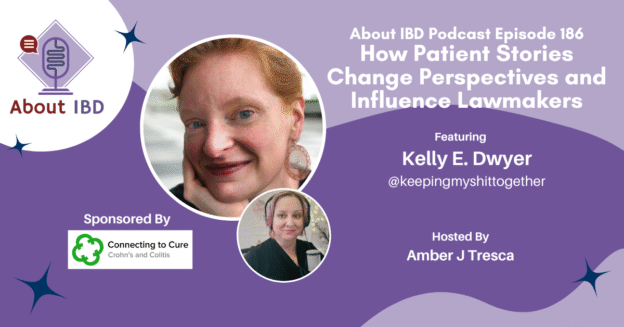
Every person living with inflammatory bowel disease (IBD) can help change public policy by sharing their story and participating in advocacy events, such as visiting legislators in Washington, D.C. Amber talks to Kelly E. Dwyer, who teaches us how to prepare an elevator speech and gives us practical tips for Hill Day logistics, working within teams, staying emotionally resilient, and following up with staffers. Advocacy is for everyone, and persistence and collaboration can lead to real policy changes to benefit the IBD and chronic illness communities. By the end of the episode, you’ll have the real resources you can use to do this work as a patient advocate both locally and nationally.
Sponsored by:

Chapters:
- 00:05 Introduction and Guest Background
- 01:23 The Role and Nature of Patient Advocacy
- 02:37 The Long Game of Advocacy: Successes and Challenges
- 04:37 Advocacy vs. Activism and Personal Motivation
- 06:05 The Importance of Patient Stories in Advocacy
- 06:52 Crafting and Delivering Your Elevator Speech
- 11:46 Managing Emotions and Practicing Your Story
- 15:42 Preparing for Advocacy Day: Research and Teamwork
- 18:07 Training and Building Confidence for Hill Visits
- 20:58 Coordinating with Your Advocacy Team
- 22:38 Practical Logistics: What to Wear and Security
- 24:42 Navigating Capitol Hill: Accessibility and Facilities
- 29:26 Managing the Day: Scheduling and Flexibility
- 32:17 During the Meeting: Structure and Communication
- 36:04 Group Dynamics and Respectful Storytelling
- 40:29 Building Relationships and Following Up
- 42:12 How to Get Involved with Advocacy Groups
- 44:42 Financial Considerations and Accessibility
- 45:17 Encouragement and Closing Thoughts on Advocacy
- 47:12 Lessons Learned the Hard Way
- 50:33 Closing Remarks and Gratitude
- 51:22 Outro and Credits
Topics on this episode:
- Overview of inflammatory bowel disease (IBD), including Crohn’s disease and ulcerative colitis.
- Personal experiences of living with IBD and the impact on daily life.
- The role of patient advocacy in improving healthcare policies and patient rights.
- Challenges faced by patients regarding insurance barriers and treatment access.
- Importance of sharing personal stories with legislators to influence policy change.
- Distinction between activism and advocacy in the context of healthcare.
- Strategies for effective communication and preparation for advocacy efforts.
- The significance of teamwork and collaboration in advocacy initiatives.
- Resources and organizations that support IBD advocacy and patient education.
- Emotional aspects of sharing health experiences and the importance of building relationships with legislative staff
Find Kelly E. Dwyer at:
- Web: https://www.keepingmyshittogether.com
- Twitter: @keepingmyshitTG
- Instagram: @keepingmyshittogether
Find Amber J Tresca at:
- AboutIBD.com: About IBD
- Verywell: Verywell Health
- Facebook: @aboutIBD
- Twitter: @aboutIBD
- Pinterest: @aboutibd
- Instagram: @about_IBD
- YouTube: @AboutIBD
- Threads: @about_IBD
Find Mac Cooney (mix, sound design, and theme music) at:
- Facebook: @maccooneycomposer
- Instagram: @maccooneycomposer
- Web: Cooney Studio
- YouTube: @MacCooneyComposer
- Theme music, IBD Dance Party, is from ©Cooney Studio.
These show notes may contain affiliate links. If you choose to purchase after clicking a link, Mal and Tal Enterprises, LLC may receive a commission at no extra cost to you.
Transcript
[Music: IBD Dance Party]
Amber Tresca 00:00:05 I’m Amber and this is About IBD. I was diagnosed with ulcerative colitis as a teen and had pouch surgery ten years later. Today I help people with Crohn’s disease and ulcerative colitis understand their disease and feel seen. About IBD is real talk on symptoms, treatment and life with IBD straight from patients, caregivers and experts. You’ll learn, feel less alone and have a laugh along the way.
This episode is sponsored by Connecting to Cure. Connecting to cure is a nonprofit whose mission is to accelerate research, amplify awareness of Crohn’s disease and ulcerative colitis, and connect and support the inflammatory bowel disease community. You can find them at Connecting to Cure. And I am so grateful for their support.
Kelly Dwyer is a writer, mother, and instructional designer who lives in the Washington, D.C. metro area. In 2018, Kelly was diagnosed with Crohn’s disease after many years of failing health. She’s a mom to two wonderful kids, spouse to an incredible partner, and writes speculative fiction in her free time. I don’t know what that is, but that’s in her bio.
Amber Tresca 00:01:23 Like many with IBD, Kelly lives with life altering disabilities, but she does her best every day to keep her [bleep] together. Kelly. Welcome to about IBD.
Kelly E. Dwyer 00:01:36 Amber, I am so incredibly excited to be here with you.
Amber Tresca 00:01:39 Me too. Our topic is one that I haven’t covered a lot, at least not to this level, and I am so excited to do so because we’re going to talk about advocating for patients rights with patient advocacy groups, and we’re going to take you through what it’s like to attend an Advocacy day or a fly in in DC and visit the offices of congressional representatives. Oh, so a lot of big words there, but I made my way through it. So. All right, let’s get started. I want to start first by talking about Kelly in our in our pre-work for this show. We were calling it the elephant in the room, which is politics. And we just want to say at the start of the show that it’s important to understand that patient advocacy groups are bipartisan. So for this episode, we’re not going to talk about politics, but we’re going to discuss how to get involved and what that looks like.
Kelly E. Dwyer 00:02:37 Yeah, I promise we won’t touch it with the ten foot pole. because advocacy is for everybody, and we want every single patient to come out and share their story. It’s so incredibly important that everybody knows that they are free to visit their congressional representatives, and they have a voice, and that sharing their story can actually make a difference. But the first thing we have to say off the bat is that advocacy takes time, and it is the ultimate in delayed gratification. And one of the biggest examples we have of this is that it took almost ten years for a coalition of advocacy groups to change the law to ensure that Medicare patients don’t receive surprise bills when they have screening colonoscopies if a polyp is removed. And so they would get terrible hundreds if not thousands of dollars of bills. And and there were no regulatory guidelines to ensure that that didn’t happen for Medicare patients. So it took us until 2020 to get that loophole closed. We were advocating for more than ten years. And even then, the loophole is not phasing out financially until 2030.
Kelly E. Dwyer 00:03:37 So this is a long haul. But it doesn’t mean that patient advocacy doesn’t work, because one of the most recent things that we’ve done is patient advocates is for United Healthcare is last year, they started claiming that they’re going to have prior authorizations for every endoscopic procedure, which is a huge barrier for most patients, and it can delay care. And so the public outcry from patients like you and me actually made a difference for them to roll back that policy within a number of weeks. So it’s really important that, you know, that it’s going to take time, but that the work that we’re doing is really important.
Amber Tresca 00:04:12 It really is. And in the United healthcare situation, people actually showed up and protested outside their corporate headquarters today. That is not, typical or usual. but, in this last thing I would say about politics, I do love a good protest. So, you know, good for them. But the. Yeah, the polyp penalty, which is what they were calling it as well.
Amber Tresca 00:04:37 I came in on the tail end of that. So I think I shopped that around for 3 or 4 years. So I wasn’t there for the whole ten years of it. But it did feel a little long. And because I didn’t understand that? I was like, it’s a bill. It makes sense. Why aren’t we doing this? No, it takes time. And once I understood that, it made me feel a lot better about basically taking some of the same or very similar legislation in front of the health policy advisors for congressional representatives, and I would be like, I would show up and say, here I am again. You know, it’s like the third party is here. Yeah. So yeah. So yeah, that’s, you know, just a little bit about the long tail, about the difference between advocacy and activism. I’ve been an activist my whole life. I have a degree in environmental science. So, turning to patient advocacy was just an outgrowth of things that I was already doing.
Amber Tresca 00:05:40 And so it’s helped inform a lot of the the work that I do in DC and at home with local representatives, because all government is local as well. So however you want to look at it, there’s a place for you. But for the purposes of patients rights, we’re pretty well aligned. I think in most patient advocacy groups are pretty well aligned on it as well.
Kelly E. Dwyer 00:06:05 I agree, and the patient advocacy groups that are out there right now that have been working together are incredible teams of people that have been working for years and years, and there are wonderful groups to join as beginners. They’re always looking for new voices to come in and join them, because every patient has an incredible story that could really lead to measurable change in Congress that improves everyone’s lives. So, you know, it’s it’s incredible to be part of the patient advocacy world. But I’m like you, I’m an activist as well. And, you know, in there there are different skill sets that you can apply at different times. And I like to do both, especially nowadays when the activism requires a little bit more yelling.
Kelly E. Dwyer 00:06:42 But the advocacy is more about speaking and collaborating, listening and convincing. And that’s where your story is. The most important thing is a patient advocate.
Amber Tresca 00:06:52 Absolutely. And to build on that, Kelly, I’d love to ask you if you would share what we’re calling your elevator speech.
Kelly E. Dwyer 00:07:00 My elevator speech. This is the very first thing we’re going to talk about, and I’ll give you mine. And then we’ll talk about how to best create them and practice them. But this is what I would say if I was sitting down in a congressional office in those comfy leather chairs and those big wood paneled rooms with a staffer that I’d never met before. Oftentimes you meet the same person over and over, but their meeting so many people during the day to reintroduce yourself and what you, who you are and what your story is, is important. But I have a couple of different versions. And when we were talking about this before, I had like a seven minute version, you’re like, no, no, no.
Kelly E. Dwyer 00:07:32 Short, short short. So here’s my maybe two minute version. I’ll go super quick. So hi, my name is Kelly Dwyer. I’m a writer and a mother and a Crohn’s patient. I have inflammatory bowel disease and I was diagnosed in 2018 after more than 20 years of failing health. 20 years. Not a mistake. And I would go to doctors and I would say, hey doc, I’m having these cycles of pretty terrible abdominal pain and episodes of diarrhea and have a lot of anxiety eating because everything makes me sick and the doctor would go cycles, periods. It sounds like you might be the owner of a uterus hysteria. You’re too Type-A, uptight. Drink some green juice. Go do some yoga. So 20 years of that and, you know, here’s the thing. Yoga and green juice really help with my anxiety. But they’re not going to help when my body is trying to kill me from the inside out, which is what an autoimmune disease does when you’re undiagnosed for 20 years. And I was violently ill in that time, 60 to £70 lighter than I am.
Kelly E. Dwyer 00:08:35 My husband had to carry me to the bathroom, sometimes 18 to 20 times a day. It was a horrific existence and I had two small kids to look after But after diagnosis, you think I’m. I’ve got a diagnosis. I know it’s wrong. I’m going to get a treatment plan. I’m going to be well on my way to healing. No. I was locked in an eternal battle with the villains of the modern era United Health Care, and they caused permanent, irreparable damage to my intestines and my body because of their policies that put profits over patients. So they required step therapy, they required prior authorizations and then denied and delayed them extensively. And plenty of other shenanigans that made my life a living hell. For several years. I’ve been stable for about two and a half years now, on remission on my fourth biologic medication, which is a little concerning because there are not too many more medications that can keep me alive. And with the recent federal cuts to clinical trials and pharmaceutical funding, my life expectancy has dropped rather rapidly, which is very stressful.
Kelly E. Dwyer 00:09:38 So there there’s a reason why I advocate I advocate for more physician education and training for earlier diagnosis for women, for regulatory guardrails on predatory insurance companies, and for more funding into pharmaceutical cures and potentially, treatments. Additional treatments that can keep me alive to see my teenagers emerge from their chrysalis of dirty laundry at 3:00 in the afternoon to be the wonderful human beings I know they’re going to grow up to be. How’d I do? Was I that was short. Do we get it short?
Amber Tresca 00:10:10 That was amazing. there’s so many things I loved about it. You gave a very succinct description, and you used a lot of words that describe what it’s like to live with an invisible, chronic illness, but then brought it back around to the changes that would have helped you, had they been implemented at the time when you were going through all of the difficulties and getting diagnosed and the changes that will help you going forward. Plus they will help other patients as well. So I loved it. When I’m ready, I’m going to take that bill to my boss.
Amber Tresca 00:10:50 What’s, what’s the bill number on that Kelly.
Kelly E. Dwyer 00:10:54 Let me tell you. I could tell you I could go on and on about the safe pact and pharmacy benefit manager regulatory benefits. It’ll be great.
Amber Tresca 00:11:02 Yeah, 100%. And I love that because you did keep it short. These meetings often. I don’t know, you might have a half an hour. You might have 15 minutes. You might have five minutes in a hallway. So it is important that you get right to the point. And I love that you did that. Something that I want to talk about in regards to building an elevator speech. And the reason it is called such is because you’re supposed to be able to give it in an elevator ride. Although, congressional representatives have their own elevator in D.C., so don’t get in that elevator. That’s not going to happen. Have 100% done that by a mistake and oh, no, to get out. Oh, yeah, I didn’t know. You know, so. But. Yeah. Anyway, I think I’ve probably done it more than once.
Amber Tresca 00:11:46 Oh. But the thing that I want to point out to is that it’s emotional to tell your story. And so something that you want to think about before you even go to DC or go to your local reps is can you get through it? Like, can you get through it without really breaking down?
Kelly E. Dwyer 00:12:05 Right. And and there’s a lot of ways that you can do that. Your number one thing that you talked about is practice. The more you practice, the more it becomes familiar, the easier it comes off the tongue, the less you’ll trip up yourself. But that emotional journey that you need to go through, especially if you’re not familiar with talking about this or if you’ve kept it private. Maybe people in your work don’t know that very much. Our journey as patients always involves grief and heartache and agony and pain. There is no one I have ever met with IBD that does not have an emotional component to retelling their story, so practicing it, but also, like I did, incorporating things with humor and levity.
Kelly E. Dwyer 00:12:41 That’s going to make it more engaging. It’s going to make it stand out more to these lovely staffers who probably are going to be meeting sometimes upwards of dozens of patients a day, not just patients, but other people from other advocacy groups that are coming in to speak about their personal issues. So practicing yours, keeping it short, punchy, engaging it’s going to be a really hard task to do, right?
Amber Tresca 00:13:03 But once you do it that first time, it’ll get easier and easier, and then you will also find yourself honing your speech, over the course of the day. Or if you go back and do this work several times, or you do it virtually, and also the things that you’ll learn while you’re collaborating and working with groups and working with other patient advocates. Because bringing up these things bring up these things to our, our, you know, nearest and dearest are difficult. But now you’re telling a stranger, a very compassionate stranger, but they are still strangers. And I will point out that there are things that I have never discussed publicly that I absolutely bring up in the room with these staffers.
Amber Tresca 00:13:47 So and that is because they are so difficult to to speak of, that it is not something that I think is for public consumption, but it is important that they know the real truth of how much my life and the lives of those around me were affected by the stupid IPD.
Kelly E. Dwyer 00:14:08 Yeah, and, you know, sometimes I’ll make a really funny joke. Like, I guess you didn’t think that we were going to be talking about poop today when you woke up this morning? Yeah, really? You have to read the room to see. Do you have somebody who might be open to that? Kind of a funny joke, because we know there is a significant stigma to talking about IBD and all of the effects that it has on the body, and we know and from lived experience, this is more just than just a bathroom disease. But also it can be incredibly shocking to say I needed to go to the bathroom 18 to 20 times a day. I think there’s something very powerful about describing that kind of lived experience, but it also may not be received well, and you have to walk delicately with that and determine how best you’re going to make an effect of your story.
Amber Tresca 00:14:49 That’s true. And sometimes you also might want to ask if they’ve heard of IBD or, you know, whatever other condition you’re discussing. If they’ve heard of an ostomy, you might be prepared to describe those things. I can’t help but make jokes. So like, that’s just what I do all of the time. I think it is helpful. Like you’re serious? Yeah. It’s serious, but that doesn’t mean that you can’t, you know, make a little joke like. And I really like the one that you described. So I think it’s okay if people take that one.
Kelly E. Dwyer 00:15:20 I agree, please do take it and use it and, and come up with your own jokes about your own behaviors. Because honestly, we all deserve a little bit of levity when we’re dealing with this disease.
Amber Tresca 00:15:30 I mean, if we don’t laugh, we’re going to cry so little sometimes. Yes, you and I are laughing as though. So that’s what we’re going to do. All right. So let’s move into how you get ready for the day.
Amber Tresca 00:15:42 Some practical pre-work. Kelly, what are the types of things that you do when you’re getting ready to visit? Well, offices on the hill.
Kelly E. Dwyer 00:15:51 Usually one of the things that I’ll do first is look at my legislators. And if you haven’t done that before, the best place to go is Congress.gov. And usually those are the place you can type in your address. You’ll figure out who your two representatives are, who your senator is. You’re going to be necessarily potentially in a group of other people that are constituents of other representatives. So you may be visiting more than just your legislators and representatives offices, but look them up. And I really like to kind of get a handle on what their views are on health care policies. I like to go to their websites, although a lot of times they’re just filled with kind of filler stuff. But it it specifically helps me when I look up their voting records on previous bills that have things to do with healthcare. It may not be specifically on IBD, but things such as pharmaceutical benefit manager reform or cancer research money.
Kelly E. Dwyer 00:16:40 There will usually be press releases on legislator websites that you can look at, and that helps you significantly when you walk in that room to make a connection with the legislator and their staffer.
Amber Tresca 00:16:51 Absolutely. And I always like to look up their their pet issues. You know, every legislator has their their issue that they like to come back to again and again. Usually it’s pretty clear when you’re on their website and you’re looking at their press releases, like you said, Kelly, sometimes it’s fluff. There’s going to be openings of things and there’s going to be, you know, them using a shovel to dig something and all of that. And that’s important and all of that is going to be there. But then there’s also going to be the real work that they’re doing, the funding that they secured, the issues that they show up for. What are those things? And can you tie that back to health policy? And I think you almost always can. Because we’re all humans and we all have to care for our health.
Amber Tresca 00:17:39 So you can always you can always find a way to do that. And I think too, if you’re not sure how to go about it, that’s something that you can discuss with the other people that you’re working with that day. Because advocacy is not a it’s a team sport. Let’s just put it that way. You’re not going it alone. So Kelly, tell me a little bit about like, the training that you can expect when you do one of these fly ins or one of these hill days.
Kelly E. Dwyer 00:18:07 Almost all of these groups will arrange some sort of training in advance, and oftentimes it will be on zoom. Sometimes it will be a PowerPoint or a PDF that they’ll send you ahead of time. Many of them will provide Q&A sessions for patient representatives. It depends on how large the group is and how many people are participating across the industry. It may not just be patient voices. You might also have physicians. You might also have industry and nonprofit representatives, which is absolutely wonderful. I think the more voices you have, the more credibility you give to advocating for your particular cause.
Kelly E. Dwyer 00:18:39 But there will be some sort of training that’s going to talk about their legislative priorities, how to give an effective elevator speech. So we’re giving you a little bit of a jumpstart here on helping you to get ready for this. But but it will be really wonderful to participate in each of these because you’re going to build your skill set more and more each training you have. And it’s just remember, you’re going to be there’s I remember my first training, I was so overwhelmed. I didn’t understand a lot of the language that people were talking about. Why it’s important for committee assignments to be considered, and why particular bill numbers need to be different between the two Congresses, and bills need to be reintroduced. I you know, I, I’m a Schoolhouse Rock kind of kid. I remember a very basic amount about our legislature, which works, but I didn’t need to be a policy expert. I just needed to be briefly aware of what we were asking for as a legislative whole, and then bring my voice and my story.
Amber Tresca 00:19:34 Yes, absolutely. I think that might be the point that is most important to understand and might keep people from doing this work. You do not have to have a degree in public policy, and you will learn over time, and you will learn in training. You will learn from the people that you are working with on that day, and you will learn if you do this work over a period of years. So don’t don’t worry about that. And I think it’s perfectly fine to when you walk into an office to say, this is my first time here. And you know, and I’m loving this work and I’m so grateful that you’re listening to us today, and I’m going to do my best. Totally fine. also, you want to make sure that you’re asking questions. I mean, of whoever is doing the training. Other people will have lots of questions too, and it’s good that you just get it all out in the open. I always say, if you have a question, there’s probably somebody else in the room that also has the same question, but they are also too nervous or whatever to ask it.
Amber Tresca 00:20:40 So just go ahead and ask it because you’re going to be doing them a favor.
Kelly E. Dwyer 00:20:43 Oh, absolutely. And you know, you’re building your knowledge about the topic. You’re ensuring that you’re going to show up in those legislator’s offices with the the best case that you can give, the best ask that you have for what you’re trying to convince them to do. If you ask questions, that’s how you learn.
Amber Tresca 00:20:58 Absolutely. And you’re going to meet your team, whatever that consists of. Could be lots of people, a few people, people from all walks of life, other patients, as you were saying, Kelly. And so it helps to sit with them for a minute or as you’re, as you’re walking over to the hill, whatever that looks like, or taking, taking a car over there, you work it out. Who’s talking when, who’s introducing, who’s closing, who’s sharing what story. Sometimes stories have overlapped. So you say, okay, I have this part of the story covered. You pull out this thread from your story.
Amber Tresca 00:21:32 So we’re making sure that we’re hitting on these things. the whole goal is to tie it back to the legislation.
Kelly E. Dwyer 00:21:37 Yeah. And I often when I come into the office, if I’m the one who’s leading the session, I’m going to have everybody introduce their names and say, we’re going to give you a brief story, then we’re going to tell you our legislative policies. And then I ask them for their their time that they have, because they often have a very limited time. but the most important thing that you can do is, is don’t overlap your asks, because you need to make sure that your story is very punchy and engaging. So in my elevator speech, I was talking about step theory, research and education for early diagnosis and legislative guardrails for insurance companies. Somebody else may only be able to talk to step therapy. I’ll take that out and make sure that they have the space and time to speak to that.
[Music: Transition]
Amber Tresca 00:22:26 Connecting to cure is dedicated to connecting and supporting the IBD community, accelerating research and amplifying awareness of Crohn’s disease and ulcerative colitis through their connections programs.
Amber Tresca 00:22:38 Connecting to cure. Offers resources like peer mentorship, gut friendly workouts, and support groups for IBD patients, caregivers, and family members. They also provide assistance to underserved communities, helping families cover the costs associated with their children’s medical care, and making it possible for kids with IBD to attend summer camp. Connecting to cure funds cutting edge research at leading institutions like Cedars-Sinai, Mount Sinai and the Mayo Clinic. To learn more or to get involved. Visit connecting to cure.org.
[Music: Transition]
Amber Tresca All right, Kelly, we have to talk about some of the practical things about the day. Like what to wear. office casual. But you want comfortable walking shoes? Maybe some stylish ones. I have some that are, like, all glittery and that kind of thing. So I’ve done my best there. It’s all I can do. Can’t wear the little kitten heels anymore. It’s not gonna work. So and you also have to remember that you’re going through security. It’s a lot like going through security at the airport. And so no sharp objects.
Amber Tresca 00:23:50 Food and water are fine. But sometimes if you have a medical device, you know you need to go to the side and they will find someone to pat you down, that type of a thing. So that’s just some practical things about entering the buildings that our congressional representatives have their offices in. And you usually have somebody with you that’s been there before. So and they’ll go over this in the training as well. They’ll remind you, I’ve usually get stopped. Like for my shoes. They always, like, wand my shoes. Or there’s something about me that they have that I usually end up getting something about. Like my ankles. I don’t understand, I can’t figure it out. Maybe it’s a stray staple that’s still, in me from my surgeries, but I usually get wounded or whatever. It’s not a big deal. it’s nothing to get too nervous about, but I think it’s just important that people know about that aspect of it.
Kelly E. Dwyer 00:24:42 And depending on the day that you’re on the hill and depending on where you’re entering, there may be long delays.
Kelly E. Dwyer 00:24:47 That’s another thing to point out. And sometimes they’re not predictable. There are oftentimes not chairs outside of security. So if you feel you need an accommodation for security, I would contact your organization ahead of time. Any accommodation at all from ability or other invisible disabilities that need accommodations. Talk through it with your your organization sponsor, because they’ll be able to give you an understanding of what they’ll be able to do for you, what’s feasible and realistic, but anticipate that security may be very short or it may be very long and give yourself plenty of time on the. The congressional buildings are separated on either side of the Capitol, north and south, and you will only have to go through security once on either side for either the the House buildings or the Senate buildings. So that spares you a little bit of time, but the buildings are wheelchair accessible and there are elevators. As long as you don’t get into the getting the residents dug into the wrong one. But they’re very well labeled. Sorry, Amber.
Amber Tresca 00:25:40 [Laughter]
Kelly E. Dwyer 00:25:43 So don’t fear. She’s not giving you an irrational fear. No, no, but you will be traveling long distances. These are huge buildings. they’re kind of a rabbit, Warren. You will have somebody to to navigate with you. Everyone I have ever talked to has been very friendly to help us navigate when I’ve gotten lost. But if you feel that you are going to be short on time, you can send someone ahead or call ahead to the next office meeting. Because many times these organizations will pack your meetings in back to back and only give you a few minutes to get from one side of a building all the way to the other. And you don’t want to waste anyone’s time. And it’s very respectful to call ahead and say, we’re running 2.5 minutes late. Like, that’s they understand that bathrooms are are available in all buildings. And I really like to walk around and like, eyeball every bathroom. I don’t know about you. I check and see. It’s like checking all your exits.
Amber Tresca 00:26:33 I’m looking for the bathroom, you know.
Kelly E. Dwyer 00:26:35 Yeah, they’re very beautiful bathrooms. And some of them, they’re quite lovely. Yeah, they are not private bathrooms. They’ll all be public bathrooms. And if you get in a jam, ask your congressional representative or the staffer where the closest bathroom is, and there’s food on site as well. There’s not only cafes, but there’s cafeterias. And, you know, I’ve I’ve been in groups with people who have severe food allergies, celiac disease, other concerns and intolerances. They’ve done very well in several of the cafeterias. But again, if you have concern about food, you can either bring your own. That’s absolutely acceptable food is allowed or or call ahead and talk to your your advocacy group because they’ll be able to tell you what’s in the cafeteria and what you can customize to your specific needs. And then the last thing about accommodations and sort of accessibility is just to talking about masking. I mask extensively everywhere on Capitol Hill. I know some people have been asked in congressional offices not to mask, but in general, in my personal experience, I have never found that the staffers that we meet with ever have any issue, and I have never been made to feel anything less than a positive connection with them, even when wearing my mask.
Kelly E. Dwyer 00:27:41 So if that’s something that you choose to do, I’d encourage it. And depending on the weather, there’s also places for you to buy food and eat outside if that makes you most comfortable.
Amber Tresca 00:27:50 Yes, there are many, many places where you can grab something quick to eat, although the recommendation to maybe pack some snacks and some water for yourself is well placed, especially because and I always forget whenever I’m there in the spring or in the fall, it is down south. So, you know, it can, be a hot day sometimes. last time I was there was. It was quite. It was quite warm.
Kelly E. Dwyer 00:28:20 It was warm. I it’s I hate to tell you, I’m a local. I’m a native here. I’m just outside of Washington, D.C., in Northern Virginia, and it is swampy.
Amber Tresca 00:28:30 No, no.
Kelly E. Dwyer 00:28:31 Every day of the year. Just be prepared. It’s going to be humid. And some of the buildings are very heavily air conditioned. Others are not. layer layers and comfortable shoes are your best guess.
Amber Tresca 00:28:45 Absolutely. I will say for myself, it’s usually like, a sleeveless top of some kind and then like a blazer or a cardigan that I can pull on and off as needed, and making it as stylish as I can. It’s just important to consider those things because we don’t want anybody passing out outside the Rayburn Building because it’s too. It’s too warm. So don’t be hero. Do what you need to do. But I’ve also seen people show up in, like, their advocacy group. Everybody gets like a t shirt and everybody wears the same t shirts. So, like, you know, whatever happens, I think it’s just important to be flexible.
Kelly E. Dwyer 00:29:26 And anticipate the day, you know, and anticipating the day and the weather. And, this will be more physical exertion than you expect. You think walking around and speaking to people is not going to be a tiring day. It is usually a 6 to 8 hour day walking, talking, hustling. And if you are, if your body or your disability means that you’re unable to support that, talk to your advocacy group.
Kelly E. Dwyer 00:29:53 Maybe you can. I know a lot of people that just do a morning or pick and choose and take a longer break at lunch. if you have a large enough group, you can swap in and out to make sure that people are resting and and able to build up their endurance as they need.
Amber Tresca 00:30:07 Yeah, you wouldn’t think that it would be a high step day, but it is. And part of it is because you may walk over and or you can also take a car over from wherever your group is meeting, whatever hotel or meeting space over to Capitol Hill. And then the buildings are on either side. So they are connected underneath by, these tunnels. It’s really it’s not tunnels, really like a big hallway. but you are walking from one side of the Capitol to the other. But even doing that the morning with Congress and the afternoon with your senators does mean that you’re walking between several buildings. And when you think about it, the buildings are really big, because every representative has their own space in it.
Amber Tresca 00:30:56 And, that’s why they’re so far apart.
Kelly E. Dwyer 00:31:01 So you do have these long hallways that connect the, congressional side or the House representative side and the Senate side. But then if it’s raining or if it’s incredibly hot, plan that you have to walk over ground to get to the other side of the Capitol, which is bring an umbrella, and then bring an umbrella for the sun or the rain.
Amber Tresca 00:31:20 Yeah. And I mean, it’s beautiful and it’s exciting and all of that, but we just have to be aware of our energy, our energy levels during the day, especially because you’re taking. I think probably the least I’ve taken is three meetings and the most I’ve taken is five. But I’ve heard of people doing more than that in one day.
Kelly E. Dwyer 00:31:42 I’ve definitely done a few more. I think I’ve done 5 or 6 in a day. Yeah. Sometimes meetings change. Be flexible. oftentimes your sponsor organization will call you and say, this meeting has to be canceled because of a staffers availability. Oftentimes, what they’ll have you do instead is called a folder drop or a file drop.
Kelly E. Dwyer 00:32:01 And we get what’s called a leave behind. So you can take that folder and drop it in the office, and then ask if there’s anybody else that might have five minutes for a meeting. But that’s oftentimes just as successful because you can get a card from the staffer you would have met with and engaged in some discussion by email.
Amber Tresca 00:32:17 Right? Absolutely. And you reminded me, Kelly, that there is a message in my voicemail right now regarding meetings that I’m having in a couple of weeks and some changes that need to be made. So note to myself to do that after we get off this call today. All right. So let’s talk about some logistics of during the meeting, Kelly, you talked about the fact that you like to if if you’re, the one that’s leading the meetings, you like to open with some introductions explaining the mission of the advocacy group. If there’s a staff member with you, that person might do that. Usually you’ll have some wording. It’s okay, you’ll have some notes. It’s okay.
Amber Tresca 00:32:56 You can go from that. and I usually ask if the staffer is was familiar with IPD, because that is the, patient experience that I speak to. And sometimes I ask them if they know what an ostomy is. That’s especially true if you’re meeting with somebody who is not a health policy expert. It’s also a great opportunity to have somebody else in that office who understands these conditions on a more intimate level. They will have questions, and it’s okay. You may or may not know the answers. It’s okay. But that’s why you get that card. Because and take some notes because later on you can email them with the answers to whatever questions that they have, and they could be questions for you. They could be questions that need to be answered by the advocacy group. They could be questions that need to be answered by the health policy expert. And you would forward those questions to that person.
Kelly E. Dwyer 00:33:52 And each organization will tell you how they prefer to follow up. But in general, it’s always a really good experience to write and thank the staffer for their time and their connection.
Kelly E. Dwyer 00:34:02 And don’t be intimidated. The staffers are trained to make you as a consensus constituent, feel heard, feel listened to, and feel respected in their offices. Almost all of the meetings that I’ve ever heard from patient advocates have almost all, not all, have been very positive and respectful conversations with the staffers. But each staffer may have multiple policy areas that they cover, and they may be new to talking about health care policy. So don’t assume that they understand each of the different things that you’re talking about. But I will say many of them have been with their legislators for years and have been working on these same bills and same priorities, and their their legislators priorities don’t change over time. They’re still health care advocates. So it’s not as if you’re beating your head against a chalkboard to try and get them on board. They’re already on board. Many times the meetings end up being more of a thank you so much for your advocacy. Please continue to help us. It’s always important to thank the staffer for the prior work and the legislative priorities.
Kelly E. Dwyer 00:35:09 The number one thing I can recommend in the meeting is take notes and take notes in the meeting. I have made the mistake almost every time I’ve gone that I’m going to walk out that door and I’m going to jot down.
Amber Tresca 00:35:21 Remember.
Kelly E. Dwyer 00:35:21 I’m going to remember. And when you get 2 or 3 meetings down the road, they all. It’s not an insult to say, but they all blend together. So take no one will be upset if you get a pencil and paper out and take those notes right away. I like to take a notebook with me, but sometimes the organizations will send you with paperwork that you can take notes for questions and follow ups. Meetings are going to run short. You mentioned this before. They sometimes can be five minutes in a basement hallway. So do your very, very best to cover the information you need to remember. You’re there to tell your story, but the organization wants you there to push legislative priorities that your story supports. So you sort of have a dual obligation to them.
Kelly E. Dwyer 00:36:04 it’s really important to think about group dynamics in the room. You’ll start to understand some people may be ramblers and talk a lot gently.
Amber Tresca 00:36:13 Saying, not you.
Kelly E. Dwyer 00:36:15 Me, never me with my big mouth that talks nonstop. The very the a funny anecdote. Anecdote. The very first time that I was, that I was a patient advocate on the Hill. My entire regional group did not show up, and I was the only person there. It was me and one staffer from the organization, and he was like, we don’t have to do this. And I was like, are you kidding? Let’s go. So, you never know. You have to sort of roll with the punches. but think about group dynamics. If you have somebody who rambles a little bit, see if you can encourage some focus. See if you can pad them on either side with people who are very brief. It’s important to be incredibly respectful of your other patient advocates that are with you, because everyone’s story is incredibly unique and incredibly important to be heard and spoken of in these meetings.
Kelly E. Dwyer 00:37:07 and then the very last thing at the meeting, usually you leave behind a folder and you collect a business card. And I especially love to take a photo. You can ask the staffer if they’ll take a photo with you or outside the offices. There are usually flags and signs that you can take a sign of.
Amber Tresca 00:37:22 Yes, absolutely.
Kelly E. Dwyer 00:37:23 Take a photo with the sign.
Amber Tresca 00:37:25 Yes. And the advocacy group may remind you to do that. And it’s a good thing to share on social media if you feel comfortable, because it shows that we’re all there and we’re doing the work, and it gives people hope. And because not everybody can do this, I wish everybody could go to DC at.
Kelly E. Dwyer 00:37:45 Least.
Amber Tresca 00:37:45 Once. It is such a special place, but it’s just not possible for everyone. And I think it does help the people that would love to go, but can’t for whatever reason, to see that you’re doing. You’re there and you’re and you’re doing that work. And they’re used to getting their pictures taken.
Amber Tresca 00:38:00 And also, by the way, if you see your representative, well, this is something that I do. Maybe a lot of people don’t do this, but I will ask a staffer. I will say, is your boss in the office? Could they take a photo really quickly? 90% of the time that answer has been no. but I ask anyway because 10% of the time the answer is yes. So?
Kelly E. Dwyer 00:38:24 So congressional offices do really nice things for their constituents. Yes. Oftentimes they can arrange tours of the Capitol. This is obviously separate from your advocacy group. sometimes you can send them notices of really special accomplishments of your family or community, and then they’ll have the legislator send back a congratulatory note. There’s there’s sweet things that they can do to connect with these staffers. I think it is worth it as a constituent.
Amber Tresca 00:38:50 Absolutely. And when you are going to the representatives of, you know, your own district. Many times the staffers live in your state. Last time I was there, I met somebody that went to my kid’s high school, and we just had a nice chat about that.
Amber Tresca 00:39:08 And I will say to your point about the nice things that that congressional representatives can do for their constituents, if you’re going on a vacation, get in touch with them. There’s all sorts of things. They will have flyers in their offices. I take those because we have vacationed in D.C. and when my son made Eagle Scout, I wrote to these offices and asked them and just told them that he made Eagle Scout. And I also pointed out that I’ve been a guest in their offices many times and have enjoyed my work with them, and they all sent back like, you know, these proclamations for him, which now I have. So these are the type of things I think a lot of people don’t think of, and they’re just really nice because you these people work for us.
Kelly E. Dwyer 00:40:01 They do, they do. That’s critically important. I think it’s so important to remember that these people work for their constituents. You are a constituent. You elected them. You are. You certainly don’t want to come in with a you’re going to do everything I say attitude.
Kelly E. Dwyer 00:40:20 What you’re coming in is this. Yeah, you’re coming in as a constituent. It’s a relationship that you can keep in mind as you step into that office.
Amber Tresca 00:40:29 Absolutely. And then you’ve had your meeting. It’s gone great because it always does. And now it’s time for follow up. That’s another discussion you’re going to have with your team and with the group that you’re with. Kelly, do you have any examples or can you tell me a little bit about the things that you do when you get home to keep up the relationship.
Kelly E. Dwyer 00:40:51 Sure. To keep up the relationship. I make sure at least within 24 hours, that I’ve sent an email to each of the main staffers that I’ve gotten a business card for. And then I also either that night, while it’s fresh in my mind, I will take notes on any of the additional notes that I need to remember. And then the following day, I will send a summary note of all of our meetings with all of the questions that I couldn’t answer to the, the sponsor organization.
Kelly E. Dwyer 00:41:18 Sometimes I will cc the sponsor organization on that initial email saying, hey, I’m not a policy expert, and the following staffer asks the following question. I’m connecting you two together so that you can get her the answer that she needs. That’s just an example. So following up on that, that relationship really involves just an initial email. I’ve actually occasionally had staffers email back with the thank you and an additional follow up, which, you know, is an incredible opportunity because they have such a short amount of time in their day to be able to follow up on these individual issues. So being really respectful of that and making sure you’re, you’re following up in a timely manner is really important. But the number one thing I do when I get home is I kick off my shoes and I hydrate, and I sit in a comfy chair with a heat pad because, oh, my body’s usually really beaten up by the end of the of a long day on the hill.
Amber Tresca 00:42:09 Absolutely. And it’s all about relationships.
Amber Tresca 00:42:12 I, you know, have gotten to the point where I’m on hug. Hello terms with some of these health policy staffers. So maybe that’s not for everybody, but I’m a hooker. so. All right, how do you get involved? How do you do this work? So I just want to point out that, some of the groups that I’ve worked with, the Digestive Disease National Coalition, the DNC, the Crohn’s and Colitis Foundation, and the International Foundation for Gastrointestinal Disorders, which is the if GD, once you start doing the work, you will it will snowball and you will start doing it more and you will learn more. And if you love it like we do, then you can just keep on going. And I will say sign up for the newsletters for the patient advocacy groups within your disease space or within broader disease spaces, because then you will learn about when they’re having their advocacy days. How about you? Kelly.
Kelly E. Dwyer 00:43:03 You know, I’ve worked with many of the same groups as you have.
Kelly E. Dwyer 00:43:05 And I also want to point out some more specialty groups that are topic specific, like Koji, The Color of Gastrointestinal Illness, Sia, South Asian IBD Alliance, and Girls with guts and IBD Social Circle. These are all groups that will bring opportunities available to patients that you can connect with. They’re also just incredible and wonderful communities of IBD patients. Connecting with the groups is really a matter of signing up for their newsletters. You can check online. A lot of people will post on Twitter or Reddit in various social communities if there are patient Opportunities. Groups like the IFD oftentimes collect patient stories for patient panels, and then they will connect you with opportunities like a hill day. But the one that I think is the really important one that you talked about was the DD and see, which is the Digestive Diseases National Coalition, which is coordinated by a bipartisan nonprofit called the Health and Medicine Council. And they every spring put on a public policy forum that also includes A day on the Hill. They have a fall public policy forum that talks about current legislative priorities, but not a Hill day.
Kelly E. Dwyer 00:44:15 So in the spring and early spring, they will have patients and lots of organizations like I know, the UOA, the United Ostomy Associations of America, Fight Colorectal Cancer, and several other advocacy groups will come and and pay to bring their patients to Washington, D.C., to take part in this free policy. But when I took part in it, I was a private advocate that came and I paid my own way to be here.
Amber Tresca 00:44:42 Well, yeah, I’ve done that a few times as well. some groups will be able to offer you a stipend for travel and then cover a hotel room for one night. Usually it all just depends. Don’t be afraid to ask, because this is a big part of it. DC is not like a place where you can get a really inexpensive hotel room. and you want one that’s near the hill anyway, just to make it easier on yourself. So if you can, you know, if you think about doing this work, make sure that you’re finding out about about the money, you know.
Amber Tresca 00:45:17 So, don’t worry about asking about that because that’s important. All right. So to close this out, I, we both have a couple of things I think that we want to say just real briefly, and I just want to say that advocacy is for everyone. Every one. you live in a place that has a government, and so you are part of it, and you belong in it, and you will learn along the way. I didn’t know very much, but I’ve worked with people, learned from them, asked a lot of questions, sometimes felt real dumb doing it. They do it anyway. And now I have more confidence. And I’ve learned over time how to be more effective. So, Kelly, what’s your closing statement?
Kelly E. Dwyer 00:46:08 Your voice matters. I mean, that’s such a cheesy thing to say, but it’s critically important for you to hear it. We all have a story about our IBD and IT. IBD is such a difficult and devastating disease. You may not realize how much your story connects with other advocates, and how much your story is really critical to pushing for legislative change to ensure that people don’t suffer the way that we have suffered.
Kelly E. Dwyer 00:46:34 There’s a lot of opportunity in the world for patient advocates to stand up and fight for change. Effective change. But change only happens through persistence. We have to continue speaking. We have to get our foot in the door and we. It’s a call to action for all of us. So find a group that you can advocate with. State advocacy is just as important as federal advocacy, if not more. Prepare your story, practice your elevator pitches, and then be brave and take that first step. Because the more patient voices we can bring to the hill, the closer we’re going to be to actually effecting real change.
Amber Tresca 00:47:12 All right, Kelly, I have I have probably the most difficult question topic that we’re going to discuss today. And this is the last question I’m going to ask you. And it is I want you to tell me a story about something that you learned the hard way.
Kelly E. Dwyer 00:47:33 Yeah, I had to. You gave me a little bit of advanced warning on this, and I had to wrack my brains because, boy, sometimes it feels like with this disease, you learn everything.
Amber Tresca 00:47:40 Everything the hard way.
Kelly E. Dwyer 00:47:42 Everything. So I’ll give you two small, funny bits. And then one. One slightly more IBD parenting centric one, which is please wear comfortable shoes. And I know you said you like to be stylish, but I am a mom. In perimenopause. I wear the most ugly, comfortable shoes I have because I learned it the hard way and I wore comfy boots the first time I was on the hill and I got terrible blisters. The other thing is, if you take biologic medication and you are prone to Humira headaches like I am, don’t take your medication the morning before you go to Capitol Hill. So on one of the advocacy training days I did my I thought I’ll just be I’ll get my shot in in the morning. And then unfortunately, occasionally I get really terrible migraines. And I was sitting in the basement for 20 to 30 minutes and then my car in the dark parking garage, waiting for the ocular migraine to resolve so I could drive home in that very brief window before the migraine headache hit.
Kelly E. Dwyer 00:48:41 And, you know, thankfully, that was only the training day and I was able to go home, rest. And the next day I was up and on the hill. So so time your meds and then the I think the more important thing to say here, as a parent with a severe chronic illness and some pretty profound disabilities is it feels like everything in parenting with a disability, you do the hard way and everything is agonizing and difficult. And I worried every day that my children were going to have profound impacts from my disability and my inability to be present for them as a healthy parent, and the lack of opportunities. Sometimes when you’re unable to take them traveling or, you know, have to run to a bathroom every 20 minutes at their dance recital. All. The thing that I learned the hard way is that they grow into compassionate, empathetic, kind, loving people because that’s how you treat them. And they learn the modeling and they learn in their hearts that caring for others is is the only way to be a wonderful human.
Kelly E. Dwyer 00:49:53 So we we might be agonizing through the hardest parts of every step of parenting, worrying about how our illness affects our kids. But for mine, and they are wonderful, even though they are teenagers, they’re going to be incredibly kind and empathetic people that care for others. And and it’s a lovely and wonderful thing.
Amber Tresca 00:50:14 That has been my experience as well. And I worried about the days when I couldn’t get off the couch. And I’ll tell you what, those were the days that actually we bonded. And the kids probably loved those days the most because they got more of their mom. So I agree with you completely.
[Music: IBD Dance Party]
Amber Tresca 00:50:33 Kelly. It has been fabulous to get to know you. First off, when we met and on the hill. And then also, it has been so great to put this episode together with you. You are a fantastic collaborator and I really appreciate all the work that you’re doing, everything that you have taught me and then everything that you are teaching the wider invisible illness community.
Amber Tresca 00:50:58 So thank you so much.
Kelly E. Dwyer 00:50:59 Thank you so much for this opportunity. I’m so incredibly excited to be here with you. And it’s I know we could probably talk about this for hours and hours. So if anyone has any questions about these particular topics, please reach out to us. We have so much more experience to share. We really want to make sure that people know how accessible and positive and encouraging being on the Hill and advocating as a patient is. Thank you for having me. This was delightful.
Amber Tresca 00:51:22 Absolutely. Kelly, thanks so much.
Hey super listener! Check the show notes to find links and information about the topics discussed in this episode. Plus, get a written transcript and much more on my website about IBD. Com. If you enjoyed this episode, please consider sharing it with someone or leaving a rating in your podcast app. Reviews and ratings help me grow the show and bring you more great content. This episode was sponsored by Connecting to Cure and I am so grateful for their support. Thanks for listening and remember, until next time, I want you to know more about IBD.
Amber Tresca 00:52:08
About IBD is a production of Mal and Tal Enterprises.
It is written, produced, and directed by me, Amber Tresca.
Mix and sound design is by Mac Cooney.
Theme music is from Cooney Studio.