
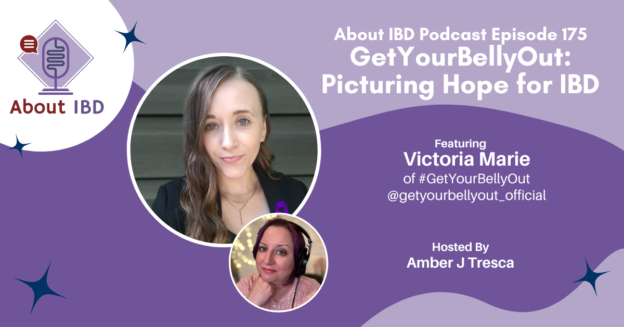
Victoria, from the patient-led, charitable organization GetYourBellyOut, shares her journey with ulcerative colitis. She describes the unique role of patient advocacy and the importance of community support, as well as the innovative projects that GetYourBellyOut is undertaking to bridge the gap between patients and healthcare providers.
Listen and Subscribe to About IBD: Apple Podcasts | Spotify | Overcast | Castbox | Amazon Music | All Other Podcast Apps
Topics covered on this episode:
- Personal journey with ulcerative colitis and diagnosis experience
- Emotional and physical challenges of living with inflammatory bowel disease (IBD)
- Importance of community support and connection for individuals with chronic illnesses
- Founding and evolution of the organization “Get Your Belly Out”
- Advocacy and awareness efforts for IBD and its impact on patients
- Family dynamics and the effects of IBD on relationships
- Role of social media in connecting individuals with IBD
- Challenges of being a public figure in the IBD community
- Importance of patient feedback in improving care and resources
- Future goals and initiatives for expanding support and resources for those affected by IBD
Find GetYourBellyOut on:
- Web: https://getyourbellyout.org.uk/
- Facebook: @getyourbellyout
- Twitter: @getyourbellyout
- Instagram: @getyourbellyout_official
- LinkedIn: @getyourbellyout-cic
- Tik Tok: @getyourbellyout_official
Find Amber J Tresca at:
- AboutIBD.com: About IBD
- Verywell: Verywell Health
- Facebook: @aboutIBD
- Twitter: @aboutIBD
- Pinterest: @aboutibd
- Instagram: @about_IBD
- YouTube: @AboutIBD
- Threads: @about_IBD
Find Mac Cooney (mix, sound design, and theme music) at:
- Facebook: @maccooneycomposer
- Instagram: @maccooneycomposer
- Web: Cooney Studio
- YouTube: @MacCooneyComposer
- Theme music, IBD Dance Party, is from ©Cooney Studio.
Transcription
Amber: I’m Amber Tresca and this is About IBD, the podcast that knows there’s no cure for any form of IBD. I’m a medical writer and patient educator who lives with a J-pouch due to ulcerative colitis. It’s my mission to educate people living with Crohn’s disease or ulcerative colitis about their disease and to bring awareness to the patient journey.
Amber: Welcome to episode 175. My guest is Victoria Marie, one of the founders of GetYourBellyOut. GetYourBellyOut is a patient-led charitable organization based in the UK. They provide support, education, and advocacy to a global community of 45,000 people. GetYourBellyOut is celebrating their 11th year of raising awareness and improving standards of care for the IBD community.
Amber: After a long road to getting the right care, Victoria was diagnosed with ulcerative colitis. Because of her experiences, she’s committed to helping others navigate the challenges of living with IBD through positivity, encouragement, and support. We not only talk about the offerings GetYourBellyOut provides to the community, but also the challenges of being a public person in this space and how we navigate the pressures of differing opinions and priorities.
Amber: Victoria, welcome to About IBD.
Amber: Hello. This has been a while in the making, but I’m delighted to actually be here. I don’t do many podcasts, but this one I felt as soon as you asked me, I was like, yeah, I’m definitely doing that. So happy to be here.
Amber: You know, and I’m so grateful that you agreed. And then also I’m wondering if I actually have magical powers of persuasion that I talked you into this. I’m not really sure.
Victoria: Well, it just happened to be like really great timing in the sense of I was already talking about you quite recently. I was sort of sharing the backstory of how we kind of know each other. And then you turned around and you asked me if I’d be on the podcast. So I was like, it’s fate. Good timing. So happy to be here.
Amber: Yeah. Yeah. And I told you offline, but that you’ve been on my short list of guests for a very long time. And then, yes, it did seem to be that this is the right time. And we will absolutely get into that as to why. But people listening might not know you as well as I do, Victoria. So would you tell us a little bit about yourself?
Victoria: Sure. So my name is Victoria. I am 37 now from the UK. And I’m the founder and director of a really wonderful organization that’s got a really funny name. It’s called GetYourBellyOut. We provide support, education and advocacy for a global community that have inflammatory bowel disease. So things like Crohn’s disease or ulcerative colitis or microscopic colitis, which is not mentioned as often, but we’re doing our best to try and right that wrong a little.
Victoria: So, yeah, we’re here. We’re run by patients and we’re for patients because there was sort of that little gap in care. And I think people can find it quite daunting to ask your medical team certain questions. So it’s a lot easier to talk to other patients to ask those sort of niggly day to day things. So we give them that platform and that safe space to be able to do that.
Amber: I love that. And you are so right about that. And so in that vein, I wonder if you would take me through your diagnosis journey. And you are diagnosed with ulcerative colitis. And how did that all start for you? And then how are things going today?
Victoria: So I first started having symptoms of inflammatory bowel disease, which I now know was ulcerative colitis, when I was about 21 years of age. And I was working away from home. So I didn’t have access to sort of the bathroom and scales. So I wasn’t aware that I was losing a significant amount of weight. I was rushing back and forth to the bathroom.
Victoria: And I went to the GP because I knew something wasn’t right. And she wanted to refer me on for further tests for a colonoscopy. And being that age and never having had any sort of invasive tests before or any hospital stays, I went home and I stuck my head under the duvet for an entire year because I was so frightened.
Amber: Gosh.
Victoria: Yeah, I was so frightened of the unknown. Wrong thing to do. It was, you know, I’d gotten so unwell from doing that, that it got to a point where I was sort of six stone, thin and bones. I was having to sit on bathroom towels in the bathtub because I was so skinny, I couldn’t sit in the bath for very long. I was just waiting for the end to come, I suppose.
Victoria: Oh, boy. Until I, you know, I think that’s my biggest regret. My biggest regret is putting my family through that, to witness somebody getting so desperately unwell and just not having the confidence to go do something about it. So I eventually wheeled myself into the hospital. I mean, I was at death’s door, I think. Again, still really apprehensive as to the tests that were needed doing. But then a nurse came in and sat on the end of my bed and drew me a really nice doodle and just explained what the process was. And it just completely changed my mindset and really relaxed me. And I had the test done and I had my diagnosis there and then. It was pretty obvious by that point because I’d left things for so long.
Victoria: So now I try to raise that awareness so that other people don’t feel the same and don’t feel so frightened that they can’t come forward and get that support because it’s so important. So it was quite a traumatic time and I’d spent two weeks in the hospital where they were filling me full of drips and all the necessary things and the steroids to get me back on the right road because I was so malnourished and so hungry that I was, you know, I couldn’t eat it. I felt full even though I very much wasn’t. I hadn’t eaten for a very long time. I was pushed out of the hospital two weeks later with a one-page printout from a national charity website to say what ulcerative colitis was and then just sent on my way.
Victoria: And that’s when I got home and I closed the door and then I think it just hit me. The emotional side of what I’d been through hit me like a ton of bricks. It was really confronting. And then I was like, well, what now? That’s when I sort of turned to social media, like I think so many of us do, to try and connect with other people, to try and find the answers because like that, your world as you know it, if you get diagnosed sort of in your late 20s, you sort of live two different lives: like you have before diagnosis and post-diagnosis. It’s like the rug gets completely pulled from under your feet and then you have to just relearn what life looks like for you now. And that takes a time to adapt to and find ways and put in accommodations in place for you. But then once you’re able to do that and advocate for yourself, things become a lot easier. But it takes a while to get there. You don’t get to that point overnight, I don’t think.
Victoria: So yeah, it was quite a whirlwind of my diagnosis in all honesty. But a lot of people spend many years trying to get a diagnosis because we’re not that familiar with inflammatory bowel disease. It’s getting a lot better, but I hear every day people fighting, trying to get those answers, trying to get a diagnosis. And that in itself, you would think, is a starting point to getting treatment and things. But even that is a struggle. You get a diagnosis, but then you’re sort of, as I was, left to it. And it’s really lonely in the sense of I’ll probably have a medical appointment with my team once a year. A lot happens in a year and between that 10-minute appointment.
Amber: Yeah, that’s a lot. So I have some follow-ups about this, about your diagnosis story. You were referred for testing, but then couldn’t bring yourself to do it. What do you think was in your mind then? Was it because you were worried about what the diagnosis would be or you didn’t want to undergo that kind of invasive testing at the time?
Victoria: Yeah, I think it was the latter. I was young and I didn’t want to be that intimate with people I didn’t really know, which I’m sure lots of people can relate to. But then it’s something that we all have in common. Everybody that has a diagnosis, we all share this one particular thing. So it’s a very normal thing and it’s a very important test to have done. It was just, I just put my head in the sand. I didn’t really want to acknowledge what was going on. But it’s so important that we do. And I have to lead by example, as my mother keeps reminding me.
Amber: Oh, that’s very funny. But speaking of your mother though, and you said that, I mean, it’s not your fault, but what your family experienced during that time. I think with IBD, we can hide a lot of the things because no one’s coming into the bathroom with us, usually. But the weight loss, I think, is sometimes the big thing. When you started losing weight, did anybody confront you or want to talk to you about that?
Victoria: I think it was very much unknown. I think, like you said, I think people with inflammatory bowel disease are very good at hiding things. We’re very good at just telling everyone that we’re okay because sometimes getting into that conversation of how we’re actually feeling is a lot. It’s a burden for other people. So a lot of the time we don’t want to burden anyone, so we don’t say anything. But I mean, there were signs. Mum, you know, jokesand says that I’d left a tread in the carpet because I was running back and forth to the bathroom. So I didn’t necessarily have to say anything. She knew. It affects the whole family. At the time, I was living at home with mum, you know, so she’d be in the bathtub, and I’d be knocking on the door saying, you need to get out, I need to go write this, and I don’t have the luxury of waiting. So, you know, it really affects everybody in ways that I don’t think we talk about enough, because I don’t think we have the space to have those conversations, but they’re so important.
Victoria: And it’s hard for people watching somebody suffering. I don’t really like to use that word, but it’s hard to see somebody going through something and not feeling like you can’t help, feeling like you want to change places with that person, feeling like, you know, you wish there was more that you could do. But I think that is, you know, just being a good support system, going to appointments and taking notes, because a lot of the time you’re sort of in this, like a deer in headlights, and you don’t take much notice of what’s getting discussed at the medical appointment. So just sit there and take notes, or, you know, just make sure that the bathroom is nice, because the likelihood is we’ll be spending a lot of time in there. So just really little small things. Those are the things that make a big difference.
Victoria: And I think having empathy, because I think people can have sort of empathy and sympathy to a point, but with a chronic illness, people tend to then just think that at some point you’re going to get better. And it’s a chronic illness. There will be times when, yes, you do feel better, but it is lifelong. So, you know, it’s not a magic fix and we won’t be better overnight. And just to be mindful that it’s so important to continue that, to still be sympathetic to people even years down the line, because we’re still going through it, even though we might be really good at hiding it.
Amber: Yeah, totally true. And I’ve heard it said many times that IBD is a family disease and not meaning genetics, but meaning that it does affect everybody in the family and in different ways.
[Music: About IBD Transition]
Amber: Coming up, Victoria tells us how GetYourBellyOut got started.
Amber: You founded a different kind of a family, the GetYourBellyOut family, and you support people with IBD, you raise awareness in a variety of ways. I want to hear about the beginnings though, because I think it’s safe to say that there’s been significant growth that maybe you hoped for, but didn’t expect. So, but tell me about how you got started.
Victoria: Yeah, so post-diagnosis, as I mentioned a little earlier, I was very lonely and I just didn’t know where to turn. So at the time I turned to an online forum, and this forum was run by the national charity. This was a good decade ago. It was basically teenagers trying to ask and answer each other’s questions, which when you think back now is like madness. In terms of sort of the accuracy of the information that was shared, there wasn’t really anybody monitoring that exchange of information. But at the time, that was pretty much all we had.
Victoria: So I saw somebody who had set up a blog and I got so much comfort from reading somebody else’s story because that was, I suppose, the first time I’d seen somebody else going through the same thing. But I was left feeling like there was so much more I wanted to add to the conversation. I wish they’d have talked about this particular topic or that topic. So then I started my own and then things just sort of snowballed from there. That’s where I met people online and connected with like-minded individuals from all over the world, people like yourselves, who just really, really helped. I was so lost and frightened and overwhelmed until that point. And it was connecting with other people that made the world of difference for me.
Victoria: It was all of the coping strategies that I had come up with. I thought I was the only person doing those things, but in reality, I’m not. We’re all doing those things. And that’s what I spend a lot of my time doing is just making people realize that we’re all the same in more ways than we realize. So yeah, it was connecting with other people that really helped to drive my advocacy efforts. I was just really frustrated thinking nobody’s talking about this topic. And if nobody’s talking about it, then nobody’s doing anything about it. We can’t encourage the greatest minds in the research fields to come and help us if they’ve never heard about it. We really need to pique their interest and get them excited about the topic in order to come and help us.
Victoria: So my advocacy efforts were born out of frustration that we weren’t talking about it and not enough wasbeing done. So I started banging my saucepan on this, you know, I started banging my saucepan to try and make a bit of noise. That’s how it started really. And then sort of one voice turned into two and turned into thousands now. We’ve got following over 50,000 or so. There were lots of different people sharing their own personal journeys on social media.
Victoria: And one day I was looking and I had seen a couple of people they’d shared photos of the scars that they’ve had from different surgeries. And I was sitting there thinking, I can’t relate to your story because I’ve been very fortunate and I haven’t had any surgery. But nonetheless, I’m still frustrated because to look at me, I don’t look unwell. So I’m trying to get my point across as to how unwell I’ve been and how I’ve been feeling. But to look at me, I don’t look unwell.
Victoria: So I just had this moment of madness and I was like, well, if I had my belly picture to the internet, never something I thought I would do, then it helps to create that narrative, that story of even though we’ve all got the same illness, how differently everybody is affected by it. And I think that’s one of the challenges to try and treat or to try and provide support to people is that everybody’s journey is so uniquely their own. There isn’t one sort of cookie cutter answer.
Victoria: And that I think was a turning point because we were able to put a visual aid to what is often thought of as an invisible illness. And I think timing helped. It was sort of just before the ice bucket challenge was a craze and it was sort of the same time as the no makeup selfies. So it was quite the craze to put a picture on the internet and then tag other people and encourage them to join in as well. So we had a lot of success. I think timing played a really good part for us. And then we just went rather viral. And I think that caught us all off guard. But then again, a lot of work went into making the most of that opportunity.
Victoria: So I had three co-founders, Sahara, Gemma and Lorna and myself. And we just sat there day and night trying to get our message across and trying to get people to talk about inflammatory bowel disease. Because at that time, it wasn’t talked about. And we would try to reach out to the newspapers and the press and they would say, it’s not a glamorous illness. We don’t want to feature it.
Victoria: I mean, not ones to shy away from that or take no for an answer. We would sit there and we would just, you know, we would contact all of the newspapers and the magazines as often as we needed to, to try and change their mind, to try and get them to feature it because it was such an important topic that we needed to talk about. And it affects so many people.
Victoria: And I find people with inflammatory bowel disease everywhere I go. It’s the first question that comes up, you know, what is it that you do? And I explained, well, GetYourBellyOut. And then they’re instantly intrigued as to what that is. And when I share, then they feel comfortable enough to come and tell me that they either have it themselves or they know somebody that’s affected. And it’s just that, it’s just starting the conversation. As soon as you start the conversation, people are very perceptive to that and they want to have that conversation.
Victoria: It’s just, it’s sort of societal norms that we don’t talk about certain topics, but GetYourBellyOut has just been able to start that conversation. And whether that’s the visual takes people’s attention away or distracts slightly from what the topic is, but it’s such an important topic because it’s affecting so many people.
Victoria: And as I said a little earlier on, we need to attract those wonderful scientists and researchers to come and help us. So it’s been a really wild journey and it’s really snowballed since then. We just really wanted to raise awareness.
Victoria: Yeah, it’s really hard to sum up what it is that we do because we do so many different things. We try to improve standards of care. We’ll have meetings with doctors and nurses and we’ll go to different conferences to share the patient’s perspective because a lot of the time there are conversations being had and the patient isn’t in the room or isn’t invited to the table to have their say. And that is madness to me.
Victoria: So we try to bring that patient voice to the forefront in a lot of the work that we do. We provide lots of social opportunities for people, whether that be a local get together or we do a national party once a year, which has been really popular. And it’s so nice to see people in person that you’ve spent so much time talking to online. Chatting online is really nice, but it doesn’t compare to spending time with those people in person.
Victoria: So that’s probably the best part of what I do is being able to spend time with these people. And I’ve been able to meet thousands and thousands of people with inflammatory bowel disease, which is so far away from where I was 10 years ago when I hadn’t spoken to anybody else going through the same thing. So I’m very lucky.
Amber: You could say that you were lucky, but I would say that it is hard work and perseverance on your part that has got you to where you are. I see how hard you work at this. And I also, because I run my own business, know how difficult it is to get attention and to make IBD sexy. I mean, like, honestly, like it’s a really difficult thing to do. And I think you’ve achieved it.
Victoria: Yeah, I’m going to use that as our new tagline, making IBD sexy. It works.
Amber: I am good at writing a tagline.
[MUSIC: About IBD Transition]
Amber: After the break, real talk about the negative aspects of the IBD community.
Amber: Victoria, over the years, you and I have talked here and there about the challenges of being the face behind a public entity. Sometimes I get DMs, I know you do too, people telling me what I’m doing wrong. Over the years, and I’ve been in this space writing publicly on the internet under my own name for 25 years, and I have a policy that I don’t fight with people on the internet. And I would never want somebody’s bad day that they took out on me to come back at them at some other time. So I’m mostly private about it, but you and I have talked about it offline. So I’m wondering, and I am keenly aware that this is a very tricky conversation for us to have, but I do think it is an important one. Can you share any examples of these types of things that have happened with you or with GetYourBellyOut? And how do you cope with them?
Victoria: I think it’s a great question. And I think it’s a discussion that we need to be having. It’s like you said, it’s talked about in the shadows, but I think it’s really important that we bring it to the forefront. I think anybody that is prepared to put their head up above the parapet and try to make a noise or try to do something out of the norm, they’re going to get attention. But I had a wonderful influence who once said, if you can’t have these difficult conversations, you’re in the wrong job. And that’s always stuck with me. People want to be heard. They want to have their say. And I completely get that. I think there’s a space to do that. But I think there’s a way of doing that. I think if you start shouting at me, I’m not going to pay you any attention because your point is completely lost. If you’ve got something important to say, I’m very much willing to listen to it. But you have to deliver it in a really, you know, in the right way.
Victoria: I think community at large, we all have the same challenges. We’ve all got inflammatory bowel disease, but we’re all so unique. And just because we have the one thing in common doesn’t mean that we would naturally want to spend time with each other in the real world. So that’s a challenge in itself. And then as you touched upon, you know, a lot of people are going through challenging times. So it’s not often their best selves. Sometimes if someone’s having a really bad day and you just happen to be in the wrong place at the wrong time. It’s a challenge because we were part of building the IBD community. And sometimes when it’s not going very well and people are having fallouts, it’s very easy to just turn your back and say, I’m not dealing with that. That’s not my problem. But we helped to build that community. So we have to help steer that community in the right direction. I feel that that is a responsibility that we have. It’s too easy just to say, oh, things aren’t working. I’m not going to be a part of it. But I don’t want that. I don’t want outside influences or new people coming into the community to have that perception of us as a whole. We all know what it’s like to be lonely, overwhelmed. You know, I don’t want the other people to be in that position. We should all be as welcoming as we were on day one. We all want the same thing. We all want awareness. We all want support. We all want for things to get better. And we’re not going to do that by having a falling out with one another.
Victoria: So social media is really valuable to people. For a lot of people, that is their only connection with the outside world. You know, people struggle to get out. So social media is such a big thing for a lot of people. And they’re so invested in it. But the reality is there’s a big wide world outside. And social media is not everything. So a lot of the time I tryto think to myself, if I was having this conversation with a grown-up that wasn’t in the social media space, to try and share some of the stories. They’re just really silly when you start to try and explain to somebody why somebody on the internet is upset with you. And I always find I try to keep that as my sort of North Star of, is this really important in the grand scheme of things? Or is somebody having a bad day?
Victoria: And I don’t have the time to sit and have a disagreement with anyone on the internet when there’s a big line of people who are genuinely asking me for support. The only thing you’re doing is distracting me from being able to help those people who are in genuine need. So I personally don’t pay any attention or time of day for those negative discussions, because nobody is going to deter me from my mission. My mission is to provide support for people living with inflammatory bowel disease, and regardless of someone’s personal opinion of me, which a lot of the time, I think people have a sense that they think that they know you because you have an online presence. Absolutely, yeah. But that’s not true. I share as much as I can because that’s part of my job, and I want people to feel connected and supported.
Victoria: But at the end of the day, I’ve got a completely different life outside of my advocacy work. So a lot of people think that they know me, but they really don’t. They only get to see what I share, and a lot of it is just their opinion taken from something and nothing, I suppose. So I don’t put any weight to anything that gets said on social media because at the end of the day, I turn it off and I go about my day. There’s always a good reason as to why I make the decisions that I make, and it’s for the benefit of everyone as a whole.
Victoria: So I hope people can see that any decisions are made for the benefit of the community as a whole. Everybody feels as if they are a part of it, and they want it to go in a certain direction, and that’s really lovely. But at the end of the day, I can’t please all of the people, and that’s an impossible task. So I will do what I can, and I will do what I think is right in my heart of hearts, and I hope that that’s enough.
Amber: Yeah, gosh, I could not have put any of that better myself. It is exactly the way that I think of things, but your point of keeping the broader community and the bigger goal in mind all of the time with everything that you say no to, but then everything that you say yes to. And we have to remember that saying yes to something often means saying no to something else. And so we make these decisions not lightly at all. I know it may seem from the outside looking in, it may seem that way, but I know you’re very careful and you’re very deliberative about what it is that you do. You were very careful about agreeing to speak to me today.
Amber: But I think that that’s right, and also the idea that because you have a public presence that you’re putting all of yourself… I’m trying to remember now. Hank Green said something one time. Let me see if I can remember rightly. He said, everything I put on the internet is me, but I don’t put all of me on the internet. And that’s exactly how I think of things too. I’m very specific. There’s a lot of things that I don’t share, most notably in regards to medications I receive or supplements I take, because I feel that just because I’m doing it doesn’t mean that it’s good for anybody else. So that’s one thing that I keep to myself. I keep private to myself, also just so that I can have something for myself, but then also because I don’t want to influence somebody else in their decision.
Victoria: Yeah, I think I was a little apprehensive. I was apprehensive of you asking me how I manage my IBD specifically for that exact reason, because we’re all so different. And exactly as you said there, I don’t want to influence somebody else’s decision. How I treat my disease is going to be very different to how you treat yours. And I wouldn’t want to be seen as given advice. And that’s something that we try to make clear. We are patients at the end of the day. We are not medically trained. We are there as a supportive role, and we will never replace that medical guidance that you are offered. That’s really important.
Victoria: And I think we’re good at doing that. I think we make it very clear. And a lot of the times there’s rules and regulations that the wider community are not aware of. They are there to protect patients,and they’re there for a reason. So a lot of the times, like you said, some of the decisions are made for the best interest of the community, but they’re not necessarily aware of the red tape that’s out there to keep you all safe. That’s the thing at the end of the day. We want to keep everybody safe, everybody as happy as we can. Sometimes that means saying no, and sometimes that’s being selective as to the things that we say yes to, as you said.
Amber: Yeah, absolutely. So, Victoria, you wear so many hats in the role that you have leading GetYourBellyOut. We were talking about how you spend some of your time stuffing envelopes, and I think that speaks a lot to your character and how you prefer a very hands-on approach to the work that you’re doing. But I want to ask you in particular about the IBD nurse helpline leaflets that GetYourBellyOut offers. We don’t really have the same kind of thing here in the United States. I’m sure you’re well aware IBD nurses aren’t—I don’t know how easy it is to get one in the UK, but we don’t even really use that term here, IBD nurse, so much. Could you tell me more about that program and about the pamphlet that you’re offering?
Victoria: Sure. I’m glad you’ve reminded me of that. So an IBD nurse is a specialized nurse that provides support for people with inflammatory bowel disease. I mean, it’s in the name. But the problem is that they’re not widely available, and it depends which hospital you go to. Some hospitals are bigger than others. Some will have more staff than others. So it’s really a lottery as to whether you even get access to an IBD nurse. When I was first diagnosed, I didn’t have access to an IBD nurse. And then one arrived, and I was delighted. And then she stayed for such a short amount of time, and then she had to leave the post. And then I went many years then without having an IBD nurse and having that support network. Because even though I had my gastroenterologist, I wasn’t going to pick up the phone to him to ask him certain questions, which I didn’t feel were medically important. So the IBD nurse fills that gap. The IBD nurse sort of helps to provide that layer of support, but then also networks with your gastro and your wider team, I suppose, because there’s lots of people involved in that care. But because there’s not a lot of them to go around, often patients become very frustrated not being able to have a quick response or a response at all sometimes.
Victoria: And we saw this discussion coming up on our social media, and we were very fortunate. We were talking at a particular event where the audience was full of IBD nurses. So we seized the opportunity to raise this with them, and they gave a very different side of the coin to say, well, a lot of the times I’m trying to return people’s calls, but I don’t know who I’m trying to contact because I’ve got lots of people with the same name on my list. So we could see that it was maybe a lack of education, because when I was diagnosed, as I said, I was given a one-page printout off of the Internet and just left to get on with it. Nobody gives you the tools and the training that you need. You know, when you make a call for support, nobody says, you know, leave an identifiable piece of information like your date of birth or your hospital number. So that really narrows down who it is that the nurse is trying to respond to. Or even like if you are on the school run or, you know, you work certain days, like give that information on your answer phone message so that they know when the best opportunity to ring you back is. They’re really easy bits of information. It’s just we just need reminding of them.
Victoria: So we devised a leaflet that helps people when you make that phone, pick up the phone to make that phone call. It’s like a little guide and it says, hi, my name is. I’m calling because, because nurses triage calls, so they will deal with the sickest person first. So if you’re trying to hide how you’re really feeling, that’s not going to go in your favor. You have to tell them, you know, how unwell you are and what it is that you need. That’s helpful as well because they’re not mind readers. Tell them what it is that you want as a result from the phone call. It’s just like a little guide to help you because some people don’t like making phone calls. Some people get very flustered when they make a call. So it’s just about having that guide in front of you. And we’ve had really wonderful feedback so far saying how they’ve really helped people. So those are available free of charge. You can get a copy of it from our website.
Victoria: Yeah, and I think it’ll help anybody, whether it’s specifically IBD related, IBD nurse related, or just trying to make a call for support. It’s about knowing what information is helpful to leave so the other person canhopefully return that call a bit quicker because IBD is so severely underfunded that we, you know, the best answer is to get more funding and more IBD nurses. That’s unlikely to happen anytime soon. So how can we find projects and ways to help streamline the system to make the nurses, you know, nurses will sometimes try three different times to return a call, and then they themselves get frustrated, but then they have to move on to the next person. A lot of people won’t answer the phone because it’s on a withheld phone number. The chances are if you’ve phoned the nurse, the chances are that person phoning you on a withheld number is going to be your nurse. Take a chance and answer the call. Like I understand why we do it, we all do it, but you know.
Victoria: That’s a really nice example of the way where the IBD community has helped us to create a project to help the wider community. It’s because patients are willing to give us that feedback and trust us that we are trying to devise a project that will help them and others that come after them. That’s I think one of the best pieces of what we do is that we’ve been able to connect the community with those people who are providing that support, providing that medical assistance, or sometimes those are companies, bigger organizations who are providing support.
Victoria: A lot of these are creating projects and services for patients, as I mentioned earlier, without actually talking to the patients or the end users. And you can say, for example, somebody who has an ostomy bag, when you just sit down and have a conversation with them, they’ll say, I love this bag, but I wish it didn’t have this little tab on the end of it, or I wish it was slightly shaped differently so that it would fit better for this reason or that reason. And that’s so invaluable for these companies. And then as a result, you get a better project because often the people who design things are not the people who are using those things.
Victoria: So that’s a really nice thing that we’re able to do is to be able to bring the IBD community to the table to share how they’re feeling and what they want so that we can design those things and deliver those things for them. Right. I love that. You’re really being the bridge between whether it’s ostomy supply company or a group of healthcare professionals and then the actual patients.
Amber: And something I talk about with people so often on this show is that disconnect, how disconnected and how sometimes we’re speaking different languages than our healthcare providers and what is important to them is not always what is important to us and the reverse. And then how do we correct this? And so I think you found a really novel way to be that bridge and to come around to it.
Amber: And then, of course, that means that you spend days, I think, stuffing envelopes to send those out.
Victoria: So I feel I need to clarify this stuffing envelopes. Stuffing envelopes is my opportunity when maybe somebody’s ordered a piece of merchandise or somebody’s ordered a leaflet like we were talking about. That’s my opportunity to connect with people one on one. You can become quite, you know, numbers on a screen is one thing, like we have a big community. But actually being able to put this piece of something in somebody’s hand and say, you’re not on your own, like I am here to support you if there’s anything we can help with.
Victoria: So I stuff envelopes because that’s a way of me still connecting with people one on one, whereas lots of people will give me business advice and say, Victoria, you should be utilizing your time elsewhere. You should be making the bigger decisions rather than stuffing envelopes and writing thank you notes to everybody. But that’s so important to me and it grounds me and it reminds me why we do what we do and why I sit up to like 10 o’clock of the night most days. Because it’s a passion project and it’s really hard to set time aside for my personal life because I’m chatting all day, every day with people who are suffering. Again, I’m not keen on that word, but people are having a really hard time. People feel like nobody’s listening to them. And just being able to say to somebody, I hear you, you’re not on your own, like there’s lots of us out here, you just need to know where to look. That’s so powerful. And that’s effectively what I do. I just give people a boost of confidence and then they absolutely flourish.
Victoria: And I think going back to your point a little earlier about there’s sort of a cycle. If in 10 years’ time you still need me, I haven’t done my job correctly. I want you to have a great support system. I want you to make new friends. I want you to feel empowered. I want you to be able to advocate for yourself and know where to get the knowledge that you need. And then I want you to go out in the world and forget about me. I don’t particularly, you know, because there’s lots of other people that will come up behind you and they will need the same exact support that I’ve given you. So, I mean, it’s great. And I absolutely want you to stay around and help. I want you to help on the journey. But if you still need me 10 years from now, I haven’t done my job properly because you should be, you know, you should be able to be back on your feet and be able to advocate for yourself and full of confidence to just flourish. And that’s my end goal.
[MUSIC: About IBD Transition]
Amber: Up next, why the needs in the IBD community are reaching a critical point.
Amber: So tell me about what does GetYourBellyOut have going on right now and what do you hope for the future?
Victoria: So GetYourBellyOut quite recently celebrated our 11th birthday, which time flies when you’re having fun, as they say.
Amber: Went by in a blink, really.
Victoria: I think we’ve proven that the concept works. I think we’ve proven that there’s a need for the services that we provide. And I think now I just, I’m frustrated because there’s more and more and more people coming in through the door because we’re much better at talking about it. We’re trying to push more people through the same system. The system isn’t growing. We’re just trying to push more people through it. And that’s never going to work. So we really need to upscale as a business.
Victoria: So we gave ourselves a legal structure many years ago so that we could open those doors. As you said, connect the patient voice with the companies that are supporting them and there to help make life a little easier for them. But we need to grow to keep up with the demand. And that demand is absolutely bonkers at the minute. So this really is our year. We really need to step up and grow the business. We are hoping to reach out to more companies that are willing to fund IBD as a whole. Some companies like to provide funding for particular projects or to be seen like they are doing good in the world. But really, we need to invest in our core costs. That gives such a flexibility. Project funding is wonderful because it means that we can provide a specific project. But we need funding as a whole to be able to bring on more staff, to be able to…
Victoria: I was asked a little earlier on to write a list of all the projects I want to deliver in 2025. And I came up with a list about 27, 28 projects. And I sat there and I thought to myself, I could have just picked 10. I could have just picked 10 and ticked the box and off we go. But that’s not what’s best for the community. I know that the community is lacking these certain things. And I’m going to deliver them. I’m going to deliver them. I know I’ve made a pact now. I’ve made a promise to the community. So it’s now down on the… And it’s non-negotiable. So I need as much funding through the door as possible.
Victoria: Because we’ve been able to provide everything that we’ve given to the community for the last 11 years, either completely free or at a subsidized rate. And that’s only possible thanks to other people’s generosity. That’s people paying it forward. People who have received support and they want other people to receive that… Other people to have that same experience. So we don’t… We’re terrible at asking for funding support. So we don’t have a paid membership. We don’t have monthly subscriptions. We don’t have… We don’t keep content behind paid paywalls. We want to be able to be accessible regardless of what’s in your wallet or wherever you are in the world. Because some people will be in a very different financial position than others. So it’s a case of everybody please chip in. We really want to upscale the business. We want to be able to deliver more projects year on year. And we can only do that by investing and upscaling.
Victoria: So I think we’re going to start getting into corporate giving and things like that. Getting lots more companies involved in what we do. Because everybody’s really receptive to our work. They can see… You only have to look at our social media to see what an impact our work is having. We just want to be able to do more of what we do, really. That’s it in a nutshell. So we’ve got lots of projects coming up. We want to attend lots of different conferences to get the word out there. To share the patient’s perspective. Because it’s so impactful. It’s what spurs a lot of ideas. And that’s where innovation comes from. Is people allgetting around the table and having those conversations. And we want the patient voice to be at the heart of that. And we also want to provide lots more social opportunities for people. Like I said, my list is 26, 27 items long, so I need all hands on deck to help me get there. And a lot of that unfortunately does come down to funding. And that’s where unfortunately we’ve lost so many great advocates and great organizations in the IBD space over the last couple of years, especially through COVID and the spending crisis. And you know, it’s been a really challenging time for the community space. But we’re still here. We still want to be here in 10 years’ time. It’s trying to get ahead of the snowball. The snowball is running downhill and we need to try and get ahead of it because people are still getting diagnosed every single day. And those figures are quite frightening when you start to delve into how many people are diagnosed every single day, how many people are diagnosed every single year. It’s a lot. It’s a lot. So the more we can do to try and get ahead of the snowball, let’s try and do some.
Amber: Agreed. I also think it’s important that when somebody asks, as you’ve just shared, when somebody asks what your priorities are or what are the things that you want to do, that maybe you don’t narrow it down because it is demonstrating the need. The fact that you have that many ideas, it shows where all of these gaps still are and all of the things that you want to do to address them. And being a patient yourself, you and speaking with thousands of other patients, you’re the right person to be able to put together that list and then maybe prioritize them at a certain point. But if you are asked what the priorities are, I don’t even know how you go about narrowing it down to a certain extent. They’re all priorities.
Victoria: So yeah, so that’s probably why the list is so long. But that list is only for this year. Next year, there will be another list equally as long, if not longer. It all depends on how much, you know, how much, you know, we need to grow the resources that we have.
Victoria: We never intended on becoming an organization. It happened because there was a need. We just wanted to start. We were patients and we wanted to raise awareness. And now it’s grown and we’re an organization that thousands of people are relying on upon every single day. It’s not like these people come and get support every now and again. You know, people are checking in with us all day, every day, because, you know, we’ve become such a big part of their lives. And I’m very honored that we are seen that way. But yes, I think a lot of the times because I’m speaking with patients all day, every day, I can see what the priorities are, but then trying to convince other people that can’t see what I see, trying to be that pioneer in the space and say, this is a problem, you need to get ahead of it. People only believe something when they can see it for themselves, rather than trusting, you know, this person has been around for over a decade and they have that indexed knowledge and they do have that one-to-one connection with people on a daily basis. So, you know, my knowledge is vast. I want these organizations to be able to tap into that so that we can deliver those projects that are so timely and so needed for everybody. But whether I can convince them to come on board is another thing. But I’ll do my very best because at the end of the day, it’s so important. The message is so important.
Victoria: And again, that comes back to the point you made earlier about people having perhaps a negative spin. You know, if we were to close our doors tomorrow, there would be such a vast hole. And where would those people get the support? We’ve already lost so many wonderful IBD organizations or IBD advocates who were once upon a time championing things, but have had to go and get traditional employment because there’s no funding pots behind them to continue their work. And, you know, it’s a shame that we’ve lost so many. And I’m determined not to be another in the statistics. You know, we have to make it work and we are going to. So this year, we’re going to make it happen.
Amber: I love your positivity and your passion. I also would love to come over and attend the GetYourBellyOut Ball because that just looks like so much fun. And I’m so jealous every year. I swear one of these years I’m going to make it over. We’re going to make it happen.
Victoria: Well, we’re very blessed. We have had guests from America. We’ve had guests join us from Switzerland and Dublin and Ireland, things like that. So they do come from far and wide for our GetYourBellyOut Balls. But what happens at a GetYourBellyOut Ball stays at theGetYourBellyOut Ball. They can be a little wild. So I’m not giving any secrets away. I don’t think I think I’ll be frowned upon if I did share anything.
Amber: Yeah, well, you know, I mean, that’s part of why I want to come.
Victoria: You are more than welcome to come. It would be a pleasure to have you.
Amber: All right, Victoria, before we close out, let’s make sure everybody can connect with you, can find you. Would you share the social media information for GetYourBellyOut?
Victoria: Yeah, we’re on pretty much all of the social media platforms. Whenever there’s a new one, we tend to take over that as well. But realistically, you can find us at getyourbellyout.org.uk, and then you’ll be able to find everything that you need on our website and all of our socials from there. But yeah, there’s always a new social media platform, and I say that I won’t take on another one, and then I do. So yeah, you’ll find us everywhere.
Amber: Yeah, same, except for TikTok. You will not find me there anytime soon.
Victoria: I’m still getting to grips with the TikTok. We are on there, but like yourself, I’m not sure people want to see me dancing on the Internet. So things could change. Things could change. But for now, I’m not dancing on the TikTok.
Amber: Absolutely. Wholeheartedly agree. That is one of my boundaries.
Amber: Victoria, it has been a pleasure to know you all of these years. I am always so excited and grateful and happy the times when we are able to DM one another and just talk a little shop and maybe share a little support for one another as we are doing these things sort of behind the scenes. And I am really appreciative and just so thankful that you felt that you could put your trust in me to speak with me today. What GetYourBellyOut does is so valuable, and you are now needing a little more support so that you can grow. And so thank you so much for everything that you’re doing.
Victoria: Thank you for having me. An absolute pleasure. Like I say, I don’t often do interviews or podcasts, but yeah, I couldn’t resist.
Amber: Hey, super listener. Thanks to Victoria Marie for agreeing to create this episode with me. I’ve had a front row seat to the growth of GetYourBellyOut over the years. They provide services and support for the community that are clearly needed. You can support this work and learn more by going to getyourbellyout.org.uk.
Amber: As always, links to written transcript, everyone’s social media handles, and more information on the topics we discussed is in the show notes and on my episode 175 page on aboutibd.com. Thanks for listening. And remember, until next time, I want you to know more about IBD.
About IBD is a production of Mal and Tal Enterprises.
It is written, produced, and directed by me, Amber Tresca.
Mix and sound design is by Mac Cooney.
Theme music is from Cooney Studio.
Victoria: Well behaved. I’m well behaved.
Amber: Actually, Victoria! I think actually you’re not. Which is good. Which is good. Well-behaved women rarely make history.
Victoria: They don’t make history, yeah. Yes.