
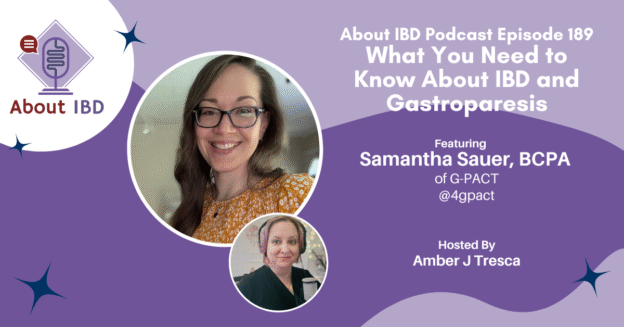
Samantha Sauer, BCPA, president of Gastroparesis Patient Association for Cures and Treatments (G-PACT) uncovers the challenges of living with gastroparesis and how it can overlap with IBD or other conditions. Sam shares her personal journey with gastroparesis and gives insights on symptoms, diagnosis, misconceptions, and the daily impact on patients’ lives. Topics include the difficulties in getting the right diagnosis, the emotional toll of dietary restriction, and the importance of support communities. Sam also highlights resources offered by G-PACT, including support groups and educational outreach, while encouraging self-advocacy and perseverance for those seeking answers or support for their digestive health.
Timestamps on this episode:
- 0:04 – Introduction and Guest Background
- 1:25 – Samantha’s Diagnosis Journey
- 4:17 – What is Gastroparesis? Symptoms and Diagnosis
- 7:19 – Misdiagnosis and Overlapping Conditions
- 10:50 – Inflammation and Gastroparesis
- 12:18 – Impact on Daily and Social Life
- 16:22 – Social Challenges and Stigma
- 18:47 – Common Myths and Misconceptions
- 22:00 – Gastroparesis and IBD Overlap
- 24:57 – Diagnostic and Treatment Challenges
- 27:32 – GPACT Resources and Support
- 31:32 – Advice for Suspected Gastroparesis Patients
- 33:09 – How to Connect with GPACT
- 36:18 – Samantha’s Treadmill and Movement Routine
- 38:42 – Closing Remarks and Gratitude
More information on the topics we discussed:
- Surviving Out of Spite Podcast
- Esophagogastroduodenoscopy (EGD) Is a Procedure to Examine Your GI Tract via Verywell Health
- Metoclopramide: Treatment for Nausea & Vomiting
- Relationship Between Gastroparesis and Inflammatory Bowel Disease: A United States Nationwide Sized Database Analysis
- Gastroparesis in patients with inactive Crohn’s disease: a case series:
Find Samantha Sauer, BCPA and Gastroparesis Patient Association for Cures and Treatments (G-PACT) on:
- Web: www.g-pact.org
- Facebook: @GPACT
- Instagram: @4gpact
- YouTube: @GPACT_nonprofit
- LinkedIn: @gpact
Find Amber J Tresca at:
- AboutIBD.com: About IBD
- Verywell: Verywell Health
- Facebook: @aboutIBD
- Twitter: @aboutIBD
- Pinterest: @aboutibd
- Instagram: @about_IBD
- YouTube: @AboutIBD
- Threads: @about_IBD
Find Mac Cooney (mix, sound design, and theme music) at:
- Facebook: @maccooneycomposer
- Instagram: @maccooneycomposer
- Web: Cooney Studio
- YouTube: @MacCooneyComposer
- Theme music, IBD Dance Party, is from ©Cooney Studio.
These show notes may contain affiliate links. If you choose to purchase after clicking a link, Mal and Tal Enterprises, LLC may receive a commission at no extra cost to you.
Listen and Subscribe to About IBD: Apple Podcasts | Spotify | Overcast | Castbox | Amazon Music | All Other Podcast Apps
Transcript
[Music: IBD Dance Party]
Amber Tresca 00:00:04 I’m Amber and this is about IBD. I was diagnosed with ulcerative colitis as a teen and had pouch surgery ten years later. Now I help people with Crohn’s disease and ulcerative colitis understand their disease and feel seen on About IBD. You’ll get real talk on symptoms, treatment, and life with IBD straight from patients, caregivers, and experts. You’ll learn, feel less alone, and even have a laugh along the way.
Samantha Sauer is the president of G-PACT (Gastroparesis Patient Association for Cures and Treatments), which is a nonprofit dedicated to empowering patients living with digestive tract paralysis, including gastroparesis, chronic intestinal pseudo-obstruction, and colonic inertia. Samantha is both a patient and a passionate advocate. After being diagnosed with gastroparesis, she joined a pact. Over time, she took on a leadership role driven by her commitment to making health care better for those facing similar challenges. Under her volunteer leadership, GPC has flourished as a fully volunteer-based organization supporting research, awareness, patient education, and advocacy. Samantha. Welcome to about IBD.
Samantha Sauer, BCPA 00:01:21 Thank you for having me. Very excited to be here.
Amber Tresca 00:01:25 Oh, it’s my pleasure. I’m so grateful that you agreed to talk to me and to address our topic today, which is gastroparesis, and how it overlaps with IBD. And we both know, and our listeners will know, that being diagnosed with either one is difficult to begin with, but they have symptoms that are similar. And so we also want to help people understand the differences as well as just what gastroparesis is, because I think, and you can speak to this more, Samantha, I think that it’s not commonly understood. Truthfully, what it really is. So, Sam, I want to first start by learning more about you. So I wonder if you would tell me about when you were diagnosed with gastroparesis and what the journey has been like so far.
Samantha Sauer, BCPA 00:02:18 Sure. I oh, gosh, it’s been since 2014, I think, when I got my diagnosis. So looking back at that, it’s been a long journey. I didn’t have as long of a diagnostic journey as a lot of people in our community have had.
Samantha Sauer, BCPA 00:02:38 I don’t want to use the word lucky in that sense, because, like, no one’s really lucky to get that diagnosis.
Amber Tresca 00:02:43 100%. Yeah, but we’ll take the win, though. We’ll take the win. Yeah.
Samantha Sauer, BCPA 00:02:50 I was fortunate to get diagnosed relatively early when I started having issues and seeing a GI specialist and really going through, like all of a sudden I couldn’t eat anything. And, there was a very specific moment where I started not being able to really tolerate food consistently. And it was Christmas in 2013 was like the last like meal that I had as symptoms started. So my mom made like this really, really great mac and cheese, and we had like a Christmas ham and all this food. Like I can still taste it now, right? And I got so sick later that evening. And that kind of like started that snowball effect of all the symptoms and not knowing what was going on, not knowing what I could eat, not knowing what was causing anything, not knowing if I was going to vomit, and why I was getting so bloated and why I just.
Samantha Sauer, BCPA 00:03:54 I had no idea what was happening. Went to the doctor And, eventually I got the gastroparesis diagnosis, I think probably about 4 or 5 months later. Super fun. Loved it.
Amber Tresca 00:04:09 Loved it. Yeah. Better than cats. Okay. [Laughter]
Amber Tresca 00:04:17 Sam, I want to ask you to step between these two roles as a patient and as the president of G-PACT. And tell me a little bit more about, actually, gastroparesis. And I’m wondering if you can talk about some of the common symptoms and then how people. I don’t want to say normally because everyone’s experience is different, but how people might get diagnosed, perhaps, maybe even that was different than your experience.
Samantha Sauer, BCPA 00:04:49 Sure. So I would say probably one of the most common symptoms is nausea. you know, when you’ve got food sitting in your stomach, it’s going to cause some level of nausea. It’s varying for all of us. but that’s usually for all of us across the board. Vomiting is, I would say, probably a close second.
Samantha Sauer, BCPA 00:05:13 But not everybody who has gastroparesis will vomit. We have a lot of people who get food stuck and they don’t vomit it back up, and that can cause a lot of pain, a lot of fullness after eating even just a few bites, because maybe you’re putting food on top of food, or it’s just sitting in there. There’s so many variables that go into these digestive disorders. And I know, like I’m speaking to the choir, talking to you about that with the variations of these symptoms. But they really they change from person to person and day to day. Right. Like my symptoms with gastroparesis are not the same every single day. Some days I’m a lot more nauseous than I was the day before. I could have very minimal nausea or nausea. That’s controlled by, you know, Zofran or some other type of nausea medication. So it’s really variable there in getting things diagnosed. The gold standard is the gastric emptying scan. So there’s two different scans. there’s a 90-minute and then a four hour test.
Samantha Sauer, BCPA 00:06:27 The gold standard would be the four-hour test. To really get that full picture from start to finish where you are on a delayed emptying. But some of us only have access to the 90-minute, so that varies a little bit too, I know some people were diagnosed through an EGD when they, you know, we all know we’ve all had EGDs. Anybody with some sort of digestive diseases probably had one done. And you’re not supposed to eat for, you know, ten, 12, maybe more hours prior to that. And there’s still a full Thanksgiving meal sitting in your stomach, you know, when they go in to check things out. So that’s not as great of a diagnostic tool, but it definitely can help show that there is something going on that maybe the next step would be a gastric emptying scan.
Amber Tresca 00:07:19 So I’m thinking about diagnosis. I’m thinking about how people are probably misdiagnosed a lot I’m guessing as well, with something else first until they can get to one of these tests.
Amber Tresca 00:07:37 But also I’m wondering, how does it ever happen that someone is misdiagnosed with gastroparesis? And then that’s not really what’s going on. Like, what are some of the overlapping, things that might happen?
Samantha Sauer, BCPA 00:07:49 Well, I know that, because motility changes day to day, like I’ve had normal scans and not normal scans. Right. So it kind of depends on the doctor, where you are diagnostically, how severe your symptoms are. I know that there have been some people in our groups that come in with every symptom of gastroparesis. Like even not being a medical professional. I’m like, it really sounds like you have gastroparesis. And then come to find out they don’t have gastroparesis because maybe they have another disease affecting motility. If that’s flaring, maybe it slows down motility. someone like myself who also has thyroid issues. Hypothyroidism can also cause some sluggish bowels, sluggish motility. And once you normalize those levels of your thyroid hormone, your motility might speed back up or kind of lessen some of those symptoms. So I think at varying degrees if you have inflammation.
Samantha Sauer, BCPA 00:08:55 Other disease states that you’re dealing with, everything affects the gut. So if something else is out of control a little bit, I think it can mimic some of those symptoms. Or if you have some form of IBD and that’s flaring, those symptoms could also flare up. What I could say are typical gastroparesis symptoms, making it seem like that’s an added bonus diagnosis, when really it’s just similar symptom patterns rather than, you know, similar actual diagnoses in that sense. But it’s so hard to say because we know the gut does whatever the hell it wants whenever it wants to. So yeah, it’s so hard.
Samantha Sauer, BCPA 00:09:40 Even as someone who’s been diagnosed for so long, like there have been days where I have very minimal symptoms and I’m like, gastroparesis, who? And then other days I’m like, oh, there he is. Never mind comes back with a vengeance. So it’s hard to say, but there’s definitely overlap or symptoms that seem like they’re gastroparesis. But it turns out, luckily or maybe not.
Samantha Sauer, BCPA 00:10:05 Luckily, I guess it depends on how you look at that. But like, it doesn’t actually turn into a formal diagnosis.
Amber Tresca 00:10:12 Yeah. I’m thinking in particular of like Crohn’s disease. And if you have structuring which is either from inflammation that’s causing so much swelling that things can’t pass, or if you have scarring that’s, you know, closing things up and so things can’t pass. Yeah, that’s the same thing. You know, if you if you have it in your upper GI tract, you will be nauseous, you will be throwing up. You will, you know, and that would definitely, sound a lot like gastroparesis. But I’m wondering though, and I thought of it like, literally just now, is there is there actual inflammation with gastroparesis?
Samantha Sauer, BCPA 00:10:52 I don’t want to say yes. I don’t want to say no either, because there I don’t know anybody that just has gastroparesis.
Amber Tresca Okay. Right.
Samantha Sauer, BCPA So it’s one of those things where somebody has something else that is inflammatory. I know for myself, when I’ve been vomiting a lot, the inflammation that comes from vomiting, like, you don’t even want to see my face after vomiting or my throat or the burning in the esophagus.
Samantha Sauer, BCPA 00:11:18 Maybe you have like severe GERD, gastritis. You know, those symptoms along as well that can cause inflammation. I don’t think just on it on its own that gastroparesis is inflammatory. But I also don’t want to say it’s not. It really depends, again, on the severity of the symptoms and what the secondary symptom based on something sitting in your stomach is going to cause some heartburn or, you know, stomach acid not being in the body exactly how or where it’s supposed to be, and that will cause inflammatory responses. Or your secondary disease state causes inflammatory responses. The gastroparesis compounds on top of that. And then you’re just an inflamed mess.
Amber Tresca 00:12:06 Yeah that makes a lot of sense. So it’s not like either too that like if you have an upper GI and they say well there’s inflammation. So it’s not gastro like that’s not a delineating factor there.
Samantha Sauer, BCPA 00:12:18 Right.
Amber Tresca 00:12:18 So let’s talk about how gastroparesis affects people’s lives I think on the face of it. and if you don’t know anybody who lives with gastroparesis, it might not—you might not get a full picture of all of the problems it causes. And so having known and I’ve known a few people that have both IBD and gastroparesis, and so it’s but it’s not obvious until you’re talking with those people and you’re truly understanding how it is affecting them. So, tell us what having gastroparesis does to people’s lives. You know, outside of like just the symptoms, which are totally bad enough, but that has effects on your day to day, right?
Samantha Sauer, BCPA 00:13:01 Yeah. I think one of the biggest things that I recognize, and you see this across the board, no matter what level of, you know, gastroparesis impacts your life, maybe it’s minimally and your symptoms are very mild. All the way to very, very severe is how it affects your social life. And by that I mean that every event has to do with food.
Amber Tresca 00:13:28 Yes.
Samantha Sauer, BCPA 00:13:28 Or some form of, you know, drink. And it’s so frustrating because you don’t actually realize that, because it’s so ingrained in, you know, culture and norms and holidays are just so food-centric, and we’re so used to it that you don’t realize it until you can’t participate.
Samantha Sauer, BCPA 00:13:48 And I think for me and almost anybody who deals with some sort of digestive restrictions feels that when they go to a party, they want to go do something, or friends invite you out to a restaurant, you feel good enough to go, but you don’t feel good enough to eat. And then you have to explain to everyone and everyone and everyone and everyone why you can’t eat something and why no, I’m sorry. That one bite actually could really hurt me. No, I’m sorry, I’m not willing to try it. Yes, I’ve tried yoga. No, I can’t have magic beans. Like, yes, I, I exercise. Yes, I’ve tried vegetables. No, I can’t eat vegetables when you can’t eat. It becomes like everyone is staring at you. It’s like that. You know what I imagine is like in a police station with that big, bright interrogation light like, on top of you. And everybody’s asking you, like, why can’t you do this? What do you mean? It’s just one bite.
Samantha Sauer, BCPA 00:14:46 It won’t kill you. Your Aunt Judy made it. She put a lot of hard work into doing this. You don’t want to offend her, do you? And it’s like, no, I don’t, but I really don’t want to throw up either. And I think that asking those questions and, you know, being asked those questions and being in that situation and having to explain these things over and over again, if you’re anything like me, you start just kind of not wanting to participate in those events anymore. And I was lucky enough that I had friends and family who didn’t always make me feel that way or were okay with me, you know, not eating anything and not calling attention to it. Now I have no shame. I have zero shame. I will bring my own food. I will be like, I’m sorry, that’s going to give me diarrhea. We’re not talking anymore. Like once you usually mention that they stopped asking you things. So, you know, I think it’s so impactful on your energy, on how, how and when you want to give your energy.
Samantha Sauer, BCPA 00:15:48 Because we all know food is sustaining, so if you don’t have that thing to sustain you, you’re so careful on where your energy goes and how your energy goes. And it’s not just a stomach ache. You know, there’s so many more pieces to it. And the other thing I would say is, you know, just because maybe you could eat something that one day if you can’t eat it the next day, having to explain why sometimes you can eat it once, but not twice. It’s so exhausting. So you just kind of remove yourself from that situation because that’s energy that you don’t want to expend.
Amber Tresca 00:16:22 Yeah. And these are things that people with IBD will completely relate to as well. Yes. I read an article some years ago about a woman with gastroparesis, and all she wanted to do was take her family out to dinner, and she was explaining to the wait staff that she couldn’t eat anything, but everybody else at the table would be ordering, and the wait staff was really not accommodating. And like literally just I think they ended up asking them to leave and it was just, wow.
Amber Tresca 00:16:54 You know, it never occurred to me that that would, you know, never having been in that circumstance, it didn’t occur to me, that that’s how someone would react to another person’s needs and how upsetting her kids were. They’re like, just ridiculous. Like, just ridiculous. You know.
Samantha Sauer, BCPA 00:17:15 It’s really hard in those situations. I’ve been where I’ve not eaten anything or I’m like, I’ll just have maybe a diet soda, you know, or maybe I’ll just have some water. Or is there soup maybe that I can eat and I can just kind of, like, sip on the broth or make it look like I’m eating something, but then, you know, you buy a small plate and you move the food around to make it look like you ate something. So they’re not, like, bothering you or giving you unsolicited advice, but then you’re paying for something that you didn’t actually eat or want. So it’s one of those things where it’s a gentle reminder to anybody that like opinions, unsolicited opinions are not always necessary.
Samantha Sauer, BCPA 00:18:00 And unless you’re, you know, the restaurant has some specific rule that you have to order something in order to sit down. Like just let them have their tea, their soda or something in peace and feel like they’re participating in life because that’s really all we wanted to begin with.
Amber Tresca 00:18:16 100%. I mean, listen, I don’t care. I’m like you. I’m at the point. I don’t care if that bathroom has a sign on it that says for customers only. If I gotta go, I’m walking in and I’m using it, and I’m not. I’m not buying anything. And you can chase me down the street. You know, so it’s like, you know, it’s just, the idea that our basic needs can’t be met, you know, when we’re socializing, it’s just it’s frankly ridiculous. So.
Samantha Sauer, BCPA 00:18:46 Yeah. No. definitely.
Amber Tresca 00:18:47 Yeah. All right, Sam, how about some misconceptions? I think we’ve gone over a few maybe already, but, you know, I’m going to. I’m going to give you the floor.
Amber Tresca 00:18:56 Tell us, what are some myths that people believe that are untrue?
Samantha Sauer, BCPA 00:19:01 Well, one of the biggest ones is you don’t have to have uncontrolled diabetes in order to have gastroparesis. And as someone who is a type one diabetic but was diagnosed with diabetes after gastroparesis, I get that assumed all the time that my gastroparesis was caused by diabetes. And it is not for the majority of people. They actually don’t know what caused it. Some maybe have an idea, but most people don’t. I, I know I said earlier, like, it’s not just a stomach ache. You know, it’s not just something where it’s like, oh, I feel a little, a little like full today or I’m a little bit bloated. There’s so much more to the idea. Like, oh, it’s just a stomach ache. You know, take some Pepto-Bismol Bismol or, you know, take something for nausea and you’ll be fine. Like, if only. Right? Yeah. But, I think the other misconception or another misconception I should say, is that because of the lack of ability to eat like a normal human or eat enough food that in order to suffer with gastroparesis or have symptoms really impact your life, that you have to be underweight.
Samantha Sauer, BCPA 00:20:13 Yeah. And that you have to look, you know, have a certain look to you or a certain weight or, you know, muscle to fat ratio, that there is no look to gastroparesis and especially there’s no look to have to suffer from the symptoms of living with it day to day. that’s something you see a lot where people don’t get taken seriously because maybe they’re a normal weight, or they might even be a little bit overweight for whatever arbitrary numbers the doctor’s office feels like using that day, to determine that. It doesn’t mean that you’re not suffering or you’re not dealing with malnutrition and malabsorption. and I think probably another one that we hear a lot is that if you end up on TPN or TPN, whichever you use their or feeding tube, that like it’s, it’s the end of it that your life is over or maybe that you failed and that is not true. And maybe you’re in a really, really bad spot in order to need that. And if anybody listening has been in that spot or feels that they’re headed in that direction: my heart goes out to you.
Samantha Sauer, BCPA 00:21:18 I’ve been there. I’ve been on two feeds, I’ve been on TPN, and it feels like everything is crashing down in those moments, and that you’ll never be able to be a functioning human again. But if maybe you can take anything away from any of anything that I say is that it can help you live a normal life again by giving you something, giving you that energy to sustain you and, you know, give you some of the ability to be out in the world however you see fit because you’re actually getting nourished. And that might look different for you, but it doesn’t mean that your life is over.
[MUSIC: About IBD Transition]
Amber Tresca 00:22:00 Up next, Sam tells us why it can be so tricky to differentiate between IBD and gastroparesis.
Amber Tresca Samantha, as we’ve talked about a little bit, there’s some overlap between gastroparesis and IBD. And from the research that I did, it looks like there’s more overlap with Crohn’s disease than with ulcerative colitis. The symptoms are similar, which makes it difficult to tell the difference between them.
Amber Tresca 00:22:36 For both patients and clinicians, as you were describing. And then I found very little research on this, and it’s mostly case reports, which I don’t know. I like case reports, but sometimes people are like, case reports. but there wasn’t even that many of those. And so because you work with so many patients, I’m wondering what you have heard on the ground about these two conditions overlapping.
Samantha Sauer, BCPA 00:23:06 I know that we’ve had, I’ll say, at least a handful. And I know I’ve spoken to a couple different people over the years that have severe Crohn’s and severe gastroparesis to maybe they have severe gastroparesis and less severe Crohn’s, vice versa. it’s not super prevalent as you point it out, but that doesn’t actually mean that it’s not super prevalent, right? I think because of the overlapping of symptoms. And if you already have one diagnosis, I think it’s harder to get that second diagnosis. And it’s not like you’re looking for the diagnosis. You’re just that could change your course of treatment, right? And I think from what I understand, some of the treatment for Crohn’s disease can sometimes cause an interruption in motility, which can cause what looks like some gastroparesis symptoms, as we were talking about earlier, that aren’t actually the disease, but the diet, not the diagnosis.
Samantha Sauer, BCPA 00:24:11 The symptoms can be very similar. So it’s an unfortunate thing that they overlap so much. And because they’re just all in the gut in one way, shape, or form, that it’s so hard for people even living in the body to tell, is this my Crohn’s acting up, or is this gastroparesis acting up? But I’ve definitely seen a few over the years, but not as many. But you know, it doesn’t mean that they’re not there. It’s just hard to really know if you don’t actually have an official diagnosis or really know how to separate the two. Because honestly, I probably wouldn’t know how to separate the two either. I don’t know half the time whether it’s my upper GI or lower GI that is being slow today, so it’s difficult.
Amber Tresca 00:24:57 Yeah, and so that makes me wonder too, if there’s people wandering around in limbo that it’s like, you know, you’re not meeting whatever guidelines or criteria that there are for gastroparesis and or a form of IBD. And so maybe just receiving treatment and seeing, oh, let’s see if this works, you know, and then if it works, maybe that’s what you have. I mean, it sounds super frustrating.
Samantha Sauer, BCPA 00:25:26 Yeah. And, you know, I understand that you don’t want to over-treat somebody if it’s unnecessary. Like, I totally get hesitation in trying medications or treatments that might have other possible side effects. Or maybe that treatment is invasive. said. I get that hesitancy. But at the same time, if somebody is suffering and you don’t have anything to offer them, you don’t have a diagnosis officially to offer them. Like you said, that maybe they don’t check every box in either of the diagnostic guidelines for Crohn’s and or gastroparesis, but they’re still suffering. Yeah. You can’t let them continue to suffer. You know, there are. I’ll say those frontline treatments, like even just treating the nausea right, is a great place to start. And it’s pretty simple. There’s there’s simple medications that can treat that like just does that help if you treat the nausea. Does that help where you feel that you can eat more. Is it just something? What could possibly be affecting the nausea? You know, it’s if we as patients have to do trial and error.
Samantha Sauer, BCPA 00:26:30 I think in the same vein, so do the clinicians to really say, we don’t know what’s wrong with you and I’m sorry for that. So let’s do a couple things and maybe test some. Least symptomatic, least, you know, invasive treatments to start and see if it helps you. Like you said, maybe that in itself could lead to a diagnosis which could actually lead to helpful treatment.
Amber Tresca 00:26:56 Yeah, nausea. Like I can deal with a lot of symptoms, like, you know, but when I’m nauseous, like I can’t function like there’s just no functioning. There’s no—I cannot set it aside. Like, I can set aside pain or, you know, other things. It’s just nausea. Nausea just always is like, at the forefront, of everything. So getting that treated, I think, you know, is, is a super helpful thing and, and so important, even if you don’t know what’s causing the nausea, like, let’s just treat it, you know?
Samantha Sauer, BCPA 00:27:29 Yeah, absolutely.
Amber Tresca 00:27:32 Okay, so let’s move on to talking about G-PACT. I know it’s probably your favorite topic. so tell me about the kinds of resources and support that your organization, offers to patients and their families.
Samantha Sauer, BCPA 00:27:48 So one of the things that we started, I believe it was June of last year, was we have two virtual online support groups that we do once a month. we do an all inclusive gastroparesis support group. So you don’t have to be a veteran or a newbie or, you know, at a certain point in your journey to attend, you might be a caregiver or family member that wants to learn more about gastroparesis, you know, from patients themselves, or a parent with a kiddo with gastroparesis. And you just, you know, want to go to a place where people understand. Right. So, we do that once a month, but we also have A to B and TPN-specific, support group as well.
Samantha Sauer, BCPA 00:28:43 And it’s not to say that if you are on TPN or tube feeds that you can’t attend the other one, but what we found out pretty quickly was that, and as someone who’s been on both knows that there are some additional things that are harder or more to navigate when you have other things to think about in regard to tube feeds and TPN. So we separated that to give them a space to ask very specific questions around what it’s like to live with that. Or maybe you just you just need to vent about it to somebody who understands what it’s like to have a J tube. So, we do those. I think the virtual support is the fourth Thursday of every month, and the tube TPN is the fourth Monday of every month, so. And I can share the links with you too. If anyone is interested in registering to sign up. we also have our own podcast called Surviving Out of Spite, where we try to to make this as short as possible. the idea of surviving out of spite. Besides, just spitefully surviving like we all do, was kind of born out of the idea that we wanted to have a place where you felt comfortable, where you felt safe, where you felt like you get some education.
Samantha Sauer, BCPA 00:29:56 You know, we have doctors and clinicians, dieticians, you know, the experts come in to talk about gastroparesis-specific issues, but we also are inclusive on the patient experience as a whole, because as you and I, just talking shows that our patient experiences can be very, very similar even with different disease states. So we want you to feel like you got something out of talking with us, whether that’s, you know, bonding over our similar medical trauma to some dark humor, to just maybe hearing somebody else be vulnerable, saying the hard thing out loud, you know, sharing your personal story that hopefully can Help whoever is listening, maybe take another step in their own journey to say the hard thing out loud, or ask for help or, you know, just feel like you’re sitting down, as we’ve said, with your chronic bestie, you know, just to feel a little bit less alone. and we are working on some additional projects that are coming out, in 2026 that we’re working on right now, which I’m really excited about.
Samantha Sauer, BCPA 00:31:01 And we do have our virtual conference that we do once a year as well. So our 2026 conference will be toward the end of March. we don’t have a date set yet, but I’m really looking forward to that too, as we have some great speakers. Same thing, you know, clinicians, patient stories and really just gastroparesis, focused topics to really give people a little bit more support and information of something that maybe could help them in their day to day journey living with the disease.
Amber Tresca 00:31:32 So I love that. That’s so helpful. All right. So I’m going to ask you the question that everybody probably asks you and that I get asked all the time as well. but there’s there’s patients out there right now who think they might have gastroparesis: talk directly to them. What’s your advice for them?
Samantha Sauer, BCPA 00:31:54 Don’t stop advocating for yourself. Don’t stop. It’s going to suck. The burden is always going to be on you. But don’t stop advocating for yourself. If one G.I. Doctor is not going to listen to you.
Samantha Sauer, BCPA 00:32:07 Go see another one. If that one’s not going to listen to you. Go see another one and join our support groups. Whether or not you think you have it, you know. Surround yourself with people that get what you’re going through and they can help you advocate for for yourself too. I know the idea of, like, just getting into another doctor, like I can say, oh, that’s so easy. Now my GI takes like six months to a year to get into. I understand it, but just never stop giving up on the idea that you deserve better, that you can have better, and you deserve to be treated with respect and be heard and not be gaslit into thinking like that. This is all in your head. So if anything comes from my mouth and you’re like, oh, this is something I liked what she said, let it be this just do not give up because you deserve to be able to eat however you can and be heard and hopefully get your symptoms improved by having somebody finally listen to you.
Amber Tresca 00:33:09 I love that advice, and I also love that G-PACT is there for people, whether or not they are firmly diagnosed, even without a formal diagnosis. I’m sure there’s lots of tips and information that can be shared through these support groups to help people get through their journey. So I’m very excited that you said that and that you’re open to that. And to that end, let’s talk about GP. Where can people connect with the group, find you, find surviving out of spite? By the way, Best title for a show ever. I just love it so much. I identify with it. And of course, I watch your show on the YouTubes. I enjoy the conversations that you’re having, and that they go in a lot of different, amazing directions. So let’s let the people know where they can connect with you?
Samantha Sauer, BCPA 00:33:58 So, on social media, primarily Facebook and Instagram, so I can share those links with you. So they’re clickable for people. because I do I remember our Instagram.
Samantha Sauer, BCPA 00:34:12 But what the full Facebook is, I don’t remember. which is probably terrible to admit, but, Surviving Out of Spite. You can find us on Spotify, Apple Podcasts, and YouTube. And we have our website as well, which is currently it’s almost finished, to be redone. So we have all of our new, you know, the support group, all of our new information, and our partnerships and our resources and everything will be available on the website as well. So I would say if you want updated information from us is to primarily follow us on social media. That’s where I try our best to keep everything updated, our podcast schedule. try to keep things a little bit funny. try to share a little of my own dark humor on there. But also our education series as well, because we’ve got some great webinars coming up. So if you want links to that information to that, you can find it all on our social media.
Amber Tresca 00:35:13 Yes. And I will put everything in the show notes.
Amber Tresca 00:35:15 And of course, as listeners know, I put everything on about ibd.com. And also in my newsletter, I like to include support, group information and events that are coming up for non-profit organizations so that people can find them easily. Because it is hard to like just because you are following someone on the Instagrams doesn’t mean that you’re actually going to see what they post. Yeah, you know, which is so wild. It’s so, fickle. Which is one of the reasons that I started my newsletter, because people are off living their lives and doing what they’re doing. They’re not living in this all day. And so and that’s fine, because I am so, you know, you know, make sure you can get that information and you are too. Sam, I have to ask you about something else. So you, the first time we met, we hopped on a virtual call. I hate the phrasing that I just used, but we got on. Oh, we got on a call together, and, like, you were on your treadmill.
Amber Tresca 00:36:18 And. Listen, I think that is the first time of all of the calls that I’ve ever had that I’ve ever logged in. And the person was on a treadmill and I was so like, damn, you know, I was like, that, I loved it. And also knowing that you live with gastroparesis, I know that that’s not easy. tell me about your treadmill use, which I know goes goes beyond that, but I, I know, but I want you to tell the people.
Samantha Sauer, BCPA 00:36:49 Well, I will say that it does help with digestion, movement, especially after meals and having a job that’s an office job like I am at home. I’m in my home office right now. But when you’re sitting all day and you eat when your food sits anyway, like I bought a standing desk and a walking pad and like me, sitting right now feels weird when I record podcast and is sitting down, I’m like, this is awkward. Like, people, people still do this. I love my walking pad.
Samantha Sauer, BCPA 00:37:19 It was the best investment that I ever made for myself with health and just movement. I have this thing in my head of like, I want to get to a million steps in a month, which I will be starting for October to see if I can get there. It’s ridiculous. Like the look you just gave me is what everybody gives me when I say that. But I’m like, you know what? I can’t do a lot of things, but I can walk. So for me, walking has been the thing that I’ve been able to do, even on some bad days, you know, maybe not possible for everybody, but for me, I’m like, I feel better when I do it. I always do it. And it’s just it’s been really great and I take a lot, a lot of walking meetings. Like at this point I again, I have no shame like this is, but I slow it down when I need to not be out of breath in a professional meeting. I’m like, I’ll slow it down a little bit.
Samantha Sauer, BCPA 00:38:17 You make that mistake once or twice and I’m like, I’m sorry. I’m super unprofessional as I’m huffing and puffing in the middle of a meeting because I’m trying to walk. But, it’s been it’s been really great for me to try to do and just see how I can maybe push myself in a safer environment for me, when you know you can’t really do all the things that you want to do. Movement or exercise wise, you’re moving.
[Music: IBD Dance Party]
Amber Tresca 00:38:42 You are supporting your community and you are supporting, like not just the gastroparesis community, but also beyond, in so many ways, especially with the work that you’re doing with your show, which I know how much goes into that. It’s a lot. And so I just want to say thank you for talking with me today. Thank you for all of the work that you’re doing. We’re going to make sure that people find you so that they can avail themselves of your resources and, maybe throw a donation your way. Like, that would be, that would be great as well. So thank you.
Samantha Sauer, BCPA 00:39:18 Yeah. Thank you for having me I know. you know, we’ve got so many commonalities, like personally, personally and professionally. So it’s been great to be on this because you’ve got a great podcast and had some great guests, so I’m honored to be included. So thank you so much.
Amber Tresca 00:39:36 Thank you.
Amber Tresca 00:39:40 Hey super listener. Check the show notes to find links and information about the topics discussed in this episode. Plus, get a written transcript and much more on my website about IBD. If you enjoyed this episode, please consider sharing it with someone else or leaving a rating in your podcast app. Reviews and ratings help me grow this show and bring you more great content. Thanks for listening and remember, until next time, I want you to know more about IBD.
About IBD is a production of Mal and Tal Enterprises.
It is written, produced, and directed by me, Amber Tresca.
Mix and sound design is by Mac Cooney.
Theme music is from Cooney Studio.